lucy@zlwyindustry.com
+86-158-1688-2025
Please Choose Your Language
- All
- Product Name
- Product Keyword
- Product Model
- Product Summary
- Product Description
- Multi Field Search

Views: 0 Author: Site Editor Publish Time: 2026-07-22 Origin: Site


Industrial and commercial facilities routinely waste significant capital on fuel and maintenance. Mismatched boiler supply and facility demand drive this financial bleed. The root cause often traces back to a low turndown ratio. This hardware limitation forces heating systems into continuous, inefficient stop-start loops to meet variable loads. Frequent cycling degrades equipment fast. It blows expensive heated air straight up the exhaust stack, driving utility bills higher.
This guide breaks down how turndown dictates burner performance. You will learn the hidden costs of short cycling and the realities of mechanical wear. We will explore technical criteria for evaluating system upgrades. You will discover whether a high-turndown or a modular setup is the right operational fit for your facility. Understanding these principles helps engineers and plant managers lock in optimal efficiency. By optimizing combustion, you protect your boiler investments and cut daily operational stress.
Engineers evaluate boiler performance using specific mathematical metrics. The most critical metric is the gas burner turndown ratio. It defines the mathematical relationship between maximum heat output and minimum heat output. You calculate it simply. Divide the maximum firing rate by the lowest stable firing rate. The resulting number dictates operational flexibility. A higher ratio indicates greater flexibility to match varying loads.
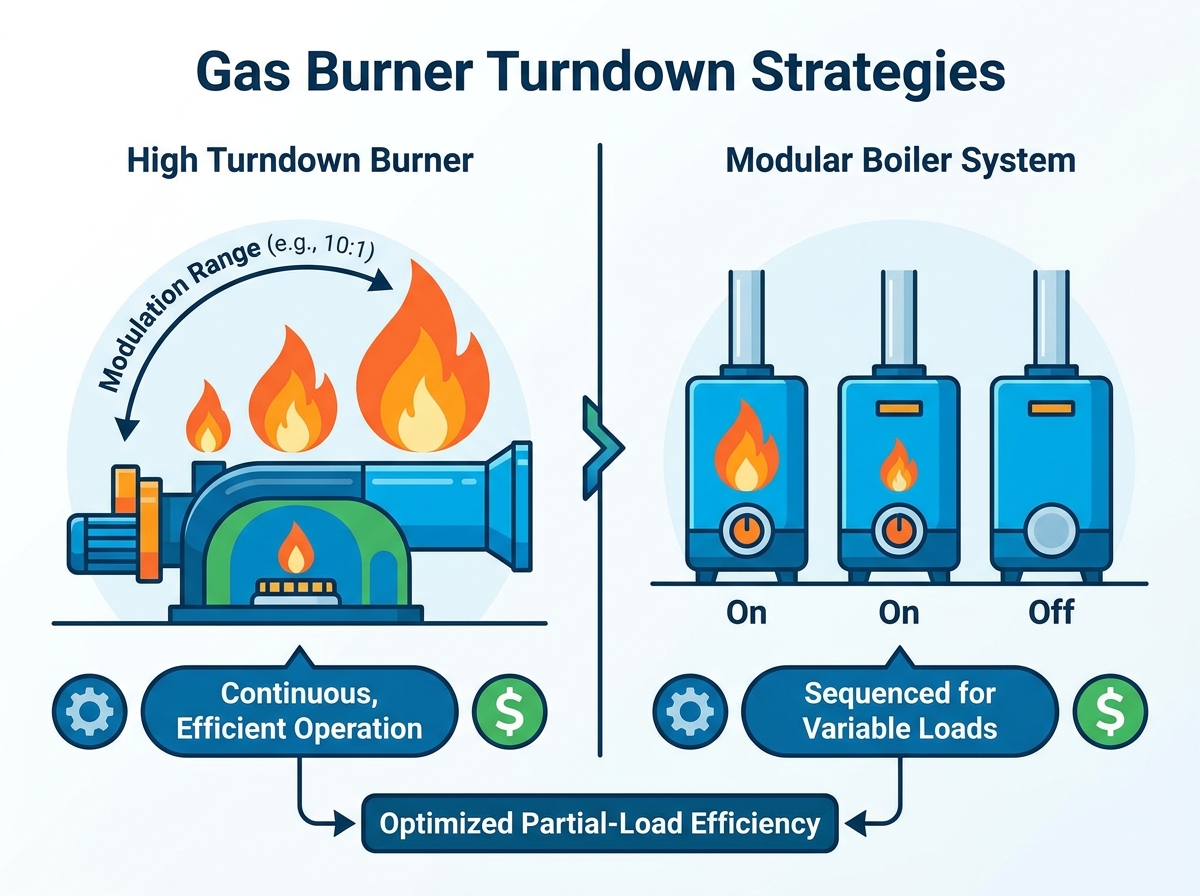
How does this ratio translate to practical operation? We call this practical span the burner modulation range. Consider a 10 MMBtu/hr burner featuring a 5:1 ratio. It can safely reduce its output to 2 MMBtu/hr. It will not shut off at this lower limit. It maintains a stable flame and continues producing steady heat.
Facilities must distinguish between three technical baselines when evaluating equipment. Basic on/off burners operate only at 100% capacity. They blast maximum heat, overshoot the temperature setpoint, and shut down. High/low/off systems offer two distinct firing rates. They typically run at 100% or 50%, providing a slight improvement in control. Fully modulating systems adjust smoothly across their entire firing curve. They act like a vehicle's accelerator pedal. They match real-time facility demand perfectly. Modern commercial facilities require this advanced flexibility. It prevents severe operational bottlenecks during low-demand seasons.
Facility demand frequently drops below a burner's minimum firing rate. When this happens, the system shuts down. As demand rises again, the burner restarts. We call this relentless start-stop process burner cycling. This constant cycling destroys operational efficiency and shortens equipment life.
Short cycling drives massive thermal inefficiency. Safety codes mandate pre-purge and post-purge sequences for every ignition cycle. The combustion blower must sweep the furnace chamber to remove unburned gases. This safety mechanism prevents furnace explosions. However, it blows heated, conditioned air straight out the exhaust stack. You literally vent expensive BTUs into the atmosphere every time the burner cycles. The metal cools down, and you must burn extra fuel just to reheat the vessel.
Relentless cycling also causes severe mechanical degradation. Equipment wears out prematurely. Ignition transformers burn out from constant sparking. Fuel valves wear down from endless actuation. Blower motors suffer electrical stress during high-amp start-up surges. Relays fail after thousands of unnecessary mechanical clicks. You will replace these parts frequently if your system short-cycles.
Downtime risk escalates dramatically under these conditions. Frequent thermal expansion and contraction stresses the boiler pressure vessel. The metal expands during firing. It contracts rapidly during cold-air purge cycles. This repetitive stress causes tube leaks over time. Refractory materials crack and crumble. Premature boiler failure becomes inevitable. These mechanical failures halt facility production and drain capital budgets quickly.
Real-world heating and process loads rarely remain static. They fluctuate based on operational shifts. Seasonal weather changes drastically alter facility heating demand. Production volume variations dictate specific steam requirements minute by minute. Most boilers operate below peak capacity 90% of the time. They run almost entirely at partial loads.
A modulating gas burner handles these fluctuations seamlessly. It continuously adjusts fuel and air inputs. This continuous adjustment maintains optimal combustion chemistry across the entire firing curve. It prevents rich or lean fuel mixtures. You maintain a safe, clean flame regardless of the exact BTU output.
You achieve superior partial-load efficiency by minimizing on/off cycles. The burner matches the exact requirement of the moment. It stays online much longer at lower firing rates. You eliminate purge losses completely because the burner never shuts off. The system simply idles at a low fire until demand increases.
Energy savings scale directly with reduced cycling frequency. Facilities often yield 10-15% annual fuel savings after upgrading to modulating controls. Consistent water temperatures improve process quality in manufacturing settings. Smooth operation extends equipment lifespan significantly. Your maintenance team spends less time replacing worn ignition components. The entire steam system stabilizes, providing reliable output year-round.
Facility managers must analyze actual load profiles before buying new equipment. You must measure your baseline load against your peak design load. Many older plants oversized their original boilers. They did this to accommodate hypothetical future expansion. As a result, the current load represents only a fraction of the boiler's capacity.
Suppose your minimum load never drops below 25% of the boiler's capacity. A premium 10:1 burner represents an unnecessary upfront equipment cost. A standard 4:1 or 5:1 system handles your demand perfectly. Do not buy ultra-high turndown if your process does not require it.
You have two primary upgrade paths. You must compare a high-turndown burner against modular boiler systems.
Success depends on balancing upfront equipment costs against projected fuel savings. You must also calculate maintenance reduction. High turndown burners cost more initially but save significant fuel over a decade.
Table: Load Profile Distribution Chart
| Load Percentage (% of Max Capacity) | Time Spent at Load (Annual %) | Ideal Burner State |
|---|---|---|
| 80% - 100% | 10% | High Fire |
| 50% - 79% | 40% | Modulating (Mid Fire) |
| 20% - 49% | 40% | Modulating (Low Fire) |
| 0% - 19% | 10% | Off / Standby |
Table: Single High-Turndown vs. Modular Boiler Cascade
| Feature | Single High-Turndown Burner | Modular Boiler Cascade |
|---|---|---|
| Initial CapEx | Moderate (Retrofit cost only) | High (Multiple new vessels) |
| System Turndown | Up to 10:1 or 12:1 | Virtually unlimited (e.g., 40:1) |
| Redundancy | None (Single point of failure) | High (If one fails, others run) |
| Footprint | Uses existing large boiler space | Requires re-piping and new layout |
High turndown is impossible using outdated mechanical linkages. Single-point positioning systems cannot maintain tight fuel-to-air ratios at low fire. Slop in mechanical cams causes dangerous fuel mixtures. Upgrading requires specific hardware and software components.
Control system requirements dictate upgrade success. You must install modern technology to achieve safe low-fire operation.
Combustion stability poses a major risk. Flames become unstable at very low firing rates. Draft changes disrupt the air mixture. The flame can lift off the burner head or extinguish entirely. Advanced controls prevent this by adjusting instantly to draft fluctuations.
Beware the condensation trap. Traditional non-condensing boilers cannot tolerate extremely low return water temperatures. Turning them down too far drops exhaust gas temperatures below the dew point. The exhaust gases condense into highly corrosive acid. This acidic moisture destroys the steel stack. It eats through the heat exchanger tubes. You must maintain minimum exhaust temperatures to prevent this destructive corrosion.
Start by conducting a thorough cycle audit. Monitor your current burner start and stop frequency. Do this specifically during low-load seasons like spring or fall. Count the purge cycles over a 24-hour period. High cycle counts prove you have a turndown problem. If your boiler cycles more than four times an hour, you are wasting fuel.
Next, consult a qualified combustion engineer. Engage an expert to analyze your operational data. They will calculate exact efficiency gains based on your local fuel costs. They analyze boiler geometry carefully. The furnace dimensions must physically support the altered flame shape at low fire.
Finally, apply strict vendor shortlisting logic. Ask vendors for written performance guarantees. Demand emissions guarantees for NOx and CO specifically at the lowest guaranteed turndown point. Many burners perform well at peak fire but pollute heavily at low fire. Verify combustion efficiency across the entire firing curve, not just at peak load.
A: A standard ratio is typically 4:1 to 5:1. High-performance modulating models reach 10:1 or even 12:1. However, "good" depends entirely on your specific minimum load requirements. If your facility never drops below 25% demand, a 4:1 ratio is perfect.
A: Yes. You can achieve this via retrofit kits involving linkageless controls and VFDs. However, your existing boiler geometry must support the smaller flame shape at low fire without causing combustion instability or flame impingement.
A: Generally, yes. It reduces emissions by preventing the spikes in unburned hydrocarbons and carbon monoxide. These spikes are heavily associated with the frequent ignition and purge phases of constant burner cycling.