lucy@zlwyindustry.com
+86-158-1688-2025
Please Choose Your Language
- All
- Product Name
- Product Keyword
- Product Model
- Product Summary
- Product Description
- Multi Field Search

Views: 0 Author: Site Editor Publish Time: 2026-08-02 Origin: Site


Plant managers and automation engineers constantly seek ways to streamline operations during furnace, boiler, or oven upgrades. You might feel tempted to consolidate all equipment logic into a single Programmable Logic Controller (PLC). Doing so seems incredibly efficient on paper. It promises a unified codebase and fewer hardware components.
However, combining combustion safety and general process automation introduces severe regulatory and safety risks. Where exactly do we draw the line between these two critical functions? Blurring this boundary exposes facilities to catastrophic equipment failures. It also invites massive liability if an explosion occurs on the plant floor.
We will unpack a clear, compliance-backed framework for dividing functions safely. You will learn exactly how to balance operational flexibility with uncompromising safety standards. Let us explore which device should handle what. This ensures your facility remains both highly productive and fully code-compliant.
Engineers face a persistent business problem when designing industrial heating equipment. They must balance modern operational flexibility against rigid, non-negotiable safety standards. Operations teams demand tight temperature control, data logging, and automated batch recipes. Safety inspectors demand absolute adherence to explosion prevention codes.
The burner program controller exists to enforce safety. It is a rigid, highly reactive device. It does one thing flawlessly. It prevents explosions and stops unburned fuel from pooling in the combustion chamber. The controller acts as the ultimate authority. It alone decides if a flame is allowed to exist at any given moment.
Conversely, the PLC acts as a proactive, highly flexible brain. It optimizes the production process. The PLC determines the "how" and "when" of production. It adjusts firing rates to hit temperature setpoints. However, it completely defers to the burner controller on the critical "if." If the safety device detects a hazard, it shuts down the burner. The PLC cannot override this decision.
When evaluating a burner program controller vs PLC, you are actually weighing liability management against operational control. You need both to run a plant effectively. You just cannot mix their responsibilities. Keeping them distinct protects your personnel and your product.
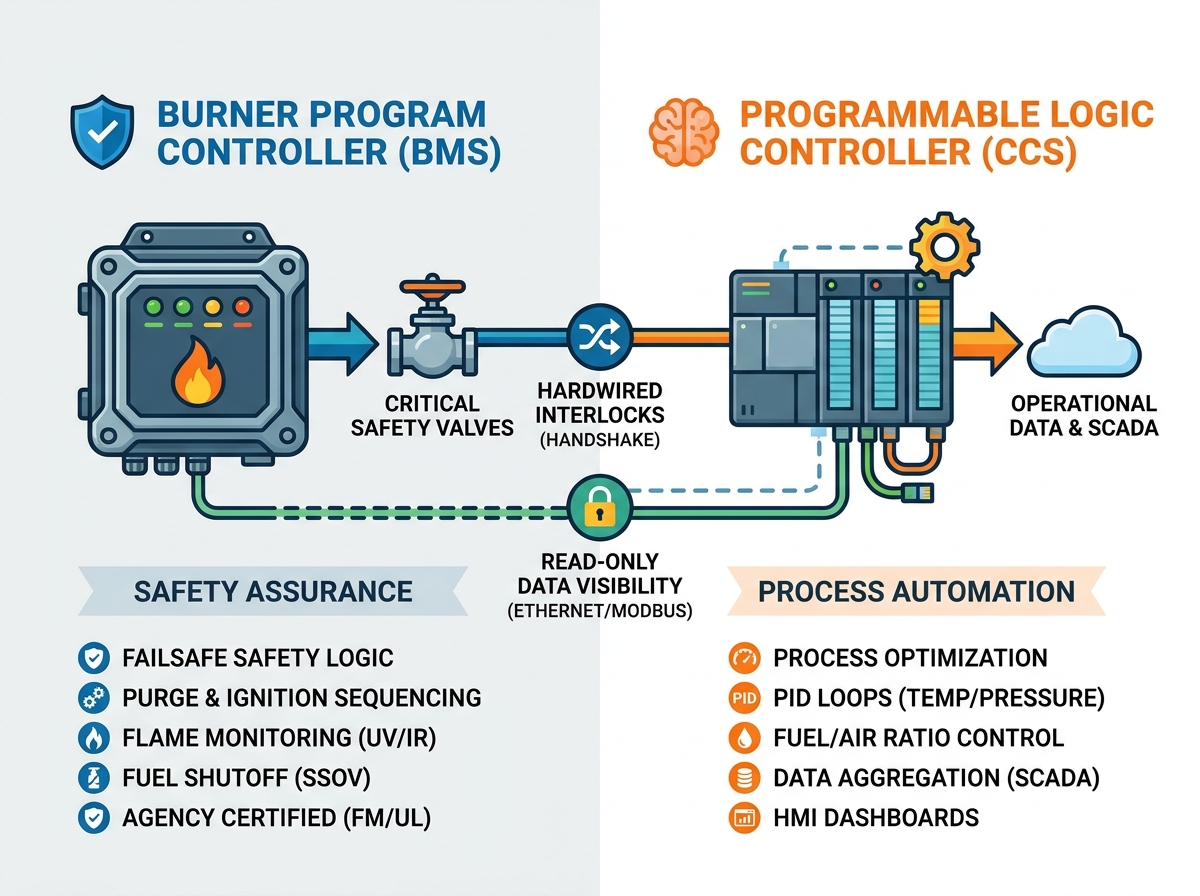
A dedicated burner management system handles all life-safety functions. This specialized hardware executes specific sequences required by codes like NFPA 86 for industrial ovens. It never deviates from its internal programming. It monitors physical limits and reacts in milliseconds.
We rely on this device to execute several core functions natively. The sequence generally unfolds in a strict, unalterable order:
These functions must live in a dedicated safety device. Agency approvals demand it. Devices carry pre-certifications from recognized bodies like FM Global and UL. Insurance companies look for these specific labels during facility audits.
Furthermore, tamper-resistance ensures ongoing safety. Plant personnel cannot easily alter the safety logic. A maintenance technician cannot simply plug in a laptop and bypass a faulty purge switch. This protects the facility against unauthorized "workarounds" during night shifts.
Finally, these devices have predictable failure modes. The internal hardware design ensures they fail to a safe state natively. If an internal relay welds shut, the microprocessor detects the fault. It then deliberately trips a redundant circuit to close the fuel valves. Standard automation equipment does not possess this self-checking hardware architecture.
Your combustion control strategy relies entirely on the PLC. While the safety system prevents explosions, the PLC ensures you actually make a usable product. It manages the nuance of the thermal process.
The PLC handles complex, continuous adjustments. These core functions keep the plant running efficiently:
These tasks belong in the PLC due to its immense computational flexibility. You can optimize the logic for energy efficiency without violating safety codes. Programmers can tweak PID tuning parameters daily if necessary.
Data aggregation also requires a PLC. The controller easily pushes operational data to SCADA or MES platforms. Plant managers need this data to track fuel consumption and production uptime. The PLC packages this information neatly for higher-level enterprise networks.
Additionally, the PLC drives the Human-Machine Interface (HMI). Operators rely on these visual dashboards for troubleshooting. The HMI displays trend lines, alarm histories, and maintenance prompts. A dedicated safety relay simply cannot generate complex graphics or log historical data trends effectively.
A dangerous misconception persists in industrial automation. Many engineers believe a standard, high-end PLC can legally run burner safety logic. They assume a fast processor and good code equate to safety. This assumption violates fundamental industrial safety standards.
The reality of standard PLCs makes them illegal for primary combustion safety under NFPA standards. Standard processors lack hardware redundancy. They have non-deterministic scan times. Their code is easily mutable. A programmer could accidentally delete a flame failure interlock during a routine update. The hardware itself could freeze, leaving a gas valve open.
However, a specific alternative exists: the safety PLC. We must evaluate this option carefully.
A Safety PLC is a highly specialized piece of hardware. It carries a SIL 2 or SIL 3 rating. It features redundant processors checking each other's math constantly. It utilizes locked safety task environments separate from standard process logic.
To understand the landscape, review this architectural comparison chart:
| System Characteristic | Standard PLC | Dedicated Burner Controller | Certified Safety PLC |
|---|---|---|---|
| Primary Function | Process optimization & modulation | NFPA-compliant flame safeguard | Customizable SIL-rated safety logic |
| Regulatory Approval | None for direct burner safety | FM, UL, CSA (Out-of-the-box) | TÜV, SIL 2/3 (Requires certified code) |
| Programming Complexity | Standard ladder logic / structured text | Fixed sequence (No programming required) | Rigorous, certified safety programming |
| Hardware Redundancy | Single processor standard | Internal self-checking relays | Dual or triple redundant processors |
The pros of a Safety PLC include a unified hardware ecosystem. You keep all I/O in one rack family. They are highly customizable for extremely complex, multi-burner process heaters. Standard safety relays often lack the I/O capacity for massive petrochemical furnaces.
The cons are significant. They carry drastically higher hardware costs. You must hire certified safety programmers to write the logic. Furthermore, every single logic change requires a rigorous, documented re-validation process. You cannot simply tweak a timer on the fly.
We recommend a strict shortlisting logic. Stick to a dedicated burner safety controller for standard ovens, boilers, and furnaces. It provides the safest, simplest compliance path. Only consider a specialized Safety PLC for highly complex, custom petro-chemical installations. Reserve them for applications where off-the-shelf devices physically cannot handle the zone count.
Understanding the implementation realities is crucial. You must connect the systems seamlessly. How do you design a burner controller vs PLC architecture without compromising the safety rating? The answer lies in combining hardwired signals for safety with digital networks for visibility.
Physical copper wire must carry critical safety commands. The PLC initiates the process. It evaluates the process temperature and sends a "Call for Heat" dry contact signal to the safety controller. This simply asks permission to start the burner.
The safety controller takes over. It checks the high gas pressure switch, low combustion air switch, and physical purge limits. If all hardwired interlocks pass, it begins the purge. The safety device retains direct, hardwired control of the gas valves. The PLC never touches the SSOV wiring.
Once the flame is proven, the safety controller sends a hardwired "Burner On" signal back to the PLC. Only then does the PLC begin modulating the fuel and air control valves. If the flame fails, the safety device drops the gas valves and sends a "Lockout" signal to the PLC. The PLC then alarms the HMI.
Modern plants require robust data. You should use digital networks, but only for specific tasks. Use Modbus RTU, Modbus TCP, or Ethernet/IP strictly for "read-only" data collection.
You can map valuable diagnostic data from the safety device to the PLC. This includes fault history codes, real-time flame signal strength (measured in volts), and cycle counts. This data empowers maintenance teams. They can see a degrading flame signal on the HMI before it causes a nuisance shutdown.
However, you must follow a golden rule. Never map safety-critical commands over standard industrial networks. You cannot send a digital network command to reset a critical safety lockout. An operator must physically walk to the burner panel. They must assess the hazard and press a physical reset button. Network resets violate NFPA safety intent.
Integrating combustion systems successfully requires acknowledging the strengths of different hardware platforms. We must divide responsibilities clearly to ensure compliance and reliability.
Take action to protect your facility today. Consult a certified combustion systems integrator to audit your current hardware. Ask them to map out an NFPA-compliant upgrade path that segregates your process control from your life-safety systems properly.
A: No. A standard PLC can control process valves for modulation (flow rate), but the primary safety shutoff valves (SSOV) must be hardwired to an approved burner management system. Standard PLCs lack the required hardware redundancy and certified failure modes to handle emergency fuel isolation legally.
A: A BMS is strictly responsible for safety. It prevents explosions by managing ignition sequences, purge timers, and emergency shutoffs. A CCS manages the thermal process. It maintains oven temperatures, optimizes fuel-to-air ratios, and dictates firing rates to meet production demands.
A: Safety PLCs are typically justified in massive, multi-burner installations like refinery process heaters. Standard off-the-shelf burner controllers often lack the I/O capacity or sequencing flexibility required for these massive applications. Facilities choose them only when budgets permit specialized SIL-rated engineering and rigorous lifecycle maintenance.