lucy@zlwyindustry.com
+86-158-1688-2025
Please Choose Your Language
- All
- Product Name
- Product Keyword
- Product Model
- Product Summary
- Product Description
- Multi Field Search

Views: 0 Author: Site Editor Publish Time: 2026-08-04 Origin: Site


Selecting the wrong combustible gas detector carries massive operational stakes. You risk triggering false alarms, missing dangerous leaks in inert environments, or drowning in escalating maintenance overhead. When safety systems fail, facilities face catastrophic downtime or severe personnel hazards.
Both primary technologies reliably measure the Lower Explosive Limit (LEL) of hazardous gases. However, their underlying mechanisms dictate entirely different operational limits, lifecycle spans, and financial burdens. A mismatch between your sensor type and your specific atmospheric conditions can blindly mask a critical leak. Many operators discover these blind spots only after an incident occurs.
We will break down how each detection method works in the field. You will learn where they thrive, where they fail, and how to balance initial equipment expenses against long-term calibration labor. This guide delivers the technical and commercial insights you need to confidently choose the right sensor for your facility.
To make an informed choice, we must first understand how these devices "see" hazardous environments. The core sensing mechanism directly influences where you can safely deploy each unit. Let us examine the physical principles driving both technologies.
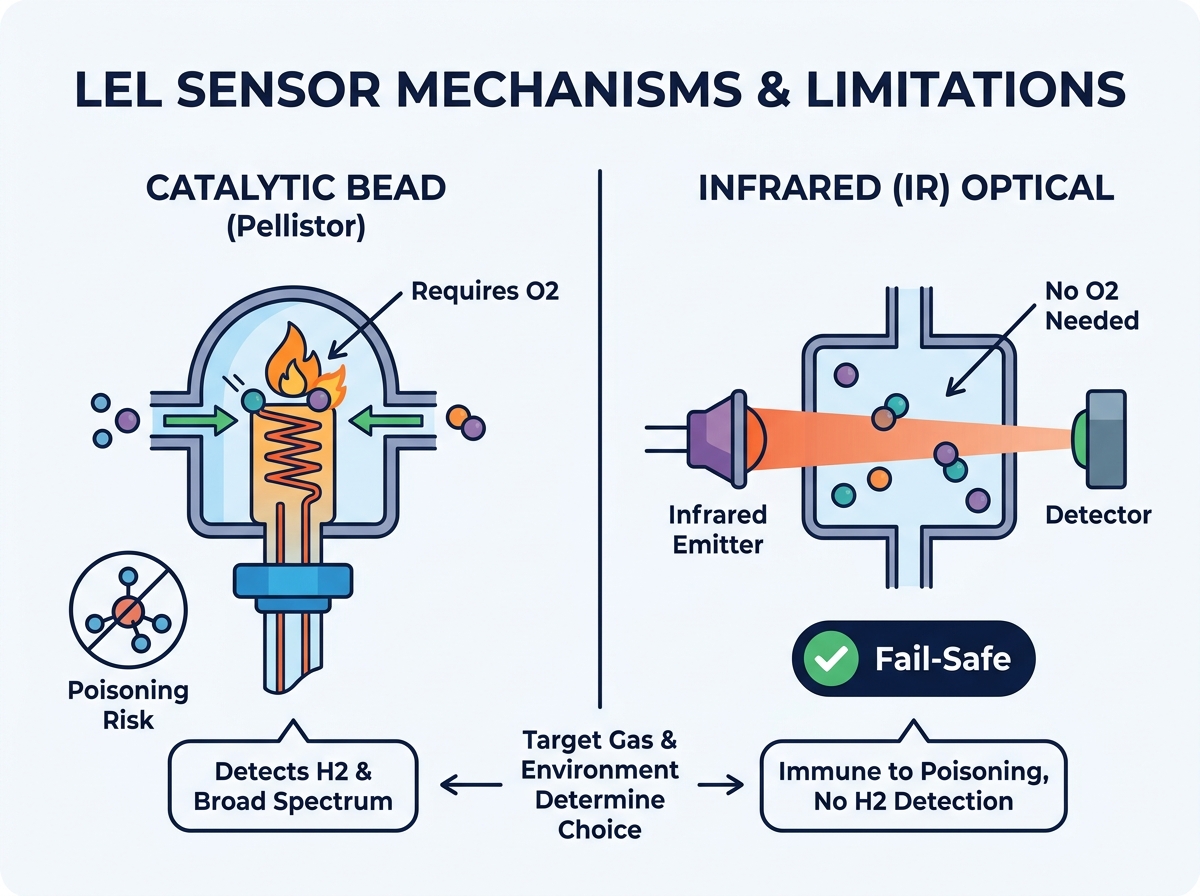
The standard catalytic gas sensor operates on a straightforward principle: controlled combustion. Inside the sensor housing, a tiny wire coil (usually platinum) is coated with a catalytic ceramic bead. We call this bead a pellistor. The device heats this bead to a high temperature.
When combustible gas enters the sensor chamber, it burns upon contact with the heated catalyst. This miniature oxidation process generates additional heat, causing the bead's temperature to rise. The temperature spike changes the electrical resistance of the wire coil. A Wheatstone bridge circuit measures this resistance change and translates it into an LEL percentage reading.
Crucial Limitation: Because this method relies on actual combustion, it strictly requires oxygen. The atmosphere must contain at least 10% oxygen by volume for the pellistor to burn the gas accurately. If you place a catalytic sensor in an inert, nitrogen-purged, or heavily oxygen-depleted environment, it cannot function. The gas will pass through the chamber unburned. The monitor will display a dangerous false zero.
Unlike pellistors, an infrared gas sensor does not burn anything. It relies on Non-Dispersive Infrared (NDIR) technology. This mechanism shines an infrared light beam through a gas chamber toward an optical receiver. Hydrocarbon gases absorb specific wavelengths of infrared light.
When combustible hydrocarbons enter the optical path, they absorb some of the light. The receiver detects the drop in light intensity. It then calculates the gas concentration based on how much light went missing. This is a purely physical optical measurement, entirely devoid of chemical reactions.
Crucial Advantage: Since it does not burn gas, it requires absolutely no oxygen. You can safely deploy IR sensors in 100% nitrogen backgrounds or heavily purged pipelines. Furthermore, they offer a fail-safe design. If dirt, water, or a mechanical failure blocks the light beam, the sensor instantly triggers a system fault. In contrast, a dead catalytic sensor simply stays quiet, looking perfectly normal while failing to read gas.
Every detection technology has inherent vulnerabilities. Understanding these blind spots prevents catastrophic deployment errors. Let us look at the environmental factors that dictate sensor accuracy and survival.
We must address the most critical limitation of optical technology first. Infrared sensors cannot detect hydrogen gas. They are completely blind to it. Hydrogen is a diatomic molecule that does not absorb infrared light at the wavelengths these detectors use.
If your facility manages battery charging rooms, hydrogen fuel cells, or syngas processes, an infrared unit is useless for H2 safety. You must mandate a catalytic bead or a specific electrochemical combustible gas sensor for these zones. Installing an IR unit in a battery room is a common, highly dangerous mistake.
Catalytic sensors face a severe threat known as sensor poisoning. Certain airborne chemicals permanently destroy the catalytic bead. When exposed to vapors from silicone caulking, adhesives, or lubricants, a glass-like silica shell forms over the heated bead. Lead and phosphates cause similar permanent destruction. Once poisoned, the bead can no longer burn gas, rendering the sensor dead.
Other compounds act as temporary inhibitors. Hydrogen sulfide (H2S) and halogenated hydrocarbons (like freon) can temporarily coat the catalyst. This drastically reduces sensitivity. While sometimes reversible by burning clean gas, inhibitors often demand immediate recalibration to ensure accuracy.
IR sensors remain entirely immune to chemical poisoning. Because they use a physical light beam, silicones and heavy metals cannot degrade their measurement capabilities. They thrive in environments that would destroy a pellistor in days.
While IR technology ignores chemical poisons, it remains sensitive to severe environmental shifts. Extreme temperature drops can cause heavy condensation inside the optical chamber. Water droplets scatter the infrared beam, mimicking gas absorption. This triggers a fault alarm or a false positive reading. While it fails safely (triggering an alarm rather than staying silent), it still causes frustrating operational downtime.
Modern IR detectors mitigate this weakness efficiently. Manufacturers now incorporate heated optics. By warming the mirrors and optical pathways slightly above the ambient dew point, they prevent condensation entirely. This allows modern IR units to function flawlessly in humid offshore rigs and cold-storage facilities.
We must look beyond the initial purchase price. The true financial impact of gas detection equipment emerges during ongoing operations. Let us break down the labor and replacement variables that define a facility's long-term budget.
Catalytic sensors hide significant labor requirements. Because the pellistor physically burns gas, it degrades slightly with every single exposure. Background poisons accelerate this degradation. To combat this constant sensitivity loss, technicians must perform frequent bump testing and calibration. Many safety frameworks recommend monthly or quarterly calibrations for catalytic arrays.
This translates into massive labor hours. Technicians must walk the site, apply calibration gas, wait for stabilization, and adjust the readings. Conversely, an infrared LEL detector maintains its calibration baseline exceptionally well. Because there is no chemical degradation, IR units rarely drift. You often only need to calibrate them annually, drastically reducing your ongoing maintenance workload.
The physical degradation of catalytic beads severely limits their operational life. Under ideal, clean conditions, industry baselines suggest a catalytic unit will last three to five years. However, in harsh environments containing mild poisons or frequent background gas, you might replace them every 12 to 18 months.
IR sensors boast a vastly superior lifespan. The solid-state optical components routinely last ten to fifteen years. You may need to replace the internal light source eventually, but the core measurement assembly remains stable for a decade.
Procurement teams frequently fall into a specific trap. They choose catalytic sensors because the upfront capital expenditure is noticeably lower. An IR head often costs twice as much initially.
We advise buyers to calculate the operational labor first. Do not select a catalytic model simply for the lower initial price tag. When you factor in the labor cost of frequent calibrations, replacement sensor heads, and calibration gas cylinders, the catalytic expenses rapidly outpace the IR savings. In many industrial environments, the break-even point occurs within the first 18 months of operation.
Choosing the optimal catalytic bead vs infrared LEL sensor depends entirely on your specific site conditions. Use the following framework to align your facility's needs with the correct technology.
| Evaluation Criteria | Catalytic Bead (Pellistor) | Infrared (NDIR) |
|---|---|---|
| Target Gases | Broad spectrum, including Hydrogen (H2) | Hydrocarbons only; Blind to Hydrogen |
| Oxygen Requirement | Requires >10% Oxygen | Requires 0% Oxygen (Works in inert zones) |
| Poison Resistance | Highly susceptible (Silicones, Lead) | 100% Immune to chemical poisons |
| Calibration Frequency | High (Monthly to Quarterly) | Low (Annually) |
| Expected Lifespan | 3 - 5 Years | 10+ Years |
We recommend standardizing on catalytic units in specific, highly controlled scenarios:
You should prioritize optical IR units when operational stability and harsh environments dictate the rules:
While point-source detectors form the backbone of industrial safety, massive facilities sometimes require broader coverage. This brings us to next-generation alternatives like Tunable Diode Laser Spectrometry (TDLS) and open-path laser gas leak detection systems.
Laser spectroscopy operates similarly to IR technology but on a massive scale. Instead of measuring gas inside a small chamber, these systems shoot a concentrated laser beam across hundreds of meters to a retro-reflector. They measure the gas plume crossing the beam's path. We position this as the premium tier for open-area monitoring.
If you manage pipeline perimeters, massive LNG export terminals, or vast chemical storage yards, hundreds of point detectors become impossible to maintain. Open-path lasers provide a continuous perimeter fence of optical detection. They complement your point-source catalytic and IR fleets, acting as the ultimate macro-level fail-safe.
The "better" sensor does not exist in a vacuum. Your facility's specific atmospheric conditions, target gases, and maintenance capabilities dictate the right choice entirely. Both technologies save lives when deployed correctly, but they fail dangerously when misapplied.
Keep these action steps at the forefront of your safety planning:
We strongly encourage you to consult with an application engineer to review your site's target gases and background environment before standardizing your entire fleet. A professional assessment guarantees you balance upfront costs against uncompromised safety.
A: No. Hydrogen does not absorb infrared light. A catalytic bead or electrochemical sensor is required.
A: They rely on controlled oxidation (burning) of the target gas. Without sufficient oxygen, the combustion cannot occur, resulting in a false zero reading.
A: Exposure to compounds like silicones, heavy metals, or certain sulfur compounds coats or destroys the catalytic bead, permanently blinding the sensor to combustible gases.
A: Infrared sensors generally have a lower lifecycle expense due to immunity to poisoning, fail-safe diagnostics, and significantly reduced calibration labor requirements.