lucy@zlwyindustry.com
+86-158-1688-2025
Please Choose Your Language
- All
- Product Name
- Product Keyword
- Product Model
- Product Summary
- Product Description
- Multi Field Search

Views: 0 Author: Site Editor Publish Time: 2026-07-27 Origin: Site


Unexpected safety shutdowns and fluctuating combustion efficiency severely impact industrial operations. These sudden interruptions directly cause lost production time. They also create serious safety risks across your facility. Operating dual fuel systems presents highly specific engineering challenges. You face complex hurdles when transitioning between gas and liquid fuels under variable loads. Maintaining optimal combustion dynamics during these shifts is rarely easy.
Resolving these combustion issues requires moving past simple trial-and-error adjustments. You must adopt a systematic, evidence-based diagnostic framework instead. Modern facilities demand precision and reliable data to ensure consistent performance. By understanding the root causes, you can implement lasting solutions. You protect your production schedules and safeguard plant personnel. A proactive approach transforms erratic burner behavior into predictable, efficient energy generation.
This guide breaks down the core mechanisms driving combustion failures. We explore mechanical faults, aerodynamic breakdowns, and transition vulnerabilities. You will learn how to apply advanced diagnostics to pinpoint exact failure modes. Finally, we provide a clear framework for evaluating repair, retrofit, or replacement options.
Micro-fluctuations in the combustion process rarely remain isolated events. Poor aerodynamic mixing creates small pressure waves inside the combustion chamber. These minor waves amplify quickly. The combustion process rapidly destabilizes. A seemingly minor unstable flame quickly cascades into macro-level operational disruptions. Facility managers often underestimate how quickly small variations degrade overall thermal efficiency.
The immediate consequence is usually a burner lockout. This event stops production entirely. Plant safety codes dictate strict purge-and-restart cycles following a trip. You must purge the furnace volume multiple times using fresh air. This process wastes valuable time. It also vents tremendous amounts of thermal energy up the stack. We lose operational continuity. Every nuisance trip drains resources and frustrates operating personnel.
Beyond lost time, severe safety and compliance risks emerge. Unburned combustibles can accumulate quickly in the furnace during erratic combustion. This buildup creates extreme explosive hazards. You also face the risk of acoustic resonance. Engineers often call this furnace rumble. Severe rumble can physically destroy refractory brickwork. Furthermore, poor combustion spikes emissions. You risk violating strict NOx and carbon monoxide limits. We must prioritize combustion stability to maintain regulatory compliance.
Table: Cascade Effects of Combustion Fluctuations
| Symptom | Direct Operational Consequence | Long-Term Facility Risk |
|---|---|---|
| Micro-pulsations | Minor draft fluctuations and heat loss. | Vibration damage to burner hardware. |
| Scanner flicker | Nuisance trips and frequent restarts. | Lost production schedules and wasted fuel. |
| Incomplete combustion | Soot accumulation and high CO output. | Regulatory fines and explosive hazards. |
Log every shutdown event meticulously. Track the exact time, fuel type, and load demand. You need this historical data to identify patterns. Do not treat a lockout as a random nuisance. Treat it as a critical symptom of a degrading system.
Identifying the exact origin of poor combustion requires isolating multiple variables. The interplay between fuel, air, and mechanical design dictates performance.
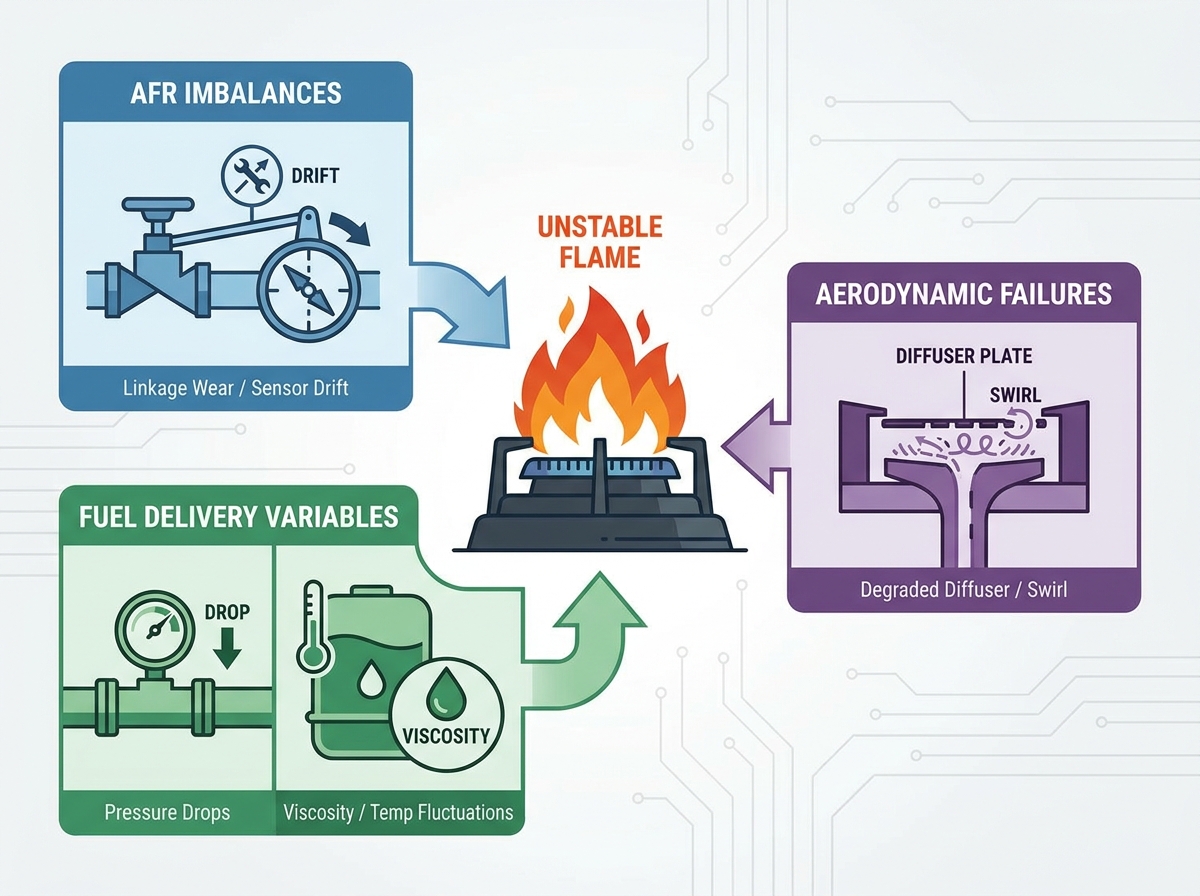
Mechanical linkages wear down continuously over time. Traditional positioning systems suffer greatly from mechanical hysteresis. A tiny gap in a control linkage changes air flow significantly. Parallel positioning controls rely entirely on sensors. Sensor drift alters the intended air-to-fuel ratio quietly over months. This silent imbalance destabilizes the primary combustion zone. You must verify sensor calibration regularly.
Fuel characteristics dictate how energy releases into the furnace. Delivery inconsistencies ruin the process.
The burner head creates a specific aerodynamic environment. Diffuser plates degrade under intense radiant heat. Warped metal alters the engineered swirl geometries. A properly shaped swirl creates a low-pressure recirculation zone. This zone holds the fire onto the burner head. When hardware warps, the recirculation zone breaks down. The fire detaches and blows out.
Exhaust dampers control internal chamber pressure. Poor damper response alters draft conditions rapidly. A sudden high draft pulls the fire right off the burner head. Varying stack drafts from external weather conditions also impact internal pressure. Poor draft control induces severe dual fuel burner flame instability. You must tune draft controls as aggressively as you tune fuel valves.
Transitioning fuels is highly critical for any industrial facility. The system shifts mechanical and electrical states simultaneously. This brief window is the absolute highest-risk phase for a fuel changeover failure. Operators must execute these transitions flawlessly to maintain boiler load.
Switching from gas to liquid fuel requires perfect synchronization. You introduce a new fluid dynamic while removing the old one. The existing fire must ignite the incoming fuel source. Any hesitation during this crossover drops furnace temperatures. A dropping temperature inhibits proper ignition of the new fuel. This leads directly to a complete flameout.
Safety shutoff valves actuate mechanically. They operate slowly by design for safety reasons. These mechanical realities cause momentary fuel starvation. They can also create dangerous, overly rich conditions. If the gas valve closes before the oil valve fully opens, the fire starves. If the oil valve opens too early, you double the fuel input. The air supply cannot support double fuel. Heavy smoke and a trip occur immediately.
A Burner Management System (BMS) guides the entire transition. Poorly tuned cross-limiting loops fail frequently during these moments. They do not maintain the required excess air margin. Cross-limiting rules are simple but strict. Airflow must always lead fuel increases. It must always lag fuel decreases. This ensures a safe, oxygen-rich environment at all times. Failure in BMS tuning causes immediate and violent instability.
Operators often force changeovers during high-load swings. You should execute transitions during stable, steady-state loads whenever possible. Rushing the valve timing to save a few seconds usually guarantees a shutdown.
Outdated diagnostic methods cost plants thousands of hours annually. We must upgrade our approach to match modern equipment complexity.
Looking at fire color is highly subjective. Modern industrial compliance demands objective, verifiable data. Human eyes cannot detect rapid micro-pulsations. You might see a bright orange fire and assume everything is fine. Meanwhile, the core is starved for oxygen. Visual checks remain useful for basic signs of soot. They are entirely insufficient for complex tuning.
Advanced pressure transmitters provide deep internal insights. They detect acoustic combustion instabilities early. We sample furnace pressure at very high frequencies. This reveals micro-pressure anomalies long before a shutdown happens. You can see the 10Hz rumble signature on a screen before you hear it. This modernizes your standard dual fuel burner troubleshooting protocols.
UV and IR scanners do more than just confirm a fire exists. They generate valuable raw voltage data continuously. Monitoring this flickering frequency reveals hidden aerodynamic problems. A steady voltage means stable mixing. A wildly fluctuating signal pinpoints specific zones suffering from fuel starvation. You can use this data to adjust individual swirl vanes.
O2 and CO trim data offer crucial diagnostic clues. You should correlate this telemetry with instability events. If O2 drops sharply right before a lockout, you know air delivery failed first. This provides an objective baseline for root-cause analysis. It removes guesswork completely.
Every facility faces budget constraints. You must decide whether to apply a patch or invest in a comprehensive upgrade. Data should drive this decision.
Sometimes, basic maintenance works perfectly. Recalibrating the air-fuel curve solves minor seasonal drift. Changing weather alters air density, requiring subtle curve adjustments. Replacing worn mechanical linkages offers a highly cost-effective fix. If your hardware is physically intact, a professional tuning session often restores stability entirely.
Evaluate the return on investment for subsystem upgrades. Upgrading specific components extends the life of the entire system.
You must establish clear replacement criteria for aging equipment. Outdated geometries cannot meet new low-NOx requirements. Flue gas recirculation (FGR) lowers emissions but makes combustion inherently unstable. Old heads cannot handle heavy FGR rates. Furthermore, recurring structural fatigue demands full replacement. When parts obsolescence makes basic maintenance impossible, replacement becomes the only viable path.
Choose a reliable combustion engineering partner carefully. They must practice transparent data sharing during the tuning process. Verifiable field experience with complex dual-fuel geometries matters greatly. Ask for their specific history with your boiler type. Clear, comprehensive commissioning documentation is non-negotiable. They must leave you with baseline data for future troubleshooting.
Diagnosing erratic combustion behavior is fundamentally an exercise in data correlation. You must measure fuel delivery, airflow, and chamber pressure with high precision. Relying on visual cues and guesswork guarantees repeated failures. By applying a systematic framework, you transform mysterious shutdowns into solvable engineering equations.
Your next step is to audit your current lockout frequency logs. Identify the exact operating conditions that trigger most trips. Shift your operations toward data-driven diagnostics immediately. Stop treating shutdowns as an unavoidable cost of doing business.
We encourage you to schedule a comprehensive combustion audit soon. Consult with an experienced application engineer to evaluate your specific BMS and hardware configuration. Securing expert guidance now prevents catastrophic downtime later.
A: Momentary drops in fuel pressure or lagging air damper responses during the transition typically trigger the BMS. The logic system detects these mismatches immediately. It shuts down the system safely to prevent explosive rich-fuel conditions or sudden flameouts.
A: Incorrect heating of heavy liquid fuels changes their viscosity drastically. This improper viscosity destroys the atomization pattern at the nozzle tip. The fuel forms large droplets that burn poorly, leading directly to a highly unstable flame and heavy soot production.
A: A failing scanner causes a false lockout by failing to detect the existing fire. However, it does not physically cause the combustion process itself to become unstable. The scanner is merely a sensor; mechanical and aerodynamic factors drive the actual instability.
A: You should upgrade when you experience frequent nuisance trips that lack clear causes. Consider upgrading if your current system cannot integrate advanced pressure diagnostics. A lack of precise cross-limiting control during fuel changeovers also strongly justifies a modern BMS upgrade.