lucy@zlwyindustry.com
+86-158-1688-2025
Please Choose Your Language
- All
- Product Name
- Product Keyword
- Product Model
- Product Summary
- Product Description
- Multi Field Search

Views: 0 Author: Site Editor Publish Time: 2026-08-14 Origin: Site


Incorrect regulator selection directly impacts downstream equipment stability. It severely affects safety compliance and daily maintenance overhead. Specifying the wrong valve often results in unacceptable pressure droop. You might experience premature wear or total system starvation. The decision between these two designs is critical. It comes down to balancing required flow capacity, acceptable accuracy variances, and the operating environment's gas quality. Evaluating a direct operated vs pilot operated gas pressure regulator requires careful operational analysis. This guide breaks down the performance realities of both approaches. We explore implementation risks and technical evaluation criteria for modern gas pressure control. You will learn how to match valve mechanics to your specific operational needs. We also cover crucial sizing calculations. Proper specification ensures site safety. It also guarantees reliable downstream performance over the long term.
A direct acting regulator operates via a simple, direct mechanical linkage. This linkage connects the sensing diaphragm directly to the valve plug. A heavy set spring actively opposes this movement. Upstream gas enters the valve body and passes through the orifice. The downstream pressure registers against the bottom of the diaphragm. When downstream pressure drops, the spring pushes the diaphragm down. This action opens the valve plug and increases gas flow.
Outcome: You achieve an immediate reaction to downstream pressure changes. The direct physical connection eliminates any signal delay. Fewer moving parts translate directly into lower initial capital expenditure (CapEx). It also guarantees straightforward field maintenance. Technicians only need basic hand tools to replace the main spring or diaphragm. However, the physical size of the spring limits the valve's ultimate flow potential.
Best Practice: Always install these units where rapid flow changes frequently occur. They excel in applications requiring fast responses to sudden demand spikes.
A pilot-operated regulator uses a fundamentally different approach. It harnesses the upstream gas pressure to drive the main valve. A smaller, highly sensitive pilot valve regulates this loading pressure. The pilot senses downstream pressure changes. It then sends a pneumatic signal to the main valve's dome or actuator. This loading pressure overcomes the main spring, forcing the valve open.
Outcome: The pilot amplifies the control signal significantly. This allows the main valve to open fully with minimal change in downstream pressure. The design separates the sensing function from the heavy lifting of the main plug. You gain incredible precision. The main valve acts only as a slave to the pilot's commands. This design manages massive flow rates efficiently.
Common Mistake: Do not install pilot-operated units in systems with highly fluctuating inlet pressures without verifying the pilot's pressure ratings. Surges can damage the delicate pilot diaphragm.
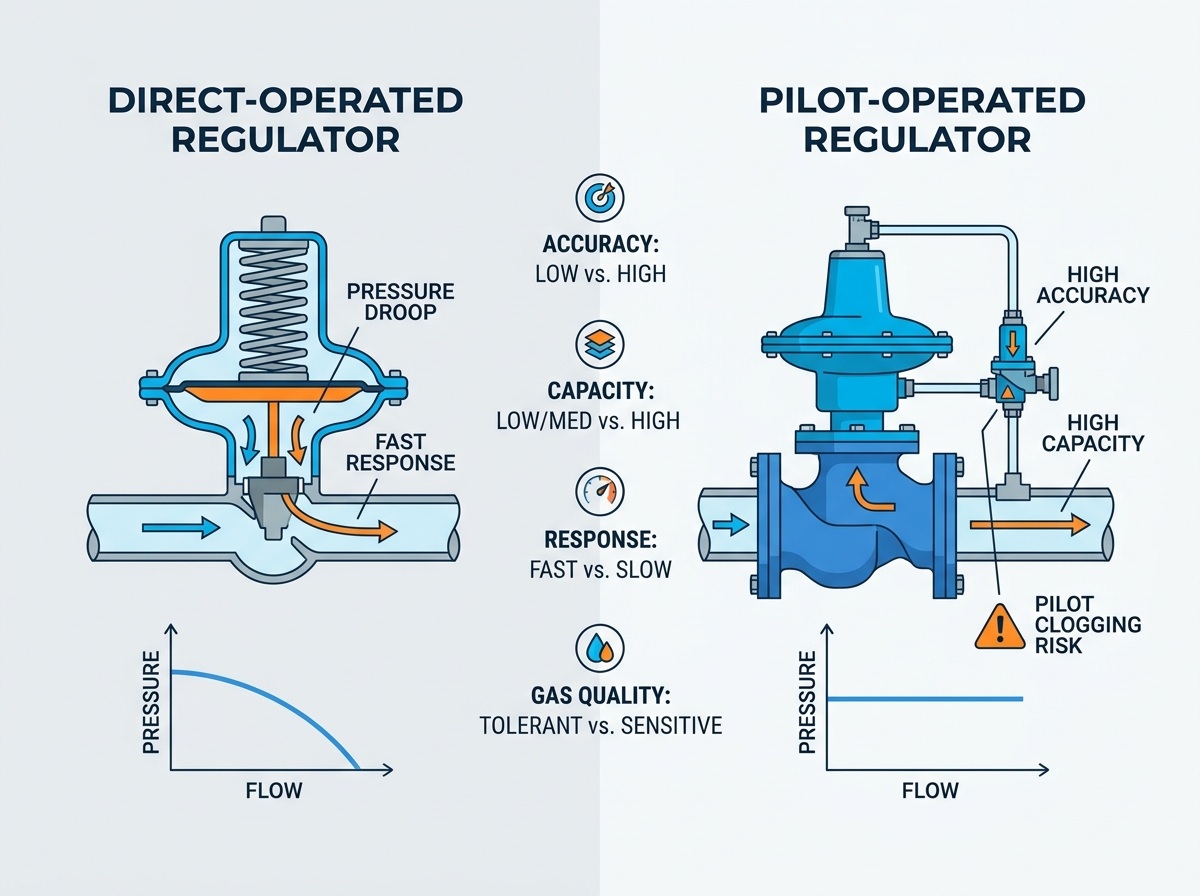
Accuracy defines how well a valve maintains its setpoint under varying loads. Direct-operated units experience significant "droop". Droop is the drop in outlet pressure as flow increases. This happens due to the spring effect. As the valve opens, the spring extends and loses compressive force. The diaphragm effective area also changes during the stroke. You should use direct units only when a 10-20% pressure variance is acceptable.
Pilot-operated units behave differently. They maintain a near-flat performance curve from minimum to maximum flow. They typically hold downstream pressure within 1-5% of the setpoint. The pilot valve constantly adjusts the loading pressure. This compensates for the main spring's physical limitations. This tight accuracy is crucial. Sensitive downstream burners or critical metering stations rely heavily on this stable pressure.
The physical size of the spring and diaphragm limits a direct-operated valve. If you need higher flow, you need a larger, stiffer spring. This makes the valve bulky and sluggish. Therefore, manufacturers generally restrict direct units to low-to-medium flow rates.
Pilot-operated units offer vastly higher regulator capacity for any given pipe size. The loading pressure provides massive force. It opens large valve plugs effortlessly. They also provide exceptional turndown ratios. A high turndown ratio means the valve handles both very low and very high flows effectively. This makes them ideal for industrial systems experiencing wide, unpredictable flow fluctuations.
Direct-operated units boast extremely fast response times. The downstream pressure acts directly on the diaphragm. There is no pneumatic delay. This speed mitigates rapid transient pressure spikes. It prevents the water hammer effect in gas systems. Fast cycling equipment requires this immediate reaction.
Pilot-operated models are inherently slower. Gas takes time to travel through the sense lines. The pilot dome requires time to load and unload pressure. Improper sizing can lead to hunting. Hunting occurs when the valve rapidly oscillates around the setpoint. Highly dynamic flow conditions exacerbate this instability. You must tune the pilot restrictors carefully.
| Performance Variable | Direct-Operated | Pilot-Operated |
|---|---|---|
| Setpoint Accuracy | Moderate (10-20% droop expected) | High (1-5% variance from setpoint) |
| Flow Capacity | Low to Medium | Very High |
| Response Time | Instantaneous | Slower (Pneumatic delay) |
| Turndown Ratio | Limited | Exceptional |
Gas quality dictates regulator survival. Pilot valves contain tiny internal orifices and restrictors. This creates a specific risk profile. These small passages are highly susceptible to clogging. Scale, moisture, or particulate matter in dirty gas lines will quickly plug a pilot. When a pilot clogs, the main valve usually fails closed or locks in position. This halts your entire process.
Mitigation requires strict upstream filtration. Pilot-operated systems demand clean, dry gas. You must install fine particulate filters and moisture separators ahead of the valve. Direct-acting units are far more tolerant of debris. Their larger internal clearances let small particulates pass through unharmed. They handle dirty applications effectively.
Pressure differential is the gap between inlet and outlet pressure. Direct-operated units function effectively with almost zero pressure drop across the valve. The downstream pressure alone provides the operating force. They excel in low-pressure networks.
Pilot-operated units have stricter demands. Most models require a minimum pressure differential between the inlet and outlet. This is often 10 to 20 psid (pounds per square inch differential). The pilot needs this energy differential to stroke the main valve. If system pressure drops too low, the pilot starves. The main valve will fail to open fully, starving downstream equipment.
Maintenance routines differ drastically between the two designs. Direct units require more frequent servicing. Diaphragms wear out, and springs lose tension over millions of cycles. However, this maintenance is simpler and cheaper. A standard technician can rebuild a direct unit in the field in minutes.
Pilot units require less frequent interventions. They endure long continuous runs well. Yet, they require highly specialized maintenance when they do fail. Technicians often need complete rebuild kits. They must carefully clean the tiny pilot passages. Tuning the pilot restrictors after a rebuild requires specialized training. You must align your staff's capabilities with the valve's complexity.
| Application Scenario | Recommended Technology | Primary Justification |
|---|---|---|
| Raw Biogas Point-of-Use | Direct-Operated | High debris tolerance; ignores moisture. |
| District Heating Boiler | Pilot-Operated | Requires tight accuracy across wide turndown. |
| Rapid Cycling Furnace | Direct-Operated | Instant response prevents pressure spikes. |
| City Gate Station | Pilot-Operated | Handles massive flow capacities reliably. |
Evaluating a direct vs pilot operated gas pressure regulator is not about finding universally "better" technology. It is about matching the valve's mechanical behavior to the system's daily operational realities. Over-engineering with a pilot-operated valve in a dirty, low-flow system introduces completely unnecessary failure points. Conversely, under-specifying a direct-acting regulator in a high-demand commercial facility will starve downstream equipment and cause faults. Finalize your precise sizing calculations first. Prioritize your gas cleanliness analysis before locking in a specification. By aligning the valve's strengths with your process conditions, you ensure safe, stable, and highly reliable pressure management.
A: Droop is the decrease in outlet pressure below the setpoint as gas flow increases. It occurs because spring force lessens as the valve opens. It is a critical evaluation metric. Excessive droop can cause downstream equipment, like burners, to fault, lose efficiency, or shut down completely.
A: Yes, they can handle high inlet pressures. However, their flow capacity at those elevated pressures remains limited. A pilot-operated equivalent of the exact same body size handles significantly more volume under those same high-pressure conditions.
A: The pilot mechanism relies on very small internal passages to route the loading pressure. Debris, compressor oil, or gas hydrates can easily plug these tiny restrictors. This blockage locks the main valve in position, leading to system failure.
A: No, most are "internally piloted." They use the upstream gas pressure of the system itself to load the main diaphragm. They do not need external air lines. However, they strictly require a minimum pressure differential across the valve to function.