lucy@zlwyindustry.com
+86-158-1688-2025
Please Choose Your Language
- All
- Product Name
- Product Keyword
- Product Model
- Product Summary
- Product Description
- Multi Field Search

Views: 0 Author: Site Editor Publish Time: 2026-07-27 Origin: Site


Facility managers and system engineers face a strict balancing act today. You must minimize upfront capital expenditure while protecting critical operations against volatile energy markets. Energy prices fluctuate unpredictably. Grid reliability often wavers during extreme weather events. You need robust contingency plans.
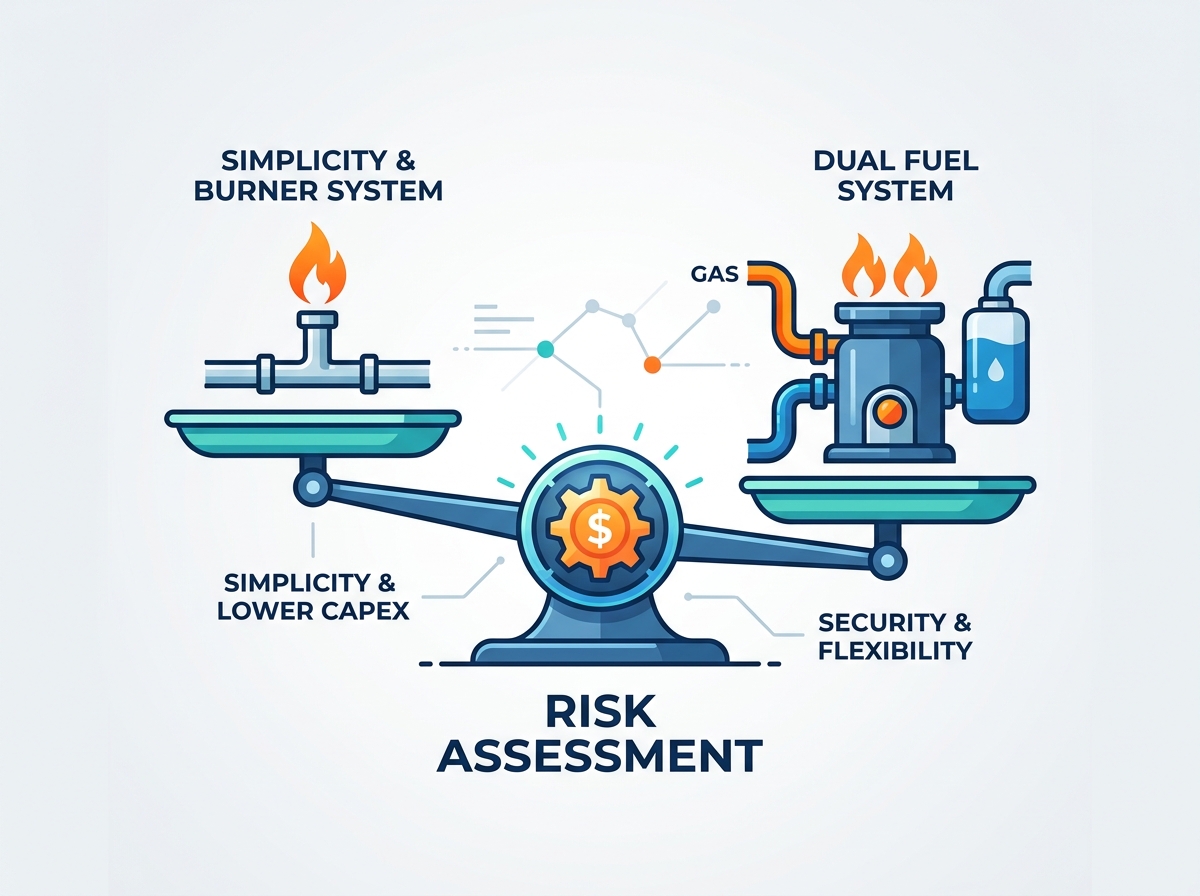
Choosing between a dual fuel vs single fuel burner is rarely a simple preference. It represents a calculated risk assessment comparing mechanical complexity against supply security. A wrong choice exposes you to operational paralysis. It might also drain your maintenance budget unnecessarily. Facility downtime carries immense financial penalties.
This guide strips away marketing claims to provide a transparent evaluation. We evaluate upfront costs, maintenance overhead, and long-term operational resilience. You will learn exactly how to weigh these competing factors. We provide evidence-based criteria to help you specify the right combustion system for your facility.
You must understand baseline mechanical differences before comparing costs. Combustion architecture dictates both daily operation and long-term reliability. Engineering teams often underestimate the complexity added by secondary fuel integration.
A single fuel burner is mechanically straightforward. These systems typically fire only natural gas or light oil. They focus entirely on one combustion profile. Engineers optimize them for predictable, single-stream efficiency.
You benefit from a much lower baseline installation footprint. Control integration remains simple. Operators manage fewer valves, fewer sensors, and a basic Burner Management System (BMS). Maintenance teams troubleshoot issues quickly. The system behaves consistently under varying load demands.
Manufacturers engineer these systems to switch seamlessly between two energy sources. Common configurations include natural gas backed by #2 heating oil or propane. This capability requires sophisticated engineering.
You must install redundant fuel trains. The system requires complex staging valves. You also need advanced BMS programming to handle distinct air-to-fuel ratios. Implementation risk rises significantly. The equipment demands an increased physical footprint. You must also integrate complex control logic into existing plant Programmable Logic Controllers (PLCs).
Financial evaluations must look beyond the initial purchase order. You must weigh upfront premiums against long-term utility savings. Proper financial modeling reveals true equipment value over two decades.
The premium for dual-source combustion is substantial. You pay for extra piping and specialized burner heads. The system requires dual safety shut-off valves. You also invest heavily in advanced electronic controls.
The dual fuel burner cost extends beyond the boiler room. You must build secondary fuel storage. This often means large on-site oil tanks or extensive propane infrastructure. You also face associated environmental permitting costs. Containment dikes, leak detection systems, and fire suppression upgrades add significant capital overhead.
Despite high initial costs, operational savings can be massive. You can capitalize on "interruptible" natural gas rates. Utilities offer heavily discounted year-round gas pricing to facilities. In exchange, you agree to switch fuels during peak grid demand.
This strategy protects operations against seasonal price spikes. You monitor daily energy markets. You then utilize the cheapest available fuel. Over a harsh winter, these savings often cover the initial equipment premium entirely.
You must establish a reliable framework for evaluating the burner lifecycle cost. Equipment usually operates for 15 to 20 years. Track initial CapEx, projected maintenance, and modeled energy savings.
Maintain a skeptical evaluation approach. Payback periods depend heavily on local utility volatility. Stable energy markets may never justify the initial premium. Run pessimistic scenarios. Assume lower utility rate differences to ensure the investment remains viable.
Financial Projection Breakdown
| Cost Category | Single-Source Systems | Dual-Source Systems | Financial Impact Strategy |
|---|---|---|---|
| Initial Equipment | Baseline pricing | 20% - 40% premium | Amortize over 15-20 years |
| Infrastructure | Standard piping | High (Tanks, dual trains) | Factor in local construction costs |
| Fuel Pricing | Firm, higher rates | Discounted, interruptible | Leverage arbitrage during winter peaks |
| Maintenance | Low predictability | High labor intensity | Budget for specialized vendor contracts |
Cost reduction is only one side of the equation. Modern facilities prioritize operational continuity. You cannot afford unexpected shutdowns.
Proper fuel flexibility acts as an insurance policy. It protects critical infrastructure. Hospitals, data centers, and continuous-process manufacturing plants mandate this redundancy. A single hour of downtime often costs more than the entire boiler installation.
You build resilience against natural disasters. Geopolitical supply disruptions no longer threaten your production schedule. When local gas lines freeze or pressure drops, your facility remains operational. You seamlessly shift to on-site reserves.
You must evaluate manual versus automated switchover capabilities. Older systems require operators to physically manipulate valves. This introduces human error during stressful emergency conditions.
Modern configurations automate this process. Sensors detect a pressure drop in the primary line. The BMS immediately sequences the secondary fuel train. Assess your acceptable downtime during this transition. Some automated systems switch without dropping boiler pressure. Manual configurations require a brief planned shutdown.
Sales brochures rarely highlight maintenance burdens. You must prepare your team for increased mechanical oversight. Ignoring secondary system maintenance guarantees failure during an emergency.
More moving parts equal a statistically higher probability of component failure. You double the number of actuators, igniters, and safety interlocks.
The harshest reality involves maintaining a system rarely used. Secondary components sit idle for months. Oil nozzles clog. Staging valves seize. Fuel degrades in storage tanks over time. Moisture accumulates inside oil reserves, promoting bacterial growth. You must implement rigorous testing schedules to keep dormant systems ready.
Environmental agencies heavily regulate industrial combustion. You face strict requirements to tune, test, and certify emissions annually. Regulators monitor Nitrogen Oxides (NOx) and Carbon Monoxide (CO).
You must certify emissions for both fuels. This doubles your testing expenses. You hire specialized technicians twice. Local environmental standards dictate strict limits. Firing backup oil often pushes facilities close to these emission thresholds. You must ensure precise burner tuning.
Your maintenance personnel need advanced cross-training. They must understand two completely different combustion profiles. Natural gas behaves differently than atomized liquid oil.
Operators must learn specific safety protocols. They need to recognize distinct flame geometries. They must troubleshoot dual BMS fault codes. High turnover rates in facility management make this training an ongoing operational expense. You cannot rely on a single expert.
You need actionable criteria to make an informed choice. Avoid defaulting to complex systems if they lack financial justification. Let data drive your procurement strategy.
Not every facility requires complex redundancy. You should specify a single-source unit if you operate under specific constraints.
Sometimes, the decision is made for you. In other cases, the financial math overwhelmingly supports the upgrade.
Do not guess. Follow a structured approach before issuing a Request for Proposal (RFP). Gather hard data to support your recommendation.
The choice ultimately requires a strict tradeoff. You balance mechanical simplicity against economic and operational security. Single-source systems streamline your maintenance program. Dual-source systems protect your bottom line against volatile energy markets.
Do not evaluate options based on equipment cost alone. Model your decision against the real-world cost of a sudden facility shutdown. Utility arbitrage opportunities often justify the initial capital expenditure.
Engage a specialized combustion engineer early in the process. Perform a transparent lifecycle cost and risk assessment before finalizing procurement. Demand hard numbers. Let localized data dictate your facility's long-term energy strategy.
A: Yes, but it is often cost-prohibitive. You must install entirely new fuel trains. You will need upgraded BMS panels to handle new logic. The process often requires potential burner head replacements. Upgrading later costs significantly more than specifying the capability upfront.
A: Modern automated systems can switch in minutes without dropping boiler pressure. They execute a seamless transition using advanced sensors. Older or manual systems require a brief planned shutdown. Operators must physically actuate valves and purge the combustion chamber.
A: It depends entirely on the secondary fuel. Natural gas burns very cleanly. Having an oil backup allows facilities to avoid electrical grid overload during winter peaks. However, firing oil temporarily increases local particulate and carbon emissions compared to natural gas.