lucy@zlwyindustry.com
+86-158-1688-2025
Please Choose Your Language
- All
- Product Name
- Product Keyword
- Product Model
- Product Summary
- Product Description
- Multi Field Search

Views: 0 Author: Site Editor Publish Time: 2026-08-10 Origin: Site


Industrial boilers and furnaces demand flawless ignition sequences to operate safely. When a transformer fails, you face immediate burner lockouts and severe safety risks. Unburned fuel accumulates rapidly inside the combustion chamber. Unexpected facility downtime follows. This downtime disrupts entire production schedules. Historically, maintenance teams relied entirely on massive, wire-wound iron-core transformers to generate sparks. Today, the industrial landscape shows a massive shift toward modern, solid-state electronic units. We structured this guide to provide a transparent, specification-driven comparison. You will discover exactly how operational environments dictate your hardware choices. Engineers and procurement teams can use this analysis to select the right equipment. You will learn the core differences in longevity, durability, and installation requirements to keep operations running smoothly.
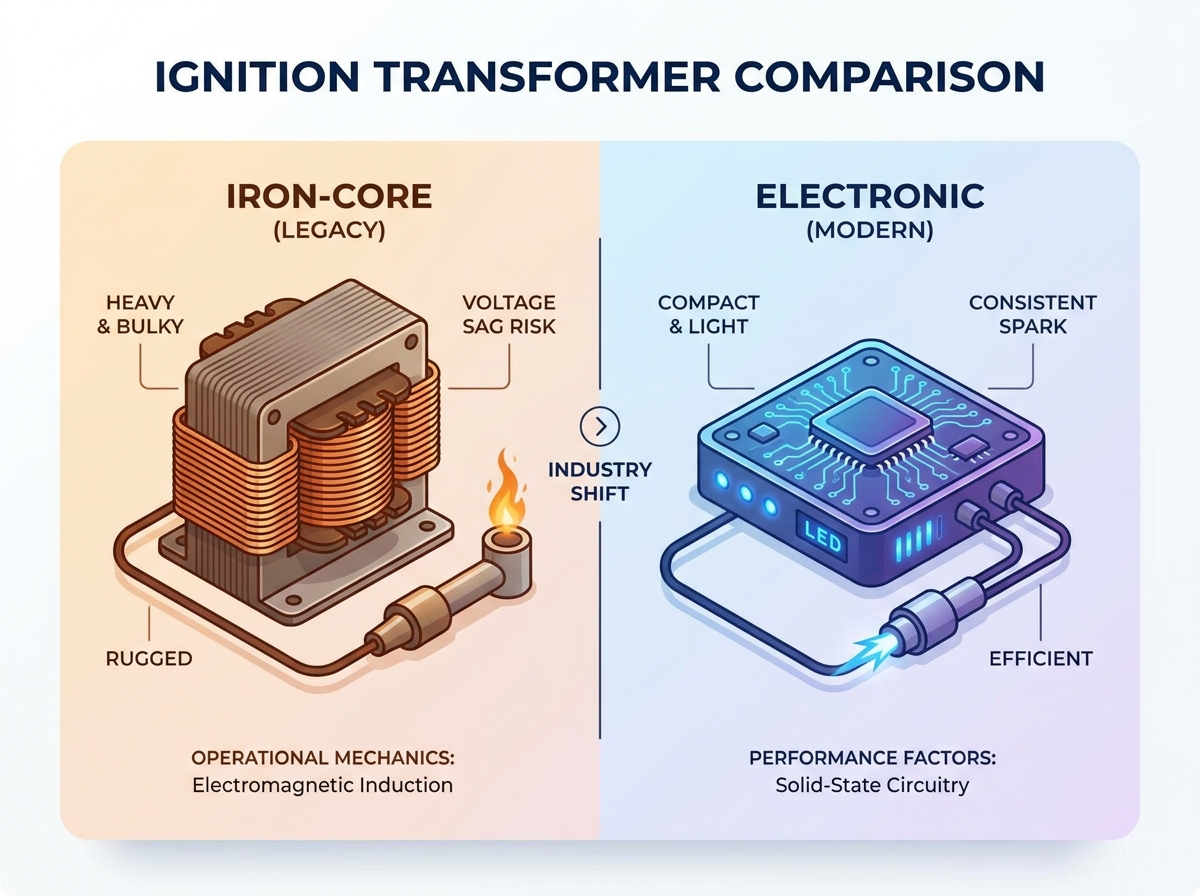
Start by examining the burner ignition system. We must look at the internal components to understand their operational differences. Both technologies share one primary goal. They must step up standard line voltage to create a high-voltage spark. This intense spark ignites the atomized fuel mixture. However, they achieve this goal using entirely different scientific principles. You must understand these principles to diagnose field issues properly.
Engineers consider these devices the traditional heavyweights of industrial ignition. They rely strictly on traditional electromagnetic induction. Inside the heavy steel casing, you will find primary and secondary copper coil windings. These copper windings wrap tightly around a massive, solid steel core.
This straightforward design has remained largely unchanged for several decades. The sheer physical mass of the copper and steel provides excellent thermal dissipation. The heavy metals absorb heat slowly. This characteristic prevents sudden catastrophic failures in hot boiler rooms.
Modern facilities often favor solid-state circuitry over heavy metals. An electronic ignition transformer functions very differently from its legacy counterpart. It utilizes internal solid-state inverters to alter the incoming electrical current.
Because they operate at these elevated frequencies, they require much smaller internal coils. This design choice drastically reduces the physical weight of the entire assembly. Many modern units also include built-in EMI and RFI shielding. This internal shielding protects sensitive burner controls from electromagnetic interference. It prevents the high-frequency waves from disrupting nearby microprocessors.
Choosing between these two technologies requires a detailed look at performance metrics. An accurate evaluation of an electronic vs iron core ignition transformer reveals distinct advantages for each setup. You must match the hardware to your facility's unique conditions.
Voltage stability heavily impacts spark quality during the ignition phase. Electronic models excel significantly in this specific area. They deliver a highly aggressive, reliable spark every single time. They maintain this powerful output even if the supply voltage drops by 10 to 15 percent. You should specify them for facilities experiencing dirty or fluctuating grid power.
Iron-core units operate quite differently under stress. Their output voltage directly correlates to the incoming input voltage. If your facility experiences a sudden voltage sag, the transformer produces a weak spark. This weakness can cause delayed ignition sequences. Delayed ignition often leads to dangerous puff-backs inside the main combustion chamber.
Physical footprints matter immensely during installation and routine maintenance. Electronic models are significantly smaller than legacy hardware. They weigh up to 70 percent less than traditional heavy options. This massive weight reduction decreases mechanical stress on fragile burner mounting plates. It also allows a single technician to perform complex installations effortlessly.
Conversely, iron-core models are inherently heavy and bulky. They demand robust, heavy-duty mounting hardware to prevent sagging. However, they provide a familiar, legacy footprint alignment. This footprint makes them highly convenient when replacing older units. You can often bolt them directly into the existing burner housing.
Boiler rooms present incredibly harsh operating environments for electrical gear. Iron-core units boast superior tolerance to extreme ambient temperatures. They also withstand heavy physical vibration much better than modern alternatives. The solid steel core simply absorbs the mechanical shock.
Electronic variants contain highly sensitive solid-state components. Ambient heat easily damages these fragile internal circuit boards. You must strictly adhere to the manufacturer's maximum temperature ratings. Failing to provide adequate cooling leads to catastrophic board failure. The microprocessors literally melt under sustained high heat.
Energy efficiency plays a crucial role in modern plant design. Solid-state units draw significantly less primary current from the grid. They often operate efficiently on under 0.5 amps. This extremely low draw drastically reduces the electrical strain on burner relays. It also extends the lifespan of your primary control modules.
Legacy iron-core models demand a much higher current draw. They routinely pull 2 to 3 amps or more during operation. You must ensure your switching components can handle this heavier electrical load continuously. Overloaded relays will fuse together and cause system failures.
| Feature Metric | Electronic Technology | Iron-Core Technology |
|---|---|---|
| Spark Consistency | Highly stable during voltage drops | Degrades during power sags |
| Weight and Size | Up to 70% lighter, highly compact | Very heavy, bulky, robust housing |
| Vibration Tolerance | Moderate to Low | Exceptionally High |
| Current Draw | Under 0.5 amps typically | 2.0 to 3.0 amps typically |
| Heat Sensitivity | High risk of solid-state board failure | Highly resilient to ambient heat |
Field engineers frequently complain about short lifespans for both technologies. We must apply evidence-oriented troubleshooting to identify the true root causes. Understanding failure modes helps you extend the life of your equipment.
When a solid-state unit fails prematurely, you must investigate these two primary culprits.
An iron-core transformer generally fails from long-term physical degradation rather than sudden glitches.
Improperly gapped electrodes force both transformer types to work significantly harder. If the spark gap becomes too wide, the electrical resistance increases dramatically. The transformer must generate significantly higher internal voltages just to jump the wider gap. This excessive internal strain accelerates insulation breakdown across all technologies. Always verify your electrode spacing carefully using a calibrated tool. Do not guess the gap distance visually.
Transitioning between different hardware technologies requires careful upfront planning. You cannot treat an industrial upgrade as a simple plug-and-play task. Several mechanical and electrical factors demand your strict attention.
Assess the physical footprint carefully before replacing a bulky legacy unit. A streamlined electronic model will look vastly different. The new unit will be substantially smaller and lighter. You will likely require custom adapter plates to secure it properly. Ensure the new mounting configuration securely fastens the lightweight unit. Loose mounting allows vibrations to shake the delicate internal boards apart.
Industrial codes strictly govern commercial combustion equipment. You must ensure the selected high voltage igniter meets all regional safety standards. Look specifically for UL, CSA, or CE certifications matching your industrial application. Using uncertified equipment voids facility insurance policies instantly. It also creates severe safety hazards for your boiler operators. Always verify the stamp of approval on the chassis plate.
We cannot overstate the critical importance of proper electrical grounding. Electronic variants require a dedicated, low-resistance earth ground to function safely. This strict necessity bleeds off dangerous secondary leakage safely. It also protects your expensive primary control boards from electrical feedback spikes. Use heavy-gauge grounding straps for the installation. Secure them strictly to bare, unpainted metal on the main burner chassis. Paint acts as an insulator and ruins the ground path.
Choosing the correct ignition hardware directly impacts your operational uptime. You must align the technology perfectly to your specific environmental realities. Making the wrong choice guarantees frustrating burner lockouts and constant replacements.
We strongly recommend shortlisting an iron-core unit under specific harsh conditions. Use them if your application involves continuous high ambient temperatures. They also excel in heavy vibration scenarios. They perform reliably in older legacy systems where electrical grounding remains questionable or inconsistent.
Conversely, you should specify an electronic ignition transformer for most modern setups. They provide incredibly consistent sparks under poor facility power conditions. They easily fit into tight, constrained mounting spaces on modern burners. They also serve perfectly when reducing control relay electrical load remains a top priority.
Next steps require careful evaluation of your current boiler room. Always consult your specific burner OEM specifications first. Evaluate your ambient operating conditions thoroughly before finalizing any procurement decisions. Proper planning ensures you secure reliable, long-lasting hardware for your facility.
A: Yes, but it requires careful modifications. You cannot simply swap them out due to vast physical mounting differences. You will likely need an adapter plate. Additionally, you must match the output voltage specifications exactly. Most importantly, you must establish a dedicated, low-resistance earth ground. Electronic units will fail rapidly without proper electrical grounding.
A: The most common culprit is poor electrical grounding. Without a solid ground, high-frequency energy feeds back into the circuitry and destroys it. Excessive ambient heat also melts sensitive internal boards. Finally, incorrect electrode gapping forces the unit to generate higher internal voltages, causing rapid internal insulation failure.
A: Yes, they often do. Solid-state units produce high-frequency electrical currents. You need high-quality, properly insulated cables designed specifically for high-frequency applications. Standard legacy cables may degrade quickly or leak electromagnetic interference. This interference can disrupt your primary burner control modules.
A: Duty cycles fall into intermittent or continuous categories. Intermittent units operate only during the brief startup sequence. Continuous units run the entire time the burner fires. Exceeding an intermittent unit's run time overheats the internal coils. This overheating rapidly destroys the internal insulation and ruins the transformer completely.