lucy@zlwyindustry.com
+86-158-1688-2025
Please Choose Your Language
- All
- Product Name
- Product Keyword
- Product Model
- Product Summary
- Product Description
- Multi Field Search

Views: 0 Author: Site Editor Publish Time: 2026-08-05 Origin: Site


Confusing a basic functional response with true measurement accuracy remains a critical operational risk. Operators frequently assume a loudly beeping monitor guarantees perfect environmental measurement. They grab their equipment, hear a startup tone, and step straight into potentially deadly hazardous zones. Industrial safety realities tell a completely different story. Facilities constantly battle tight maintenance budgets and manage time-poor operators. At the same time, safety managers must satisfy stringent safety guidelines and strict compliance mandates from regulatory bodies. Missing the subtle difference between these maintenance checks puts frontline lives on the line daily. This definitive guide breaks down exactly what a gas detector bump test vs calibration actually proves in the field. You will discover the hidden dangers of treating these distinct procedures as interchangeable tasks. We will also explore how to build a highly reliable, bulletproof routine to protect your workforce.
Safety managers often view daily equipment checks as a singular compliance box to check off. This narrow mindset leads to improper testing frequencies and poorly allocated safety resources. A clear distinction exists between simple sensor verification and true accuracy correction. Understanding this difference forms the foundation of any reliable hazard prevention program.
A basic check delivers entirely qualitative results. It confirms the physical pathways remain clear of obstructions. Mud, thick dust, or water will not block the sensor face. This quick test validates that the audible, visual, and vibrating alarms activate aggressively under direct exposure. It simply proves the device wakes up and can alert the user.
Conversely, a full adjustment delivers quantitative facts. It measures the exact degree of sensor degradation, which experts commonly call "drift." This thorough diagnostic proves the device can accurately quantify the precise amount of hazardous gas present in the atmosphere.
Treating these two processes interchangeably creates immense danger for field operators. A detector can easily pass a functional check because it detects a small fraction of gas. However, it might remain dangerously out of alignment internally. The digital screen might display a safe 10ppm while the actual atmospheric environment sits at a lethal 50ppm. Relying on an uncalibrated device provides a false sense of security.
| Test Type | Primary Purpose | Measurement Value | Result Output |
|---|---|---|---|
| Bump Test | Verify pathway and alarms | Qualitative (Pass/Fail) | Alarms trigger successfully |
| Calibration | Correct sensor drift | Quantitative (Exact Data) | Accurate ppm/LEL readings |
Best Practices: Always separate your qualitative checks from your quantitative adjustments in your standard operating procedures. Train workers to understand what the alarms actually mean.
Common Mistakes: Assuming a successful startup self-test replaces a physical gas exposure check.
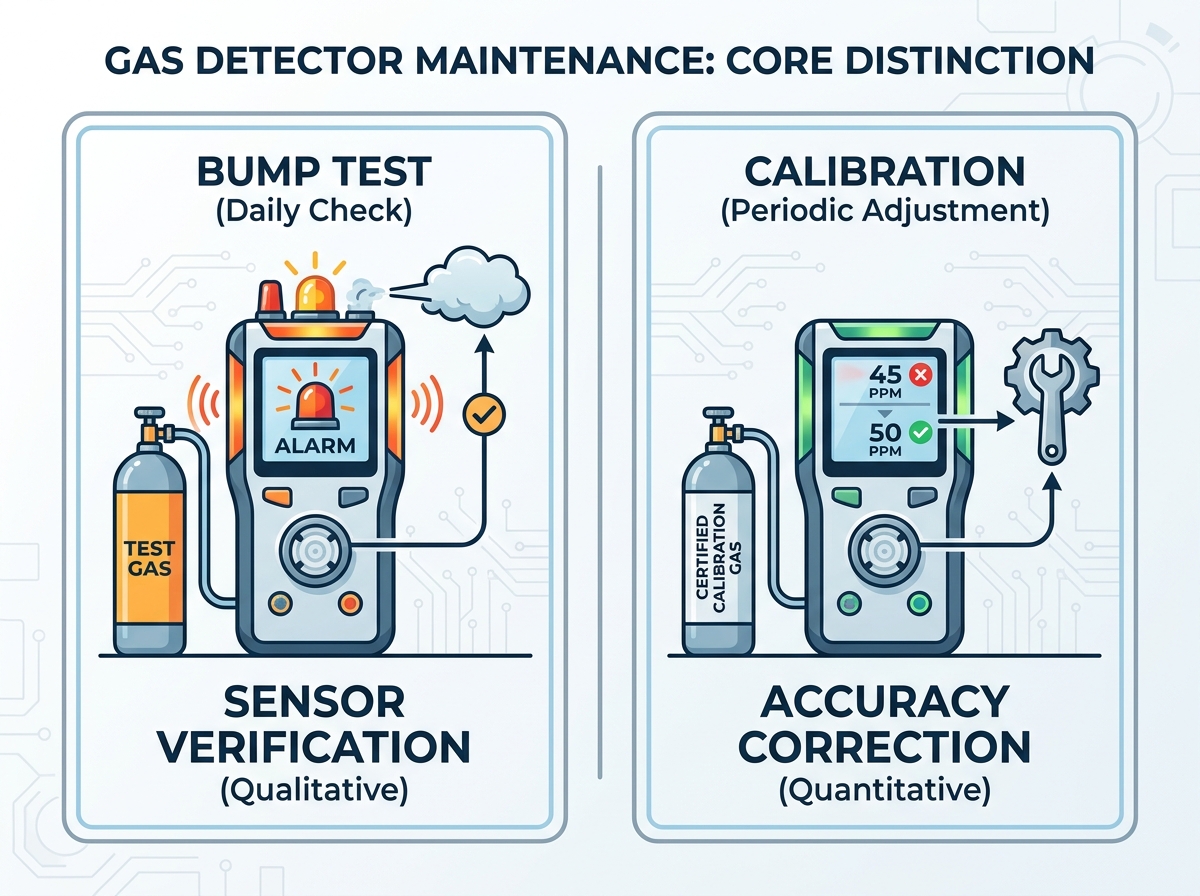
Field implementation demands strict daily habits from every team member. A proper gas detector bump test must function as a non-negotiable, pre-use routine. You should view it as a quick-pass survival check rather than a deep technical diagnostic. OSHA strongly advises performing this check before every single shift.
The physical procedure requires minimal time and effort. You briefly expose the portable unit to a known, certified gas concentration. You apply the gas just long enough to trigger the lowest alarm setpoint on the device.
Evaluating the result happens in seconds. You must follow strict protocols based on the outcome:
Resource management also plays a crucial role here. This quick functional check uses a very small fraction of your cylinder compared to a full adjustment. Operators save valuable chemical supplies while confirming the device will alert them to immediate danger.
Common Mistakes: Exposing the monitor to too much gas for too long. This wastes expensive supplies and artificially saturates the sensors.
Sensors degrade naturally over time due to harsh environmental realities. Extreme temperatures and high humidity silently alter the sensitive internal components. Exposure to common industrial poisons like silicone, cleaning solvents, or high-concentration gases accelerates this degradation rapidly. Even physical drops alter the fragile internal alignments.
To fix this invisible drift, technicians must perform a comprehensive gas detector calibration. This highly controlled procedure involves two distinct, critical steps:
Frequency guidelines depend heavily on daily usage and specific manufacturer specs. Industry experts often cite a standard 30-day recommendation for full adjustments. However, you must remember a crucial rule. A failed daily verification automatically triggers a mandatory realign, regardless of the official maintenance schedule.
Best Practices: Never perform a zero adjustment in a potentially contaminated area. Even small amounts of background exhaust will skew the baseline and ruin the device's accuracy for the entire shift.
Regulatory bodies take atmospheric monitoring extremely seriously. The Occupational Safety and Health Administration (OSHA) issues very specific safety recommendations regarding direct-reading portable monitors. They emphasize rigorous verification protocols to prevent fatal confined space accidents.
Safety teams must clearly understand the operational hierarchy of rules. You should prioritize local or state regulations first, as they often carry stricter mandates. Next, you must strictly follow the explicit manufacturer specifications for your specific device model. Finally, you apply general OSHA safety guidelines to fill any remaining procedural gaps.
Audit preparedness separates proactive safety cultures from reactive ones. You need robust digital or physical logs backing up every device. During an incident investigation, state auditors look for hard proof of maintenance. Legally speaking, undocumented tests are treated identically to tests that never happened.
The cost of non-compliance extends far beyond standard agency fines. Catastrophic legal liability arises when unverified equipment fails during a toxic chemical leak. Worker safety plummets when frontline teams blindly trust inaccurate monitors. Maintaining crystal-clear maintenance records shields the company and protects the vital workforce.
Transitioning from theoretical safety rules to reliable daily practice requires highly efficient systems. Proper gas monitor maintenance takes considerable time, and industrial fleets scale upward quickly.
Relying entirely on manual testing presents distinct operational limitations for growing safety programs. It incurs exceptionally high labor costs because skilled technicians spend hours applying gas by hand. It remains highly prone to human error, especially regarding inconsistent application times. Manual processes routinely waste expensive test cylinders and make centralizing compliance logs exceptionally difficult.
Automated docking stations offer a massive operational advantage for decision-stage criteria.
For shortlisting logic, facilities managing fleets of five or more monitors should aggressively transition to automated docks. This upgrade guarantees strict logging compliance and eliminates the daily friction of manual upkeep.
Proper atmospheric testing requires a balanced, dual approach. Functional checks and accurate internal adjustments act as two essential halves of a complete safety strategy. One simple procedure ensures the device is awake, while the other complex adjustment ensures it tells the absolute truth about the environment.
Take immediate action to audit your current testing frequency protocols. Evaluate exactly how your management team logs these vital compliance records. Identify any operational gaps where manual processes might introduce critical human errors.
Explore automated docking stations to streamline your daily safety routines. Contact a dedicated industrial safety specialist to thoroughly assess your specific fleet needs. Upgrading your protective infrastructure today ensures your team returns home safely tomorrow.
A: No. A bump test only verifies that gas reaches the sensors and the alarms trigger successfully. It cannot correct internal sensor drift or guarantee measurement accuracy.
A: Remove it from active service immediately. You must perform a full accuracy adjustment on the unit. If the device fails the subsequent calibration, you must replace the sensor or the entire unit.
A: OSHA formally recommends conducting a functional bump test before each day's use, immediately prior to entering any potentially hazardous or confined environment.
A: Yes. Reactive calibration gases degrade naturally over time. Using expired gas for sensor verification or adjustment provides false readings, compromises worker safety, and completely voids compliance logs.