lucy@zlwyindustry.com
+86-158-1688-2025
Please Choose Your Language
- All
- Product Name
- Product Keyword
- Product Model
- Product Summary
- Product Description
- Multi Field Search

Views: 0 Author: Site Editor Publish Time: 2026-08-16 Origin: Site


Treating LPG and natural gas as interchangeable fuels presents a critical engineering challenge. Many technicians mistakenly swap control equipment between these different systems. This simple error often leads to total system failure, severe equipment damage, or extreme safety hazards. The stakes for your facility are undeniably high. Selecting an incorrect valve immediately impacts process efficiency and regulatory compliance. It also drastically increases bottom-line operational costs.
To prevent these catastrophic failures, system designers must understand the distinct fluid dynamics of each fuel type. This article provides a comprehensive technical evaluation framework. You will learn how to specify the correct control equipment based on exact fluid properties and proven sizing formulas. We will explore mechanical design variations, practical implementation realities, and critical safety codes. By applying these engineering principles, you can confidently build robust gas systems.
Fuel properties fundamentally alter how control equipment functions. You cannot evaluate these systems without looking at specific gravity. Natural gas is naturally lighter than air. It typically carries a specific gravity rating of approximately 0.60. LPG behaves very differently because it is a heavier molecule. Its specific gravity usually hovers around 1.50. This variance in gas density directly dictates how molecules pass through an orifice. A heavier vapor flows more sluggishly through a restricted opening. Manufacturers must account for this drag when rating valve capacities.
Energy density adds another layer of complexity to the selection process. These two fuels carry vastly different thermal payloads. LPG contains approximately 2,500 BTU per cubic foot. In contrast, natural gas provides only about 1,000 BTU per cubic foot. This thermal disparity changes the required volumetric flow entirely. You need a much lower volume of LPG to achieve your target heating load.
This implementation impact changes physical hardware requirements. Because of the concentrated energy, a standard propane regulator handles smaller vapor volumes to deliver equivalent thermal output. You simply do not need massive flow passages for high-BTU fuels. Selecting hardware based on natural gas volume assumptions will lead to erratic behavior in an LPG setup. Engineers must always calculate the actual flow required by the specific appliance. You must align the valve size precisely with the fuel's specific energy profile.
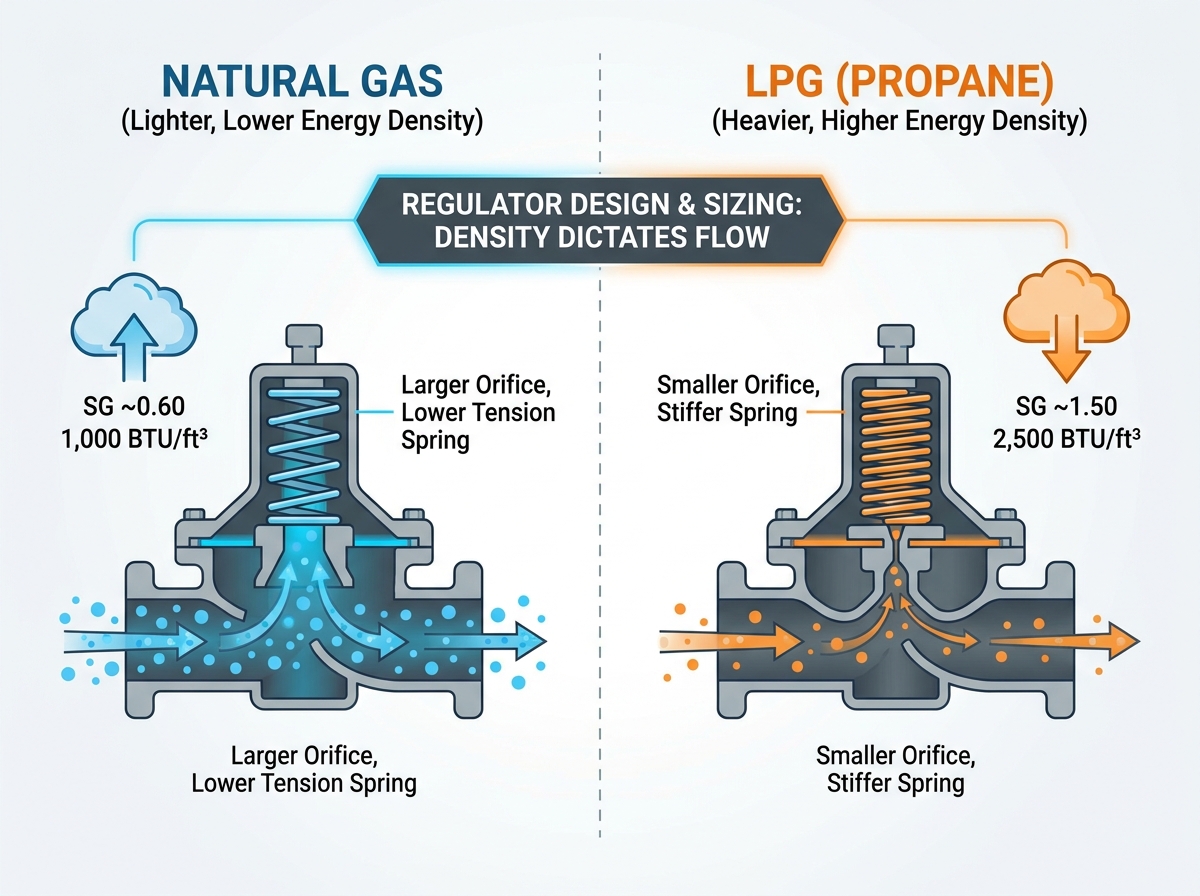
Evaluating an LPG vs natural gas pressure regulator requires a close look at internal architecture. Orifice sizing strategies vary significantly between the two fuel types. High energy density and elevated tank pressures mean LPG units utilize noticeably smaller internal orifices. If you use a large orifice designed for utility gas on an LPG tank, the valve will struggle. It will let too much fuel pass too quickly. This causes poor control resolution during low-demand cycles.
Spring tension variations are equally critical for safe operation. LPG systems typically draw directly from high-pressure storage tanks. The initial stage might see pressures exceeding 150 PSI during warm weather. To step this immense force down safely, these units require exceptionally stiff control springs. They also feature robust, reinforced diaphragm materials. Utility-supplied natural gas operates in a different universe. It usually arrives at the commercial meter at mere fractions of a PSI. Natural gas hardware uses highly sensitive, flexible springs to manage these delicate utility pressures. Swapping these springs yields dangerous results.
Material compatibility cannot be ignored during the specification phase. Commercial-grade LPG contains different chemical impurities compared to pipeline natural gas. Manufacturers engineer internal components to resist specific chemical degradation. They carefully select elastomeric materials for diaphragms, internal O-rings, and seat discs. A component designed for clean pipeline vapor might swell or crack when exposed to raw tank vapors. You must verify elastomer compatibility before installing any valve in a harsh industrial environment.
Precision sizing prevents operational nightmares. You must ditch guesswork and rely on hard math. Engineering the right capacity requires standardizing your baseline sizing formula. Do not attempt to specify a unit without gathering specific data points first.
Here are the mandatory inputs you need for accurate sizing calculations:
Once you gather these metrics, you must factor in droop. Droop is also known as the proportional band. It represents the inevitable drop in outlet pressure as flow demand surges. A perfect flatline pressure curve does not exist in mechanical systems. You must evaluate how much pressure drop your appliance can tolerate before its performance suffers. High-demand surges must never starve the downstream burner.
Engineers must actively avoid the "pipe size" fallacy. Never specify a natural gas regulator based purely on the existing pipe diameter. A two-inch supply pipe does not automatically require a two-inch control valve. Matching pipe size often leads to severe oversizing. A properly engineered LPG pressure reducing valve might be significantly smaller than the surrounding piping network. Basing decisions on pipe geometry creates operational instability and wastes capital budget.
Industrial applications demand strict adherence to advanced evaluation criteria. Standard residential guidelines fall short in heavy-duty environments. Overpressure protection (OPD) is a primary concern. You must evaluate whether your system requires built-in relief mechanisms or external relief components. Local safety codes heavily dictate this choice. Large-scale commercial setups often mandate external relief lines piped safely outdoors. Smaller, localized systems might legally operate using internal, limited-capacity relief vents.
Turndown ratio requirements define operational flexibility. You must assess how well the hardware maintains a steady outlet pressure across varying demand states. A boiler system might have a tiny pilot light but a massive main ignition burner. The selected control equipment must handle both tiny trickles and massive surges smoothly. High turndown ratios indicate a highly versatile, stable valve design.
Facility managers frequently encounter dual-gas or convertible models. You must objectively assess their viability before deployment. Convertible models make sense in residential or light commercial settings. They allow quick field adaptations when a building switches utility providers. However, heavy industrial applications require dedicated, single-gas engineering. Convertible models introduce unnecessary failure points in high-volume, critical process environments.
The following chart illustrates typical comparative criteria for sizing evaluation:
| Evaluation Parameter | Natural Gas Baseline | LPG Baseline |
|---|---|---|
| Typical Specific Gravity | 0.60 | 1.50 |
| Standard Inlet Pressure Source | Utility pipeline (low/medium) | Storage tank (high) |
| Relative Orifice Size | Larger | Smaller |
| Relief Venting Focus | Indoor atmospheric venting | Strict outdoor piping required |
Poor specification leads directly to severe implementation risks. The danger of oversizing remains the most common field error. An oversized valve suffers from a phenomenon known as "hunting." This occurs when a massive orifice tries to regulate a tiny flow rate. The valve seat rapidly slams shut and bounces open repeatedly. This chattering destroys internal elastomers quickly. It also sends pulsating pressure waves into the burner, causing flame instability and soot accumulation.
Freeze-ups present a unique physical risk for high-pressure systems. Rapid expansion of compressed vapor absorbs massive amounts of heat. This thermodynamic reality causes severe frosting or internal freezing. You mitigate this specific danger through staged regulation. Two-stage regulation breaks the massive pressure drop into smaller, manageable steps. This prevents the hardware from freezing solid during heavy winter usage.
You cannot ignore strict venting and compliance standards. Proper vent piping is legally mandatory for indoor installations. If a diaphragm ruptures, the escaping vapor must exit the building safely. You must ensure total compliance with established industry standards like NFPA 54. Only install equipment carrying verified UL or CSA certifications. Cutting corners on compliance exposes your facility to massive liability risks. It also guarantees failure during routine safety audits. Always prioritize certified hardware and code-compliant installation methods.
Relying on guesswork compromises facility safety and process efficiency. You must gather precise operational metrics before purchasing control hardware. We highly encourage system designers to utilize technical calculators to verify their mathematical assumptions. Alternatively, consult with a certified gas control specialist before finalizing any procurement decisions. If you are currently upgrading an industrial burner system, request a comprehensive technical review of your facility specifications today. Explore our full catalog of certified, code-compliant control equipment to guarantee reliable long-term performance.
A: No, unless it is specifically designed, dual-rated, and properly converted by a qualified technician using the manufacturer's approved spring/orifice kit. Using an unconverted NG regulator for LPG causes severe overpressurization and fire hazards.
A: Flow capacity decreases as gas density increases. Manufacturers typically publish capacity charts based on natural gas (0.6 SG); these figures must be multiplied by a conversion factor (usually around 0.63) to find the accurate capacity for LPG.
A: Oversizing leads to poor control at low flow rates, causing "hunting" (rapid opening and closing), premature wear on internal components, and unstable burner flames.
A: LPG is stored as a high-pressure liquid. Two-stage regulation (stepping down tank pressure to an intermediate pressure, then to appliance pressure) prevents regulator freeze-up and provides a smoother, more consistent flow compared to a single massive pressure drop.