lucy@zlwyindustry.com
+86-158-1688-2025
Please Choose Your Language
- All
- Product Name
- Product Keyword
- Product Model
- Product Summary
- Product Description
- Multi Field Search

Views: 0 Author: Site Editor Publish Time: 2026-07-31 Origin: Site


In industrial boilers and commercial HVAC, the precision of your air-to-fuel ratio dictates both fuel expenditure and emissions compliance. Even minor fluctuations compromise overall system efficiency rapidly. Facility engineers often face a critical specification choice when upgrading burner management systems. They must choose between relying on standard positioning devices or investing in high-precision feedback loops. The right choice prevents excessive energy waste and ensures long-term operational stability. Understanding the technical gap between a servo motor vs damper actuator prevents costly over-engineering. It also ensures critical combustion processes meet stringent safety and efficiency standards.
Fuel Efficiency and Operational Costs remain top priorities for plant managers. Small drifts in the air-to-fuel ratio lead to unburned fuel. Sometimes, excessive heat simply escapes out the stack. Both scenarios waste valuable energy resources. Inefficient burns directly inflate monthly operating expenses. Facility managers often fail to notice this drift until the monthly fuel bill arrives. Precise combustion control is essential for optimizing boiler efficiency and minimizing daily fuel waste.
Emissions Compliance represents another major operational challenge. Strict NOx and CO regulations require tightly controlled combustion environments. Modern environmental standards are unforgiving of mechanical hysteresis. Slop in physical linkages causes immediate compliance failures. Regulatory bodies heavily fine facilities failing emissions tests. You must maintain strict air-fuel synchronization to meet ultra-low NOx targets. Accurate air modulation keeps harmful stack emissions within legally permitted limits.
Safety and Reliability cannot be compromised in industrial settings. Unstable airflow can lead to severe flame instability. It causes dangerous soot buildup inside the combustion chamber. These conditions create potentially hazardous explosive environments. Reliable mechanisms prevent catastrophic boiler misfires and dangerous puff-backs. Industry safety standards like NFPA 85 demand highly responsive air delivery mechanisms. Plant safety relies entirely on predictable and precise air intake matching.
Mechanism: It utilizes an internal encoder or potentiometer. This component provides constant position feedback to the burner management system (BMS). The controller knows the exact mechanical position instantly. This closed-loop communication enables constant micro-adjustments during operation. Advanced optical encoders offer extreme accuracy for demanding industrial applications. The constant communication loop prevents positional drift completely.
Key Traits: Engineers value their high resolution and step-less modulation. Direct-coupled designs eliminate mechanical play entirely. They offer rapid response to variable load demands. You achieve pinpoint accuracy across the entire boiler firing range. This ensures the air damper opens to the exact millimeter required. These traits make them indispensable for modern high-efficiency boiler retrofits.
Primary Use Case: They control the exact position of fuel valves and air dampers. You see them heavily utilized in fully modulating burner servo motor applications. They map complex air-fuel curves perfectly. Facilities upgrading to parallel positioning systems rely almost exclusively on these advanced motors.
Mechanism: Simple 2-position or floating signals drive these robust devices. Some utilize basic 0-10V or 4-20mA proportional signals. They often operate without continuous micro-positioning feedback. The open-loop design relies on basic command signals sent from a central controller. Once commanded to open, they move until hitting a physical limit switch.
Key Traits: They provide extremely high torque output. You get robust construction suited perfectly for large heavy louvers. Response times are generally slower compared to servos. Many utilize mechanical spring-return fail-safes for critical power-loss scenarios. They push through high static pressure effortlessly. Their heavy-duty gearboxes handle substantial physical resistance over decades of continuous use.
Primary Use Case: Facilities use a standard damper actuator for general draft control. They manage makeup air intakes and exhaust flues efficiently. Exact millimeter precision is secondary to reliable opening and closing. You specify them when bulk air movement takes precedence over finite modulation.
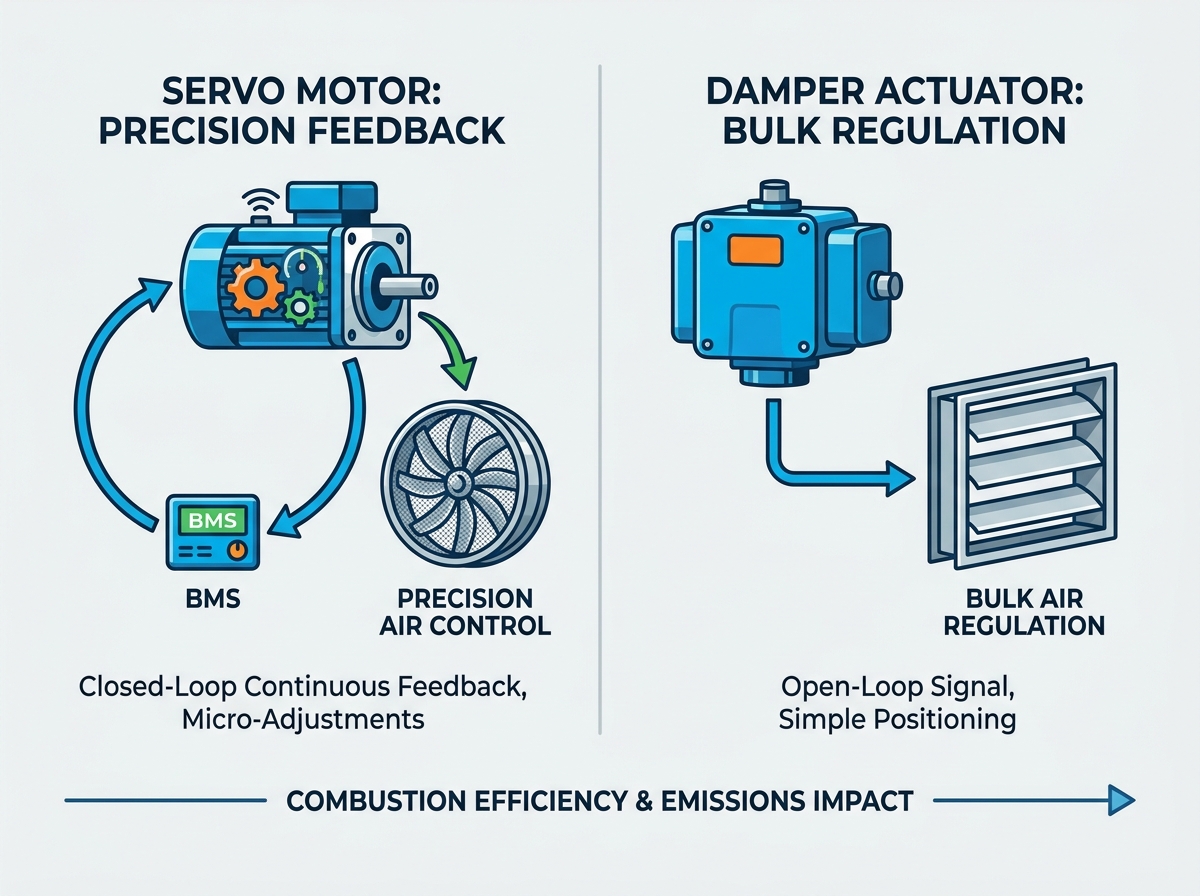
Servo: Closed-loop communication ensures physical positions perfectly match commanded signals. The BMS constantly verifies the exact rotation angle mathematically. Outcome: You maximize fuel efficiency and maintain incredibly stable O2 trim. Modulating burners depend entirely on this exact alignment. It prevents burner hunting during rapid facility load changes. This precision guarantees a perfect burn profile continuously.
Damper Actuator: Open-loop or basic proportional control has distinct limitations. The mechanical mechanism is susceptible to drift over time. Friction and physical wear degrade positioning accuracy gradually. Outcome: They are completely sufficient for basic draft balance. However, they risk substantial fuel waste in precise burner applications. You cannot rely on them for micro-stepping adjustments.
Servo: The engineering prioritizes speed and exact repeatability above all else. Zero-hysteresis guarantees the device returns to exact setpoints always. Direct shaft coupling often eliminates error-prone linkages entirely. They react instantly to BMS trim adjustments. Speed ensures the air intake matches fuel flow perfectly during rapid firing changes.
Damper Actuator: The internal design prioritizes brute high torque delivery. Moving heavy, multi-blade dampers requires substantial physical force. The motor pushes effectively against high static pressure inside massive air ducts. Speed is willingly sacrificed to maximize turning power. Minor hysteresis remains completely acceptable for bulk air movement tasks.
Integration Needs: You must carefully sync the air control mechanism. It coordinates directly with the gas or oil valve actuator. Servos allow for parallel positioning systems known widely as electronic camming. This independently maps complex air and fuel curves digitally. Standard actuators often rely on single-point positioning via mechanical linkages. Jackshafts physically link the air and fuel components together rigidly.
Assessment: Standard actuators have a significantly lower upfront cost. They are also much cheaper to replace upon failure. Servos require higher initial capital investments and compatible BMS controllers. However, they pay for themselves quickly. High-capacity boilers easily see substantial fuel savings annually. Efficiency gains offset the initial capital expenditure rapidly. Financial returns depend heavily on your specific boiler size and operational runtime.
Wiring and Signal Integrity represent major installation challenges for technicians. Servos require specialized shielded cables and precise grounding techniques. You must prevent electromagnetic interference (EMI) effectively. EMI easily disrupts delicate feedback signals traversing the wire. Improper shielding causes erratic motor hunting and sudden system lockouts. Installers must strictly route communication cables away from high-voltage power lines.
Environmental Durability requires careful site assessment before procurement. Burner environments feature extreme heat and constant vibration. You must verify the IP rating and thermal limits carefully. Standard ruggedized damper actuators sometimes outlast commercial-grade servos. Extreme ambient heat damages unshielded electronics quickly. Consider dedicated heat shields for devices mounted directly on hot burner faces.
Retrofit Complexity demands thorough project planning and extended downtime. Upgrading from mechanical linkages to servo-driven parallel positioning is difficult. It requires a complete BMS software overhaul. Technicians must re-commission the entire combustion curve manually. Every single firing point requires manual verification and rigorous gas analysis. This complex process demands highly specialized combustion technicians.
Choosing the correct component determines your long-term system reliability. You must align component capabilities perfectly with process demands. Overspecifying increases project costs unnecessarily. Underspecifying leads to massive efficiency losses and compliance failures. Assess your exact operational needs before making a final purchasing decision.
Specify a Burner Servo Motor when:
Specify a Damper Actuator when:
Component Selection Chart
| Feature | Servo Motor | Damper Actuator |
|---|---|---|
| Control Type | Closed-loop, continuous feedback | Open-loop, 2-position or floating |
| Positioning Accuracy | Extremely high (sub-millimeter precision) | Moderate (bulk air positioning) |
| Primary Application | Air/Fuel ratio, modulating burners | Draft control, makeup air, louvers |
| Linkage Requirements | Often direct-coupled (linkage-less designs) | Mechanical jackshafts and physical arms |
| Initial Capital Cost | High | Low to Moderate |
| Speed of Response | Fast and dynamically adjustable | Slower, fixed torque prioritization |
Next Steps: Audit your current burner management controller carefully. You must verify full compatibility with digital servo communication protocols before procurement. Engage a qualified combustion engineer to assess your mechanical linkages. Determine if parallel positioning justifies the required retrofit investment.
The choice between a servo motor and a standard damper actuator comes down to the required resolution of your combustion curve. Precision matters immensely for fuel efficiency and strict emissions compliance. Open-loop systems suffice perfectly for general draft management and bulk air handling. However, modern environmental standards push facilities heavily toward highly accurate closed-loop control.
Do not over-engineer bulk air intakes unnecessarily. Standard high-torque actuators handle heavy louvers perfectly well. Never compromise on the exact precision of primary combustion air. Transitioning to servo-driven parallel positioning is the industry standard for modernizing boiler efficiency. Evaluate your current mechanical linkages today to discover massive potential fuel savings.
A: No. Fuel delivery requires specialized valve actuators built for explosive environments and precise flow characterization. They are often integrated with advanced servo technology for safety shut-off compliance. Standard draft actuators lack the speed and hazardous-location approvals required for handling combustible gases safely.
A: While some offer spring-return mechanisms, many burner servos rely on electronic fail-safes and capacitors. This requires the BMS to rapidly detect signal loss and trigger an immediate system shutdown. Electronic fail-safes prevent mechanical wear and ensure predictable failure modes during sudden power losses.
A: Re-calibrate them typically during annual boiler tune-ups. Unlike mechanical linkages that wear and slip constantly, electronic servos hold their calibration much longer. However, regular sensor verification is strictly required for overall safety compliance. Annual emission checks ensure the electronic camming maps remain highly accurate over time.