lucy@zlwyindustry.com
+86-158-1688-2025
Please Choose Your Language
- All
- Product Name
- Product Keyword
- Product Model
- Product Summary
- Product Description
- Multi Field Search

Views: 0 Author: Site Editor Publish Time: 2026-08-06 Origin: Site


Choosing the correct piping layout for your heating equipment goes far beyond a simple technical preference. It is a critical engineering decision. This choice directly impacts boiler reliability, fuel unit lifespan, and strict environmental compliance. Upgrading or replacing existing fuel equipment requires you to perfectly match the plumbing configuration to your tank location. You must also account for specific fuel delivery demands. A mismatch often causes continuous burner lockouts. Worse, it can lead to disastrous environmental leaks. This article breaks down the complex single pipe vs two pipe burner oil pump decision. We evaluate mechanical performance and assess hidden installation risks. We also explore modern industry-standard alternatives designed to simplify retrofits. You will learn exactly how to align your specific site constraints with the optimal plumbing strategy. This ensures you maximize safety, meet local codes, and maintain peak combustion efficiency year-round.
We must establish fundamental mechanical differences before discussing site constraints. You do not need a degree in fluid dynamics to understand these concepts. The setup you choose simply dictates how liquid fuel moves from the storage vessel into the combustion chamber.
A single-pipe oil burner system represents the simplest configuration available. It uses only one supply line. This line routes fuel from the tank directly to the fuel unit on the burner. This setup relies heavily on gravity to feed the liquid forward. It functions best under very low lift conditions or minimal vacuum requirements. Mechanics prefer this layout for its sheer simplicity and minimal parts count.
Limitation: This method cannot automatically vent trapped air. If a tiny air bubble enters the line, it disrupts the suction. The system will lock out. You must bleed the trapped air manually using a wrench to restore proper operation. This manual intervention becomes frustrating if micro-leaks exist in the filter housing.
A traditional dual-line configuration utilizes both a main supply line and a dedicated return line routing back to the tank. The internal gear set moves significantly more fluid than the combustion chamber actually consumes. The unit continuously pushes the excess fluid back to the storage vessel. It pushes any trapped air back alongside the excess fluid.
Advantage: This continuous loop creates a powerful self-priming capability. It offers a much higher suction threshold for demanding setups. You rarely need to bleed these units manually. They clear air bubbles automatically during the pre-purge cycle. This makes them highly reliable for deep tanks.
Selecting the correct plumbing arrangement requires a careful assessment of your physical layout. What works perfectly for a residential basement might fail entirely in a commercial high-lift scenario. You must evaluate these three specific criteria.
Assess the vertical distance and horizontal run carefully. Fluid dynamics dictate how hard the gear set must work to pull liquid. If the tank is buried underground, you face a high lift requirement. If it sits significantly below the burner, a two-pipe oil system is traditionally mandated. The continuous loop prevents vacuum loss over long, uphill pulls. It prevents fuel column separation. Conversely, if your tank sits at basement-level, a single line is sufficient. If an outdoor tank is physically higher than the burner, gravity does the heavy lifting for you.
We must discuss the primary risk associated with older dual-line configurations. Buried metal lines inevitably corrode over decades. If an underground return pipe corrodes, it leaks. Because the unit circulates far more fuel than it burns, a compromised line pumps unburned fuel directly into the soil. It does this continuously while the motor runs. Homeowners and facility managers face massive environmental cleanup fines when this happens. Many local building codes now heavily restrict buried return lines. Strict EPA guidelines often ban new installations of buried loops to prevent these hidden environmental disasters.
Cold weather dramatically changes liquid viscosity. Thick fluid strains the internal gear mechanisms. Continuous circulation in a dual-line layout actively helps warm the fluid stored in outdoor tanks. The friction from moving the liquid generates mild heat. This constant movement prevents fuel gelling during extreme cold weather snaps. However, the industry has evolved. Modern chemical additives and kerosene blends largely mitigate this gelling risk for single-line setups today. You no longer strictly need a dual loop just for winter weather protection.
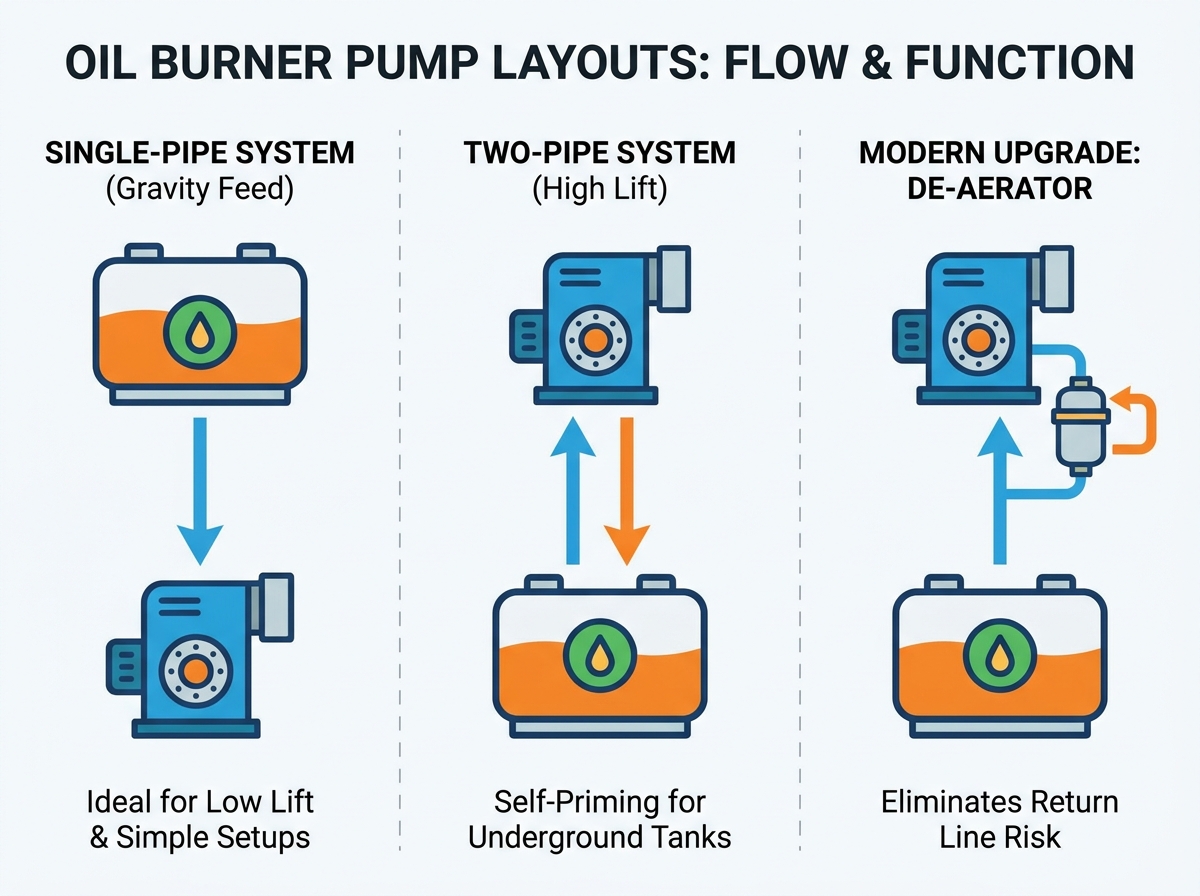
Industry professionals recognized the severe environmental risks of buried return pipes. They needed a solution offering dual-line performance without the soil contamination liabilities. They developed a highly effective hybrid workaround. This option bridges the mechanical gap between traditional single and dual-line layouts.
A fuel de-aerator mounts directly next to the burner assembly. Tigerloop is the most recognized brand, though others exist. The device takes a single supply line coming from the tank. However, it acts as a dual-pipe loop directly at the burner itself. It features an internal float chamber. It creates a localized, continuous circulation cycle right at the heating equipment.
Technicians overwhelmingly favor this setup for retrofits and safety upgrades. Here is why it became the modern industry standard:
Field errors during installation often destroy brand-new equipment in seconds. Mechanics must understand internal routing to prevent catastrophic failures on the job site. You cannot assume a unit is ready for your specific pipe layout straight out of the box.
You must verify internal fluid routing before turning on the power. When setting up a dual-line system, you absolutely must install the oil pump bypass plug. Manufacturers usually tape this tiny set screw to the unit or place it in a small plastic bag. Inserting this screw internally blocks a specific channel. It forces excess fluid to divert out of the return port.
The Fatal Error: Technicians sometimes leave this tiny screw installed during a single-line installation. Disaster strikes instantly. The gear set builds massive internal hydraulic pressure. It has absolutely nowhere to send the excess fluid. The pressure will immediately blow the main shaft seal. It sprays fluid everywhere and destroys the brand-new unit instantly.
Industry terminology often confuses new technicians. We need to clearly separate "Single-stage vs. Two-stage" from "Single-pipe vs. Two-pipe." These are entirely different concepts.
You can pipe a single-stage model as a one- or two-pipe system. You can do the exact same configuration with a two-stage model. They are completely independent variables. Match the stages to the lift requirement, and match the pipes to the environmental safety plan.
| System Layout | Air Handling Strategy | Vacuum Lift Capability | Environmental Risk Level | Best Application Scenario |
|---|---|---|---|---|
| Single-Pipe | Manual bleeding required | Low (Gravity feed works best) | Very Low | Above-ground, higher-elevation tanks |
| Two-Pipe | Automatic (Self-priming loop) | High (Deep vacuum capable) | High (Buried line leaks) | Legacy industrial, extreme high-lift setups |
| Single-Pipe + De-aerator | Automatic (Self-priming loop) | Moderate to High | Very Low | Modern retrofits, upgraded safety compliance |
Making a final decision requires balancing mechanical lift needs against modern environmental safety standards. Use this practical shortlisting logic to guide your upcoming installation project.
Stick with a single-line approach if you have a gravity-fed setup. If you utilize an above-ground tank positioned close to the heating equipment, keep the plumbing simple. This yields a low-risk, highly compliant installation. You will deal with occasional manual bleeding, but you avoid unnecessary complexity.
Choose a traditional dual-line approach if you manage a grandfathered high-lift industrial application. This makes sense only where long, heavily insulated pipes already run safely above ground. You want to avoid laying new buried lines at all costs due to code restrictions.
Upgrade to a single-line plus de-aerator if you are replacing an old underground system. If you face moderate lift requirements from a buried tank, this hybrid option is ideal. You cap off the old return pipe permanently. You utilize the existing supply line. You eliminate severe environmental soil risks without sacrificing reliable, self-priming performance.
Managing your fuel delivery system correctly prevents costly downtime and extremely dangerous environmental leaks. The choice heavily depends on vertical lift requirements and strict environmental risk management. Gravity-fed setups thrive on simple single-line configurations. Traditional dual loops handle massive lift but carry severe soil contamination risks. De-aerators offer the safest, most efficient upgrade path for aging underground systems.
Always verify internal plug settings before firing up a newly piped motor. To ensure safety, consult a certified HVAC technician. Have them evaluate your local building codes. Assess your existing copper line integrity carefully. Finally, determine if a de-aerator retrofit provides the most reliable path forward for your facility.
A: You can determine this by visually inspecting the fuel unit mounted on your burner. Look at the bottom or side ports. If you see only one copper line entering the unit from the tank, it is a single-pipe setup. If you see two separate copper lines connected, you have a two-pipe setup.
A: Yes, but you cannot just cap the external copper pipe. You must physically remove the internal bypass plug from the pump first. Otherwise, the pump will rupture instantly. Additionally, you must verify if the remaining single line can handle the system's vacuum requirements without losing prime.
A: Losing prime usually indicates air entering the suction line. Common culprits include loose flare fittings, deteriorated rubber gaskets in the filter housing, or micro-cracks in the copper line. If you frequently lose prime, installing a de-aerator often resolves the issue permanently.