lucy@zlwyindustry.com
+86-158-1688-2025
Please Choose Your Language
- All
- Product Name
- Product Keyword
- Product Model
- Product Summary
- Product Description
- Multi Field Search

Views: 0 Author: Site Editor Publish Time: 2026-07-28 Origin: Site


Industrial combustion systems operate under immense pressure and extreme thermal conditions daily. Their primary function is delivering fuel safely and reliably to the combustion chamber. However, relying on a single isolation point to stop fuel flow introduces a massive operational risk. A single valve failure can easily lead to catastrophic fuel accumulation during routine off-cycles. This dangerous scenario often results in devastating furnace explosions, extensive unplanned downtime, and severe legal liability for facility operators.
In this comprehensive guide, we will explore why modern industrial systems demand mechanical redundancy to protect critical assets. You will learn the core engineering logic and strict compliance mandates behind specifying dual-valve setups. We will also cover essential procurement, engineering, and maintenance considerations to help you optimize your industrial combustion applications for long-term safety and operational resilience.
Industrial environments push mechanical components to their absolute limits daily. Pipeline debris constantly bombards internal metallic surfaces. Elastomer seals degrade rapidly under continuous thermal stress. Electrical coils suffer from frequent power cycling and unexpected voltage spikes. These harsh physical realities mean we cannot trust a single sealing point indefinitely. A primary isolation mechanism will eventually suffer fatigue. It will remain partially open or leak gas when it should sit tightly closed. Combustion engineers call this incredibly dangerous phenomenon "valve passing." You must plan for this mechanical eventuality.
Combustion chambers become highly vulnerable when isolation mechanisms pass fuel. Imagine a massive industrial boiler shutting down for a routine off-cycle. The single isolation unit receives a standard electrical closure signal. However, severe internal wear prevents a complete mechanical seal. Unburned fuel gas slowly seeps into the dark, incredibly hot combustion chamber. The explosive gas accumulates silently during the standard purge or standby sequence. Residual heat or a subsequent ignition spark hits this trapped gas pocket unexpectedly. The resulting furnace explosion destroys expensive equipment and severely threatens human lives.
Adding a redundant mechanism is never an optional safety upgrade. It serves as a foundational requirement for baseline operational security. You must ensure operations remain secure even when primary components fail. Relying on a single mechanism ignores the realities of mechanical wear. Redundancy guarantees we protect facility personnel and expensive infrastructure from inevitable hardware fatigue. It forms the bedrock of responsible engineering design.
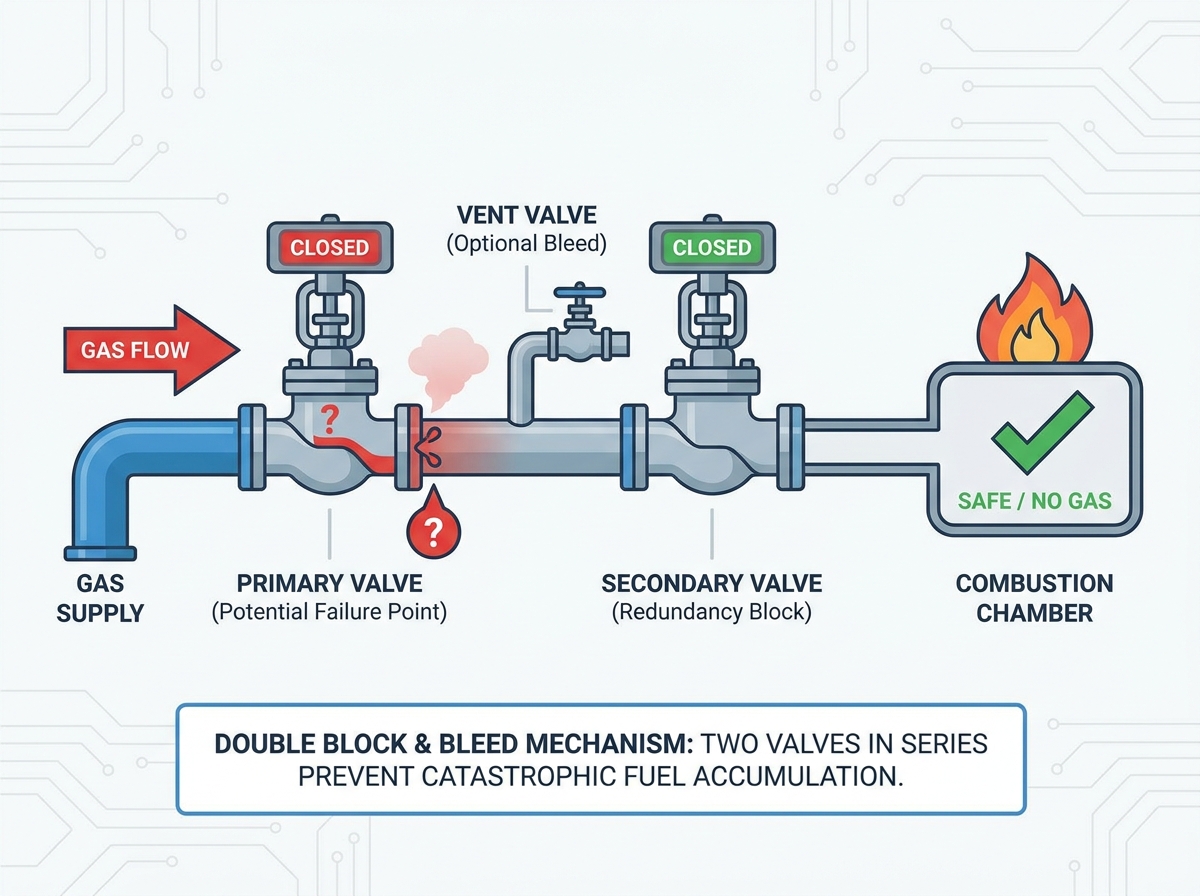
A double solenoid valve gas train directly mitigates the catastrophic risks of unburned fuel leakage. This intelligent setup relies on a fundamental "Double Block" mechanism. Two completely independent isolation bodies operate in series along the primary fuel line. They provide immediate, foolproof redundancy for your combustion system. The primary unit handles the initial upstream isolation duty. If this first unit fails to seal perfectly, the secondary downstream unit catches the full line pressure. The combustible fuel stops completely at this secondary physical barrier. You gain invaluable peace of mind.
Many engineered setups integrate dedicated vent mechanisms for enhanced environmental safety. Industry professionals often refer to this as a block and bleed configuration. These advanced systems incorporate a normally open atmospheric vent. Engineers install it directly in the short piping span between the two primary shutoff bodies. Imagine the first upstream isolation body leaks slightly during an off-cycle. The intermediate vent routes this escaped gas safely outdoors to the atmosphere. This critical venting action prevents hazardous pressure buildup against the secondary downstream seal.
Modern dual-valve setups also utilize advanced electrical interlocks for systemic awareness. We call these physical components Proof of Closure (POC) switches. They mechanically verify both valves sit fully closed. The burner management system (BMS) monitors these electrical switches constantly. The BMS demands positive confirmation from both POC switches simultaneously. It absolutely refuses to initiate a new burner restart sequence until it verifies complete closure. This intelligent feedback loop prevents accidental ignition of leaked fuel.
Industrial combustion safety is heavily regulated across the globe. Regulatory bodies mandate strict adherence to redundant isolation protocols. A double safety shutoff valve configuration represents a mandatory compliance standard today. Facility operators must understand and implement these governing codes rigorously.
Consider these mandatory industry standards guiding modern regulatory compliance:
Boiler inspectors take these regulatory codes very seriously during safety audits. National Board inspectors actively look for dangerous single points of failure. They meticulously evaluate your entire gas delivery infrastructure during site visits. Non-compliant single-valve systems immediately fail these routine inspections. Inspectors will issue instant shutdown orders for dangerous pipeline configurations. You face prolonged operational downtime until you upgrade to a fully compliant dual-valve system. Ignoring these audit realities brings severe legal and financial consequences for your business.
Evaluating and specifying the right block valves requires deep engineering foresight. Proper specification directly impacts system uptime, maintenance schedules, and overall audit readiness.
Response time dictates overall facility safety during critical burner trips. Your safety components must actuate incredibly fast during an emergency. Regulatory codes typically demand maximum closure times well under one second. Instant mechanical isolation starves the burner of fuel immediately upon a fault detection. Slow components allow dangerous gas volumes to enter the hot chamber post-trip. Fast-acting electromagnetic coils prevent this hazardous post-combustion fuel accumulation. You must verify actuation speeds during your initial procurement phase.
Engineers must carefully calculate sizing and pressure drops beforehand. A robust gas valve train design balances maximum safety and flow efficiency. Adding redundant components naturally increases flow resistance inside the burner gas train. You must size both flow bodies generously. Undersized components cause unacceptable pressure drops across the pipeline. This physical restriction starves the burner and causes erratic combustion performance.
Leakage class and material compatibility remain crucial specification metrics. Industry standards demand rigorous internal leakage ratings, such as ANSI Class VI shutoff capabilities. You must also select appropriate elastomer seals carefully. Natural gas, liquid propane, and emerging hydrogen blends interact differently with various seal materials. Operating environment temperatures further complicate your material selection. Choose robust rubber compounds capable of withstanding your specific process conditions indefinitely.
Procurement teams must eventually choose between integrated and modular pipeline assemblies.
| Design Approach | Space and Footprint | Initial Procurement Cost | Maintenance and Replacement |
|---|---|---|---|
| Integrated Assemblies (Monoblock) | Highly compact. They save significant physical pipeline space in tight boiler rooms. | Often lower upfront costs due to single-unit manufacturing and reduced piping. | Complex to repair. You often must replace the entire integrated block if one internal seal fails. |
| Modular Piped Assemblies | Requires more physical space for discrete bodies, pipe nipples, and fittings. | Higher initial costs due to additional raw materials and extended labor hours. | Highly serviceable. You can easily isolate and replace individual failed components quickly. |
Implementing redundant isolation systems introduces specific ongoing maintenance obligations. Routine leak testing requirements form the basis of actual operational safety. Facility personnel must perform regular manual tests on all safety components. These diagnostic tests reveal microscopic seal degradations before they become catastrophic pipeline leaks. Routine monitoring prevents unexpected emergencies effectively.
Many modern manufacturing plants utilize automated valve proving systems (VPS) instead of manual testing protocols. A VPS actively verifies the structural integrity of both components independently. It pressurizes the intermediate space between the seals and monitors for rapid pressure decay. The system performs this automated integrity check before every single burner startup sequence. If the VPS detects even a minute leak, it locks out the burner safely.
Strict maintenance schedules prevent unexpected operational failures. You must establish realistic operational expectations for all mechanical parts. We recommend following these structured maintenance protocols:
Proactive replacement schedules prevent destructive emergency shutdowns. Replacing wearing parts early minimizes expensive facility damage. It also limits prolonged operational downtime significantly.
Redundant safety isolation mechanisms stand as a completely non-negotiable element of modern combustion engineering. Utilizing dual shutoff setups eliminates highly dangerous single points of failure. They protect your personnel, secure your expensive infrastructure, and ensure you remain compliant with strict international regulations.
We strongly encourage facility managers, procurement officers, and combustion engineers to act proactively today. Audit your current gas delivery pipelines immediately. Compare your existing isolation infrastructure against the latest NFPA or ASME safety codes. Identify any outdated single-valve configurations lurking in your facility. You should consult with certified manufacturers and experienced combustion specialists soon. They will help you plan strategic system upgrades or compliant replacements. Prioritize redundant safety isolation to guarantee resilient and secure industrial operations for years to come.
A: Yes, retrofitting is highly recommended for older, non-compliant systems. However, engineering feasibility depends on physical pipeline space. You must have adequate room to pipe a second mechanical body. You will also need to update your Burner Management System (BMS). The BMS requires new electrical inputs to monitor the added Proof of Closure (POC) switches. Always consult a certified combustion engineer before modifying legacy fuel lines.
A: A standard Double Block uses two shutoff bodies in series. A Double Block and Bleed setup adds a normally open vent valve between them. When the main units close, the vent unit opens. It bleeds any leaked gas safely to the outside atmosphere. Certain stringent safety codes mandate this bleed configuration for high-capacity systems or highly volatile fuels.
A: Yes, motorized or electro-pneumatic actuators are perfectly acceptable. They are often entirely necessary for larger pipe diameters where solenoid coils struggle to actuate massive bodies effectively. These alternative actuators remain fully compliant. They simply must meet the same strict fail-safe closure standards. Regulators require them to close completely in under one second upon losing electrical power.