lucy@zlwyindustry.com
+86-158-1688-2025
Please Choose Your Language
- All
- Product Name
- Product Keyword
- Product Model
- Product Summary
- Product Description
- Multi Field Search

Views: 0 Author: Site Editor Publish Time: 2026-08-24 Origin: Site


Few daily operational issues frustrate maintenance teams more than erratic, unpredictable burner shutdowns. You rely on highly stable boiler operations to keep industrial production moving smoothly. Unplanned system lockouts shatter this delicate operational balance in an instant. We must clearly differentiate between a valid safety lockout and a mere mechanical misfire. A genuine lockout effectively prevents catastrophic combustion failure and protects your personnel. Conversely, phantom system faults simply drain valuable facility resources and stall critical workflows. This comprehensive guide provides facility managers and maintenance engineers a robust, structured diagnostic framework. We will help you identify the precise root causes behind these erratic cycling patterns. You will also learn to evaluate permanent, code-compliant solutions to restore system reliability safely.
Unplanned downtime severely impacts your financial bottom line. Each unexpected shutdown interrupts ongoing facility processes abruptly. It forces the burner into a mandatory pre-purge cycle before restarting safely. Repeated purge cycles blow cold air across hot boiler tubes unnecessarily. This causes thermal shock and wastes massive amounts of expensive fuel. You lose valuable production yields during these frustrating delays. Experiencing a pressure switch chatter nuisance trip directly sabotages daily output goals.
Rapid on-and-off cycling heavily degrades your physical combustion hardware. Gas valves slam shut and snap open continuously during chatter events. Control relays spark heavily and wear out their internal contacts prematurely. Burner ignition transformers face intense thermal stress from constant firing attempts. You will likely replace these expensive components much earlier than their expected lifespan.
You cannot treat every system trip as a minor operational annoyance. Doing so creates dangerous alarm fatigue among boiler operators over time. Personnel might begin ignoring critical system warnings entirely. Ignoring the actual root cause introduces severe personnel safety risks. It also violates strict regulatory compliance standards governing industrial combustion. Treat every fault as a genuine symptom needing immediate investigation.
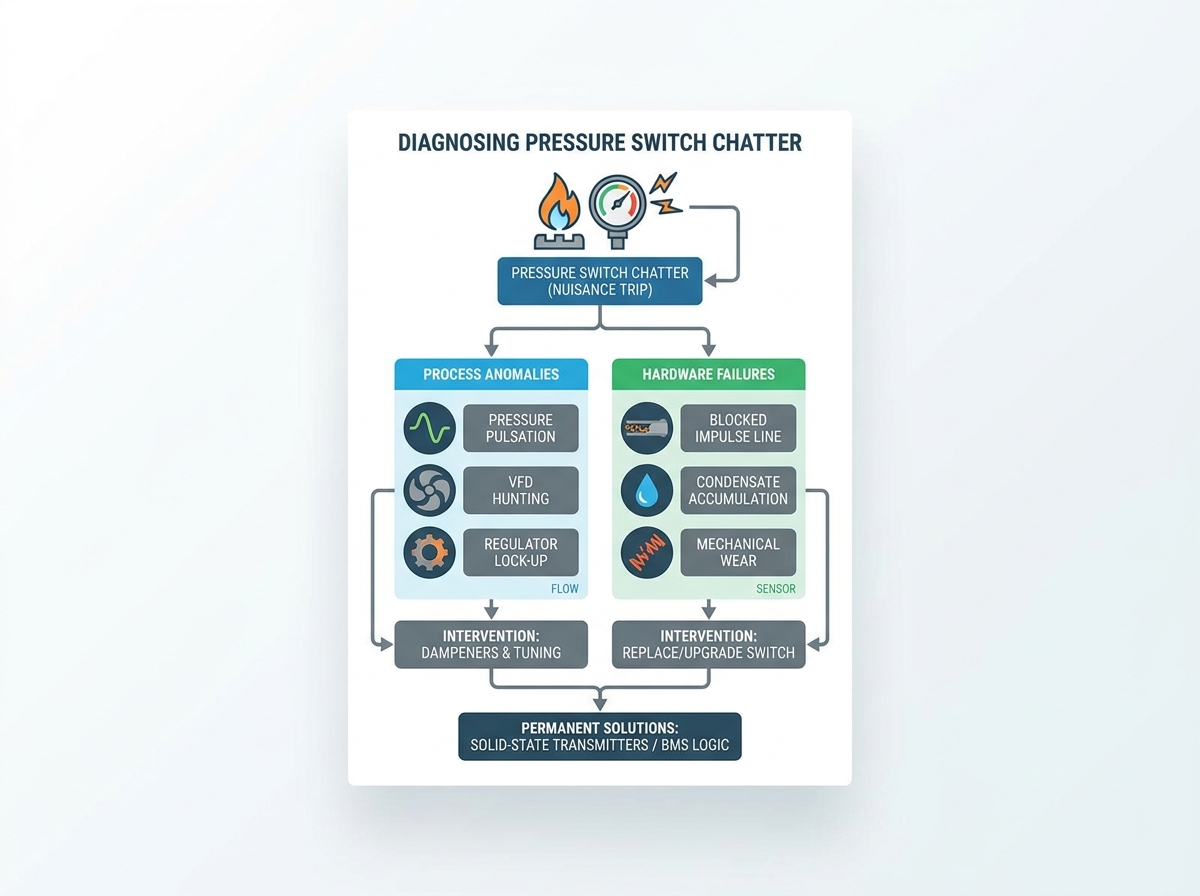
Fluid dynamics play a massive role in overall combustion system stability. Unstable gas regulators easily generate heavy pressure pulsation within your piping network. Turbulent combustion air from aggressive draft fan adjustments also disrupts stable flow. These aerodynamic shifts hit the sensitive switch diaphragm repeatedly. The resulting mechanical bounce triggers a false system shutdown.
Many modern forced draft blowers utilize Variable Frequency Drives (VFDs). VFDs improve electrical energy efficiency tremendously across varying load demands. However, poorly tuned VFDs often hunt for a stable operating frequency continually. This hunting behavior creates constant micro-fluctuations in duct air pressure. Such rapid pressure shifts cause the switch contacts to bounce uncontrollably. You must ensure PID control loops remain properly tuned for stability.
Sluggish gas pressure regulators struggle to adapt during dynamic load changes. They often fail to open or close fast enough during burner light-off sequences. This sluggish mechanical response creates transient pressure spikes in the main gas train. The control switch reads this momentary spike as a critical high-pressure fault. It reacts instantly and locks the burner out.
Process gases often carry tiny particulate matter through the piping system. Over time, soot, pipe scale, and debris accumulate inside narrow sensing tubes. Even small insects sometimes build nests inside open atmospheric vent ports. A blocked impulse line physically traps air pressure against the internal diaphragm. The switch actuates erratically because it cannot vent trapped pressure backward. It reads a static high state despite actual line pressure dropping.
Moisture buildup frequently plagues outdoor or high-humidity boiler installations. Sudden temperature drops cause rapid condensation inside metallic sensing lines. Water droplets pool together and create false head pressure against the switch diaphragm. This liquid barrier prevents accurate gas pressure readings from reaching the sensor. It essentially blinds your safety controls to actual system reality.
Industrial boilers natively generate significant physical vibration during high-fire operation. Rigid steel piping transmits this mechanical resonance directly to the control housings. Heavy external vibration can physically bounce delicate switch contacts open momentarily. The burner management system interprets this mechanical bounce as a genuine process failure. This simulates a classic nuisance trip without any actual process anomaly existing.
Continuous high-cycle operations eventually destroy internal mechanical parts. Weakened internal springs lose their intended tension over millions of actuation cycles. Rubber or synthetic diaphragms stretch and lose their original elasticity. These physical changes permanently alter the actual tripping setpoint over time. An old switch might trip early even though you set it correctly.
We refer to the difference between cut-in and cut-out points as the deadband. Setting this differential too tightly guarantees continuous operational headaches. Boiler pressure naturally varies slightly during normal firing rate transitions. If your tolerances remain tighter than the system's normal operating variance, the switch trips constantly. You effectively engineer failure right into the combustion control loop.
Electrical interference sometimes mimics physical mechanical contact bounce flawlessly. Variable frequency drives and large facility motors generate heavy electromagnetic interference (EMI). Unshielded control wiring picks up this electrical noise easily across long runs. The Burner Management System (BMS) registers these phantom voltage spikes as rapid pressure switch chattering. The system shuts down despite the mechanical hardware functioning perfectly.
Never guess whether a transient pressure spike actually occurred. You must validate your baseline readings using proven, objective measurement tools. Follow this step-by-step logic to establish your system baseline accurately:
A thorough visual inspection often reveals hidden mechanical flaws quickly. Check your impulse tubing routing carefully from pipe to switch. Ensure all sensing lines have proper downward slopes to drain moisture effectively. Confirm installation teams added appropriate drip legs to catch condensation safely. Inspect the internal switch contacts for visible pitting or dark carbon scoring. Pitted contacts indicate excessive electrical arcing from rapid bouncing.
You must isolate the problem domain accurately to avoid wasting parts. If the digital manometer confirms wild pressure swings, you have a process-driven issue. Process-driven issues require tuning gas regulators or adjusting linkage dampers. If the manometer shows perfectly stable pressure while the switch chatters, you have a sensor-driven fault. Sensor-driven issues usually dictate replacing the faulty hardware immediately.
| Observed Symptom | Primary Domain | Common Culprit | Recommended Action |
|---|---|---|---|
| Real pressure spike on manometer during light-off | Process-Driven | Sluggish gas regulator | Tune or rebuild the regulator assembly |
| Switch bounces while manometer reads perfectly stable | Sensor-Driven | Fatigued internal spring | Replace mechanical switch hardware |
| Delayed actuation or sticky response time | Sensor-Driven | Contaminated tubing | Blow out tubing and install drip leg |
| Spikes align exactly with VFD fan speed changes | Process-Driven | Poor PID loop tuning | Adjust VFD integral/derivative parameters |
You can modify the immediate hardware environment to protect the sensitive sensor. Install pressure snubbers directly upstream of the measurement port. Snubbers act like tiny shock absorbers for transient gas spikes. Pigtail siphons or surge dampeners also help smooth out aggressive fluctuations nicely. They dissipate harsh kinetic energy before it reaches the fragile diaphragm.
Aging mechanical switches eventually become unpredictable operational liabilities. Consider upgrading to modern adjustable deadband models for better flexibility. These allow you to widen the differential safely within allowable safety codes. Highly accurate solid-state transmitters offer an even better long-term upgrade path. They eliminate moving parts entirely while sending continuous analog signals to the controller.
Sometimes the safest fix involves upgrading your control software logic. Local safety codes sometimes permit specific software modifications for transient faults. Evaluate implementing strict, micro-second time delays directly in the Burner Management System. A tiny programming delay filters out acceptable transient noise effectively. It prevents nuisance shutdowns without compromising the required combustion safety envelope.
We must stress absolute caution regarding unauthorized field adjustments. Warn your maintenance team against unauthorized tweaks to critical safety setpoints. Do not let operators adjust internal screws blindly just to keep the burner running. Any physical adjustment requires proper combustion testing and a thorough safety audit. Modifying safety limits carelessly invites catastrophic facility disasters and regulatory fines.
Treat every unexpected burner shutdown as a critical diagnostic symptom rather than a minor operational annoyance. Phantom trips signal underlying instabilities demanding immediate professional attention. Accurate troubleshooting prevents unnecessary parts replacement and keeps your facility running smoothly. Correct diagnosis also ensures you maintain strict safety compliance across your operations.
To establish long-term reliability, facility teams should implement these action-oriented next steps:
A: Chatter involves rapid, repetitive contact bouncing due to minor pressure fluctuations or mechanical vibration. It briefly interrupts the circuit but might not latch a hard fault. A hard safety lockout represents a complete, latched circuit interruption. The burner management system detects a severe anomaly and shuts fuel valves completely. You must perform a manual reset to clear a lockout safely.
A: Widening the differential often stops erratic chattering successfully. However, you must only perform this adjustment within safe operating limits. Always consult the original burner manufacturer specifications before making changes. You must also adhere strictly to NFPA guidelines regarding allowable pressure deviations. Unauthorized deadband adjustments compromise system safety and risk catastrophic combustion events.
A: First, disconnect the sensing line from both the switch and the main process pipe. Never blow air directly into a connected switch. Use regulated compressed air to blow out the line backward. Clear all soot, scale, and moisture thoroughly. Finally, ensure technicians install a proper drip leg during reassembly. This prevents future condensation and debris buildup from reaching the sensor.