lucy@zlwyindustry.com
+86-158-1688-2025
Please Choose Your Language
- All
- Product Name
- Product Keyword
- Product Model
- Product Summary
- Product Description
- Multi Field Search

Views: 0 Author: Site Editor Publish Time: 2026-08-13 Origin: Site


A failed heating system triggers immediate panic during the peak of cold weather. When staring at a dead boiler, you might feel an intense temptation to grab any available part to restore the heat instantly. Generally, doing this is a terrible idea. Swapping a gas unit in place of an oil version introduces critical safety risks and guaranteed performance failures. You simply cannot mix these fundamental components safely.
This article provides a comprehensive technical breakdown of exactly why these igniters differ at an engineering level. We will explore the dangerous physical risks of forcing hardware compatibility where none exists. Finally, you will learn how to read nameplate specifications and select the precise replacement component needed to bring your equipment back online securely and in full compliance with industry standards.
Heating systems rely on precise physics to operate safely. Fuel state differences dictate entirely different ignition strategies. Gas operates as a highly combustible vapor. It mixes effortlessly into ambient air. A minimal energy source easily triggers combustion. Heating oil, specifically No. 2 fuel oil, presents a completely different challenge. It remains a dense liquid. The burner must mechanically atomize this liquid into a fine mist before combustion can occur.
Atomized liquid droplets demand substantially more thermal energy to catch fire. You cannot simply introduce a weak spark and expect a robust flame. When analyzing a gas vs oil burner ignition transformer, you immediately notice these distinct spark characteristics. Gas burners only need a short, low-energy spark. The vapor ignites almost instantly upon contact.
Oil burners require an aggressive, sustained, high-voltage arc. This arc must literally punch through a dense, turbulent air-and-fuel mixture. The blower fan creates a chaotic environment inside the combustion chamber. A weak spark will simply blow out before igniting the oil mist.
Many technicians fall victim to the compatibility fallacy. They assume a physical fit equals an electrical fit. If the mounting plate aligns with the burner housing, they bolt it down. However, electrical incompatibility remains hidden inside the casing. The internal windings operate differently. The energy delivery curves do not match. You must address the exact physical reality of the application to prevent catastrophic system failures.
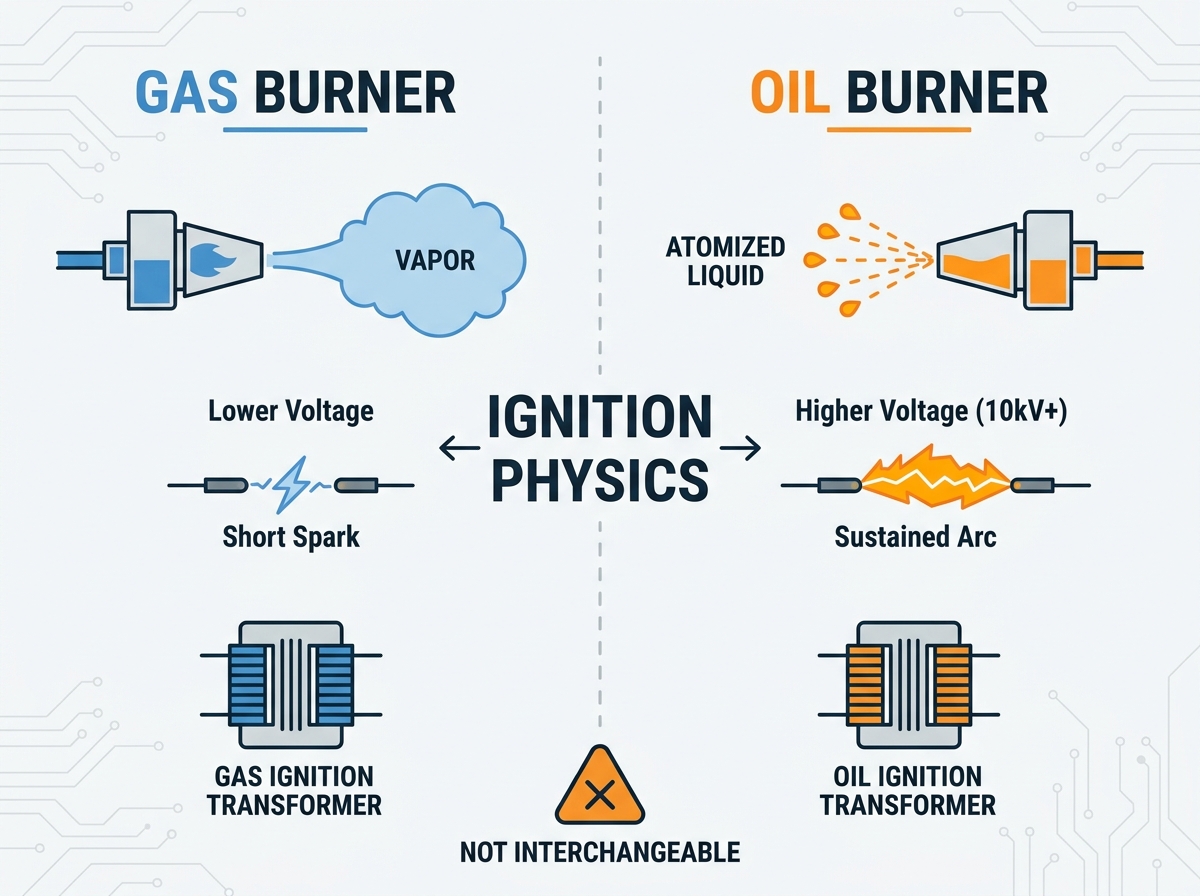
Evaluating ignition components requires a strict look at numerical specifications. You must map these features directly to their operational outcomes. The most critical dimension is the secondary voltage output. A standard oil burner ignition transformer outputs massive secondary voltages. Traditional iron-core models generate between 10kV and 12kV. Modern solid-state electronic igniters push this boundary up to 14kV or higher. Gas burners require a fraction of this voltage.
Timing plays an equally important role in system evaluation. You must understand your specific ignition duty rating. This term defines the exact percentage of time the component is engineered to actively spark. We typically divide this into two main categories:
Beyond voltage and timing, the milliamp (mA) output dictates arc strength. Voltage allows the spark to jump the physical gap between electrodes. Current, measured in mA, provides the heat. A typical oil unit delivers 20mA to 35mA. This robust current prevents the blower draft from extinguishing the arc. A lower current rating would fail entirely in this turbulent environment.
Below is a visual breakdown of typical specifications across fuel types.
| Specification Metric | Typical Gas Burner Specs | Typical Oil Burner Specs |
|---|---|---|
| Secondary Voltage | 6,000V - 8,000V | 10,000V - 14,000V+ |
| Secondary Current (mA) | Low (often under 20mA) | High (20mA - 35mA) |
| Arc Characteristics | Brief, lower heat, easy to jump | Aggressive, sustained, high heat |
| Spark Duration | Intermittent (mostly) | Intermittent or Continuous |
Ignoring engineering specifications creates immediate implementation risks. Forcing transformer compatibility between incompatible fuels leads to disaster. You invite severe safety hazards into residential or commercial spaces.
Consider the scenario of using a gas-rated unit on an oil system. The resulting arc will be dangerously weak. It fails to ignite the atomized mist immediately upon startup. The fuel pump continues spraying liquid into the combustion chamber. Unburned fuel rapidly accumulates. Eventually, the weak spark manages to catch a localized vapor pocket. This causes a delayed ignition, commonly known as a "puff-back." The accumulated fuel explodes all at once. This violent mini-explosion damages boiler seals, blows off the flue pipe, and pushes hazardous soot throughout the building.
Reversing the error yields different but equally destructive results. Installing a high-voltage oil unit onto a gas system creates massive over-voltage conditions. The 14kV spark can easily jump across gaps it was never meant to bridge. It can arc directly into sensitive gas control modules. It will fry pilot assemblies and destroy primary circuit boards.
You also face severe code and compliance realities. The National Oilheat Research Alliance (NORA) and local HVAC codes dictate strict installation protocols. Modifying safety controls outside of OEM parameters violates these industry standards. If a fire or puff-back occurs due to an incorrect part, insurance companies will investigate. Finding mismatched components often voids insurance policies and introduces severe liability for the person who performed the installation.
When failures occur, you face critical purchasing decisions. You must navigate various solution categories carefully. Never install a universal unit simply because you cannot find a dedicated gas burner ignition transformer or its oil equivalent.
Start by reading the existing equipment nameplate. This metal tag contains non-negotiable specifications. You must exactly match the Primary Voltage (usually 120V), Secondary Voltage, Secondary mA, and Hertz (typically 60Hz in North America).
Next, evaluate the technology type. You generally choose between two categories:
Finally, exercise caution regarding "universal" replacement kits. Many manufacturers sell solid-state igniters packed with multiple base plates. They label these boxes as universal. Remember a vital rule of thumb: universal means mounting flexibility, not cross-fuel flexibility. A universal oil kit fits ten different oil burners. It does not fit a gas system. Always ensure the universal kit explicitly lists your specific fuel type on the packaging.
Evidence-oriented verification prevents unnecessary part swapping. You must systematically confirm the component has actually failed. Many technicians mistakenly condemn a good part because they skipped basic troubleshooting steps.
Start with visual and auditory checks. Inspect the casing. If you have an older iron-core unit, look for physical bulging. Check for black tar leaking out of the seams. This indicates catastrophic internal overheating. Next, listen to the system during startup. A healthy unit produces a distinct, aggressive humming and snapping sound. Silence indicates a failure to send power or a dead primary coil.
HVAC professionals must conduct precise electrical testing. First, safely check the primary input voltage. Use a multimeter to ensure the control board actually sends 120V to the component. If the input power is absent, the primary control is the actual problem. Next, use a dedicated ignition transformer tester to verify secondary output. Never use the old DIY screwdriver arc test. Purposely drawing a 10,000V arc to a screwdriver introduces severe high-voltage shock risks and damages modern solid-state circuitry.
Before buying a replacement, rule out related components. You must inspect the physical firing assembly.
| Component | Check For | Potential Result of Failure |
|---|---|---|
| Electrodes | Worn, burned, or blunted tips | Weak spark, wandering arc |
| Gap Spacing | Measurements wider than OEM specs | Spark fails to jump the gap |
| Porcelain Insulators | Hairline cracks or carbon tracking | Voltage grounds out before reaching the tips |
| High Tension Leads | Brittle insulation, loose connections | Intermittent firing, arcing to the burner housing |
If the electrodes are worn or spaced improperly, even a brand-new power unit will fail to ignite the fuel.
Gas and oil ignition components are strictly non-interchangeable. The physical states of the fuels require fundamentally different spark characteristics. Forcing a mismatch ignores engineering reality and invites catastrophic equipment damage, severe soot hazards, and significant safety liabilities.
Decision-makers must prioritize exact OEM replacements. If you choose to upgrade an older system, stick to brand-approved, fuel-specific solid-state upgrades. Verify that the new unit matches the primary voltage and duty cycle of your existing setup.
Take immediate action by shutting off power to your system and locating the equipment nameplate. Document the exact specifications. Then, consult with a certified HVAC parts supplier to source the precise match required for safe, reliable operation.
A: It will overheat and fail rapidly. The internal windings are not rated to dissipate the heat generated by constant operation. You will likely experience a complete burnout within a few days of installation.
A: Yes, provided the new solid-state igniter matches the primary voltage, is explicitly rated for oil burners, and fits the mounting footprint. They often provide a hotter spark for better startups.
A: Typically 5 to 10 years, depending on duty cycle, basement humidity, and the overall health of the burner's electrical grounding. Poor grounding can destroy modern solid-state units much faster.
A: No. While there are "universal" replacements within fuel categories (e.g., a universal oil igniter with multi-fit base plates), the electrical characteristics required for gas vs. oil are too fundamentally different for a single unit to safely serve both.