lucy@zlwyindustry.com
+86-158-1688-2025
Please Choose Your Language
- All
- Product Name
- Product Keyword
- Product Model
- Product Summary
- Product Description
- Multi Field Search

Views: 0 Author: Site Editor Publish Time: 2026-07-25 Origin: Site


Cleaning a sooted boiler without addressing the underlying air-fuel ratio guarantees the problem will return. A thick layer of soot inside your boiler signals a fundamental imbalance. It rarely means you just skipped a routine cleaning. These recurring issues create serious business and safety stakes. Equipment degradation wastes thousands of dollars annually. Wasted fuel costs drain facility budgets silently over the heating season. Furthermore, carbon monoxide hazards represent massive risks to human life. Ignoring them allows soot to choke heat transfer while dangerous gases build up indoors. This guide provides a clear path forward. We provide a rigorous, instrument-driven framework for diagnosing poor oil combustion. You will learn to resolve these issues permanently. We will teach you to measure drafts, interpret flue gases, and secure a clean, efficient burn.
You lose money daily when a boiler operates inefficiently. Imagine a commercial facility using thousands of gallons of heating oil yearly. A mere 2% drop in combustion efficiency translates to massive annual fuel waste. You burn more oil simply to maintain baseline temperatures. This financial drain happens silently.
Equipment lifespan also suffers under poor combustion parameters. Soot acts as a highly effective insulator inside the boiler. Just a fraction of an inch of soot drops heat transfer efficiency drastically. The boiler runs longer cycles to meet heating demands. This constant thermal stress degrades the metal heat exchanger. The burner motor and fuel pump wear out prematurely.
Safety and compliance risks pose an even greater threat. You face severe liability if your equipment produces dangerous emissions. Exposure to elevated carbon monoxide levels threatens facility occupants. Regulators routinely fine facilities failing local safety compliance standards. Poor combustion makes your building a massive compliance liability.
A successful tune-up requires clear, measurable parameters. You need strict operational targets. We define a successful tune-up by four critical metrics. It yields absolute zero smoke. It maintains a stable over-fire draft. It achieves steady-state efficiency of 80-85% or higher for standard oil equipment. Finally, it keeps CO levels well below standard safety thresholds.
The following metrics highlight the operational standards you should target during evaluation.
| Metric | Standard Target | Critical Threshold (Action Required) |
|---|---|---|
| Smoke Number | True Zero | >1 (Trace) |
| Over-Fire Draft | -0.01 to -0.02 in WC | Positive pressure |
| CO2 Percentage | 11% - 12.5% | <10% or >13% |
| Carbon Monoxide (CO) | <50 ppm | >100 ppm air-free |
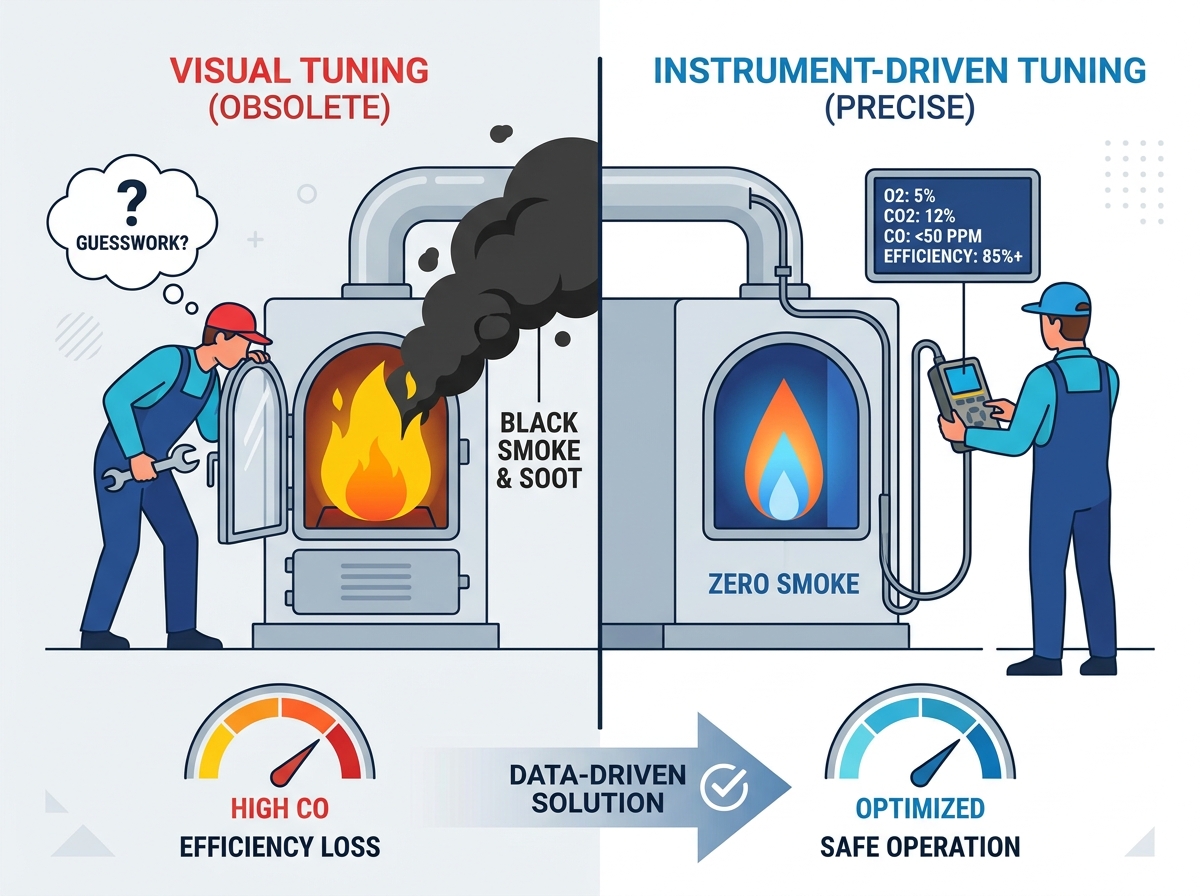
Too much fuel and too little air create a fuel-rich condition. This lack of oxygen prevents complete combustion inside the chamber. Unburned carbon particles clump together rapidly. They cling to the heat exchanger walls immediately. This directly causes oil burner black smoke to pour from your chimney. We must balance this ratio precisely.
Evaluating physical components before tuning is mandatory. Mechanical failures easily mimic poor air adjustments. You must rule out hardware problems first.
Environmental factors also disrupt the combustion process. Boiler rooms require constant oxygen. Modern sealed buildings often starve burners of makeup air. A starved burner pulls draft erratically. You must assess the room for proper ventilation grilles. Compromised chimney venting also ruins draft stability. Draft fluctuations destroy any air-fuel calibration.
Many technicians fall into the "cleaned but still sooting" trap. Physical brushing removes the immediate symptoms. Vacuuming the chamber makes it look spotless. However, physical cleaning fails if the primary air band remains misadjusted. The soot formation cycle simply restarts the moment the burner fires. You must address the underlying air shortage.
You cannot manage what you do not measure. A true zero smoke number is the foundational metric. You use a manual smoke pump tester for this. You draw flue gas through specialized filter paper. You compare the spot to a standard smoke scale. You must ensure absolute zero smoke before making final efficiency adjustments.
Establishing the baseline draft is your next priority. You must measure the over-fire and breech draft. Draft must pull negative to safely vent gases. Stable negative pressure ensures the air-fuel mixture remains constant. You cannot tune a bouncing flame. A fluctuating draft ruins gas measurements.
Oxygen (O2) and carbon dioxide (CO2) percentages drive your efficiency tuning. They share an inverse relationship. As you reduce air, O2 drops and CO2 rises. You want the theoretical "sweet spot" for heating oil. This typically lands between 11-12.5% CO2. You also need a corresponding O2 buffer. This buffer prevents soot if environmental conditions change.
The chart below illustrates this inverse relationship during tuning.
| Air Adjustment Status | O2 Output | CO2 Output | Combustion Result |
|---|---|---|---|
| Too Much Air (Lean) | High (7%+) | Low (<10%) | Inefficient, low heat transfer |
| Optimal Buffer Target | Moderate (4-6%) | Ideal (11-12.5%) | Clean, highly efficient burn |
| Too Little Air (Rich) | Low (<3%) | High (>13%) | Soot production, heavy smoke |
Tracking carbon monoxide remains your most critical safety check. Carbon Monoxide indicates incomplete combustion. We track high CO as the primary indicator of flame impingement. It also reveals a severe lack of air or imminent mechanical failure. Any spike requires immediate investigation.
Step 1: Baseline Testing & Draft Calibration. You begin by running the system to a steady state. This typically requires 10 to 15 minutes of uninterrupted operation. Let the stack temperature stabilize completely. Once stable, set the draft regulator. Achieve your target negative pressure.
Step 2: Smoke Testing. Slowly adjust the air shutter inward. Reduce the air until a trace of smoke appears on your pump tester. You have found the combustion limit. Now, open the air band slightly. Retest until you achieve a solid zero smoke reading. This establishes your baseline threshold.
Step 3: Excess Air Adjustment. Insert the probe of a calibrated digital combustion analyzer into the flue. Measure the O2 and CO2 levels accurately. You must perform a precise excess air adjustment. Adjust the air shutter to achieve the manufacturer's specified excess air buffer. This is usually 20-30% excess air. This buffer accounts for winter weather and fuel temperature changes.
Step 4: CO and Efficiency Verification. Watch your digital analyzer screen closely. Confirm CO parts per million remain stable. They must stay well within safe operational limits. Log the final combustion efficiency rating for your facility records. Proper oil burner combustion tuning demands this verified, printed data.
Step 5: Lock Down and Re-test. Secure all air bands tightly. Tightening locking bolts often shifts the metal shutters slightly. Take a final instrument reading. Ensure securing the hardware did not alter the delicate air-fuel mixture. The final numbers must match your target goals exactly.
Many untrained personnel rely on visual checks. They assume a bright yellow flame equals safe combustion. This represents a dangerous "eyeball" fallacy. Visual tuning is completely obsolete in modern boiler rooms. Human eyes cannot see carbon monoxide. You cannot accurately gauge excess air by looking at a fire.
Proper diagnosis dictates strict equipment requirements. You need professional-grade tools to succeed. A digital combustion analyzer is non-negotiable. You also need a specialized smoke pump, an accurate draft gauge, and a fuel pressure gauge. Cheap, consumer-grade carbon monoxide monitors cannot handle industrial flue gases. They will melt or fail instantly.
Knowing when to call a professional prevents catastrophic failures. Apply clear shortlisting logic. You should bring in an expert if specific warning signs appear.
You must demand accountability from your chosen contractor. Always request a printed combustion analysis report post-service. This physical receipt proves the tune-up was data-driven. It verifies they achieved proper draft, O2, and CO levels. It protects your facility from liability.
Oil burner adjustment requires a precise, data-driven process, not guesswork. Throwing a wire brush at a sooted boiler provides only a temporary illusion of repair. Resolving soot and smoke permanently saves money, reduces fuel consumption, and protects building occupants from lethal gases. Establishing a stable draft and utilizing digital analyzers guarantees maximum operational efficiency.
Your next step requires immediate action. Advise your maintenance team to schedule a certified combustion analysis. Alternatively, invest in standardized technician training and proper digital instrumentation for your in-house staff. Ensure every boiler receives an instrumented tune-up before the next heating season begins.
A: The technician likely cleaned the soot but failed to adjust the air-fuel ratio. If the burner runs fuel-rich due to low excess air, incorrect pump pressure, or a worn nozzle, soot will rapidly rebuild. Physical cleaning must always accompany a digital combustion analysis.
A: High carbon monoxide indicates incomplete combustion. This results from severe air starvation, flame impingement against the combustion chamber walls, or mechanical failures like a defective nozzle. You must halt operation and troubleshoot the mechanical components immediately.
A: No. Adjusting excess air requires measuring exact oxygen and carbon dioxide percentages in the flue gas. Visual flame inspections cannot accurately quantify these gases or detect dangerous carbon monoxide levels. A calibrated digital analyzer is strictly required for safety.
A: The only acceptable level is absolute zero. You verify this using a smoke pump tester on standard filter paper. Any trace of smoke indicates unburned carbon, which will eventually insulate the heat exchanger and reduce boiler efficiency.
A: You should perform instrument-driven tuning at least once a year, typically before the heating season. You should also conduct a new combustion analysis whenever you replace the nozzle, adjust fuel pressure, or alter the burner hardware.