lucy@zlwyindustry.com
+86-158-1688-2025
Please Choose Your Language
- All
- Product Name
- Product Keyword
- Product Model
- Product Summary
- Product Description
- Multi Field Search

Views: 0 Author: Site Editor Publish Time: 2026-07-22 Origin: Site


Industrial facilities rely heavily on stable steam and hot water generation to maintain daily production. Choosing the correct boiler equipment ensures these critical systems run safely and predictably. Incorrect sizing introduces severe operational risks for any plant. Undersizing a unit leads to significant pressure and temperature drops during peak production loads. Conversely, oversizing causes rapid short-cycling, accelerates equipment wear, and wastes substantial amounts of fuel.
Retrofitting or specifying new equipment requires moving past simple nameplate capacities. You must account for real-world system efficiency, site-specific conditions, and modern emission standards. A one-size-fits-all approach simply does not work in modern thermal processing. This guide provides facility managers and plant engineers with an evidence-based framework. You will learn how to accurately determine energy requirements, evaluate commercial options, and confidently finalize procurement decisions. We will help you balance thermodynamic math against practical site realities for long-term success.
Effective boiler burner sizing starts by clearly defining your actual load requirements. You must understand exactly what the boiler needs to deliver before selecting combustion equipment. Steam boilers and hot water boilers use entirely different metrics. You measure steam boilers using Boiler Horsepower (BHP) or pounds per hour (lbs/hr). Hot water boilers rely on British Thermal Units per hour (BTU/hr) or kilowatts (kW). Mixing up these metrics leads to disastrous sizing errors.
Facility managers must differentiate between peak load and continuous load. You should size the system for the maximum continuous rating (MCR). However, you must also account for morning startup spikes or severe seasonal peaks. If you size strictly for an absolute, once-a-year peak, the equipment will run inefficiently during normal shifts.
Evaluating current boiler efficiency is a critical step. Never assume an older boiler operates at its original nameplate efficiency. A heavily scaled heat exchanger drastically reduces heat transfer. A highly efficient, brand-new burner cannot magically compensate for a dirty boiler. You must use the expected or current operational efficiency (often 80-85%) to determine how much raw fuel energy you actually need.
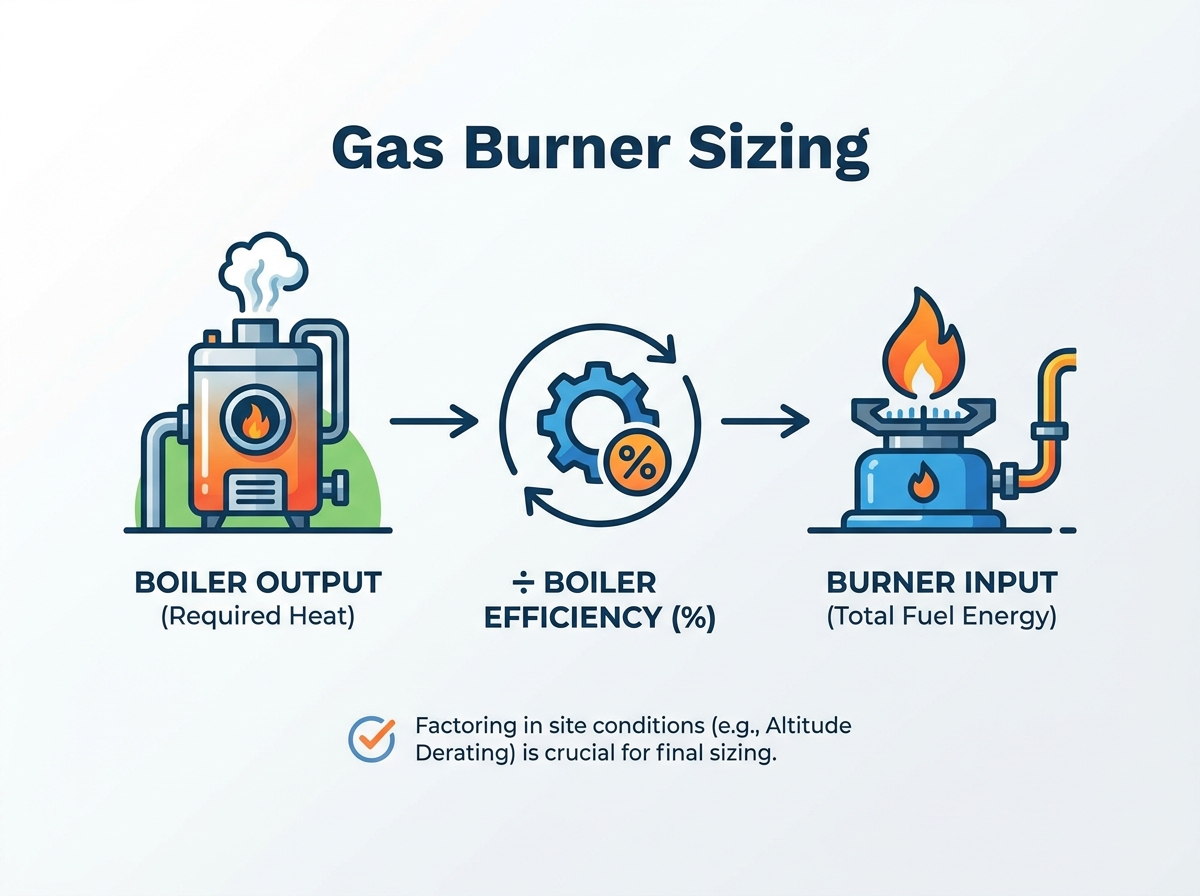
You need hard numbers to make informed decisions. A reliable gas burner capacity calculation bridges the gap between your thermal demand and fuel supply. The core formula revolves around determining the required burner heat input.
The standard equation is straightforward:
Burner Input (BTU/hr) = Boiler Output (BTU/hr) / Boiler Efficiency (%)
For example, if you need 10,000,000 BTU/hr of output and your boiler operates at 80% efficiency, your required input is 12,500,000 BTU/hr. You must feed the burner 12.5 million BTUs of raw gas to get 10 million BTUs of usable heat.
| Input Metric | Conversion Factor (Output) | Application |
|---|---|---|
| 1 Boiler Horsepower (BHP) | 33,475 BTU/hr | Standard Steam Boilers |
| 1 lb/hr of Steam | ~1,000 BTU/hr | Process Steam Systems |
| 1 Kilowatt (kW) | 3,412 BTU/hr | Hot Water / Electric Systems |
| 1 Therm | 100,000 BTU/hr | Gas Utility Measurement |
You must also factor in site realities, particularly altitude derating. Air density drops as elevation increases. A fan moving 1,000 cubic feet of air at sea level moves significantly less oxygen at 5,000 feet. The industry rule of thumb dictates a 4% capacity reduction per 1,000 feet above sea level. Temperature adjustments also play a role. Extremely hot boiler rooms mean less dense combustion air, which further reduces potential heat input. Ignoring these environmental constraints guarantees operational shortfalls during peak demand periods.
Thermodynamic math tells you how much heat you need. Aerodynamic realities dictate whether the equipment can safely deliver it. The blower fan plays a massive role in system stability. It must physically push the flame and hot gases through the heat exchanger. This process encounters significant aerodynamic resistance.
Understanding the internal combustion chamber pressure is paramount. Different boiler designs create different levels of backpressure. A 3-pass firetube boiler creates much higher furnace pressure than a large watertube boiler. If the fan cannot overcome this backpressure at high fire, the flame will smother, causing explosive soot buildup or dangerous shutdowns.
Gas supply pressure introduces another layer of engineering reality. You must verify the incoming natural gas pressure at the facility meter. This incoming pressure must handle the cumulative pressure drops across the entire gas train. Valves, pressure regulators, safety shutoffs, and the burner head all restrict gas flow.
All piping and pressure parameters must strictly align with relevant safety standards. Organizations like the National Fire Protection Association outline clear rules. NFPA 85, for example, dictates specific safety interlocks and valve configurations. ASME codes govern pressure vessel integrity. Following these standards ensures regulatory compliance and protects your facility personnel.
Modern combustion technology offers massive efficiency gains over older systems. You need to look beyond basic heat delivery to evaluate long-term commercial returns. Turndown ratio serves as a primary performance indicator. The turndown ratio represents the highest firing rate compared to the lowest firing rate.
Standard models typically offer a 4:1 turndown. High-efficiency models push this to 10:1 or even higher. A 10:1 ratio means a 10 million BTU unit can ramp down to 1 million BTUs without shutting off. High turndown drastically reduces short-cycling. Every time a system cycles off and on, it wastes expensive heated air during pre-purge and post-purge cycles. Tighter temperature control limits thermal shock and extends equipment life.
Control systems also dictate operational ROI. Traditional mechanical linkages use physical metal rods to connect fuel valves and air dampers. These linkages wear out, bend, and lose calibration over time. Parallel positioning, or linkageless controls, use independent servomotors.
Emissions compliance acts as the final technological filter. Local environmental regulations often mandate specific nitrogen oxide (NOx) limits. Standard units produce high NOx levels. Low-NOx and Ultra-Low-NOx options use advanced techniques to reduce emissions. Flue Gas Recirculation (FGR) lowers flame temperature by piping exhaust gases back into the combustion zone. However, FGR requires larger, more powerful fans. You must weigh these fan power consumption trade-offs against regulatory requirements.
Procuring new combustion equipment requires rigorous vendor evaluation. You cannot rely on sales brochures alone. You must request and closely scrutinize specific engineering data. Demand transparent combustion curves from potential vendors. These curves prove how the unit behaves across its entire firing range. Ask for guaranteed efficiency numbers at both minimum and maximum fire. Do not forget to request acoustic data. Some high-intensity models produce deafening noise levels requiring expensive sound attenuation.
Physical footprint presents a major retrofit risk. The best equipment in the world is useless if it does not fit your boiler. The chosen unit must securely mount to the existing boiler front plate. The blast tube must match the furnace geometry perfectly. If the blast tube is too long or too short, you risk flame impingement. Flame impingement occurs when the active fire touches the metal water walls. This causes severe carbon buildup and rapid metal failure.
Finally, frame your decision logically around capital expense versus operational expenditure. Cheaper upfront costs often hide massive long-term fuel penalties. Encourage your finance team to weigh initial quotes against a 5- to 10-year projection. Factor in projected fuel savings, reduced maintenance downtime, and utility rebates for high-efficiency installations. A premium unit often pays for itself within the first few years of operation.
Proper boiler equipment sizing bridges the gap between thermodynamic theory and commercial reliability. We have explored the critical variables you must balance, from calculating baseline energy needs to navigating aerodynamic resistance. Overlooking a single variable like altitude derating or furnace backpressure can cripple a facility.
Here are your core takeaways:
Your next step is clear. Gather your boiler nameplate data, pull your most recent combustion reports, and log your facility gas pressure readings. Use this data to initiate a qualified technical review with an engineering firm or request a custom quote from a reputable manufacturer.
A: Low incoming gas pressure restricts fuel flow. This may require a physically larger gas train or a specialized burner design to achieve the required capacity. If pressure is inadequate, the system will starve the flame at high fire, causing unsafe shutdowns or failure to meet steam demand.
A: No. Intentional oversizing leads to rapid short-cycling. This wastes significant fuel during mandatory pre-purge and post-purge cycles. It also causes thermal shock to internal boiler components, drastically increasing long-term maintenance costs and reducing the lifespan of your equipment.
A: Input is the total raw thermal energy consumed by the combustion process (the actual fuel burned). Output is the usable heat successfully transferred to the water or steam. The difference between these two numbers represents the system's total thermal efficiency.
A: While the total BTU requirement remains identical, propane possesses a higher energy density per cubic foot. The gas train components, specific orifices, and operating pressure settings must be uniquely sized, configured, and certified for the selected fuel type to ensure safe operation.