lucy@zlwyindustry.com
+86-158-1688-2025
Please Choose Your Language
- All
- Product Name
- Product Keyword
- Product Model
- Product Summary
- Product Description
- Multi Field Search

Views: 0 Author: Site Editor Publish Time: 2026-07-24 Origin: Site


Industrial facilities expanding capacity or replacing aging boilers face a critical procurement tradeoff. You must weigh the higher fuel price of light oil against the complex infrastructure demands of heavy fuel oil. Selecting the wrong system directly impacts long-term profitability. Unexpected downtime, excessive energy costs for fuel preparation, or strict compliance penalties can quickly derail your operations.
This guide evaluates both systems on capital expenditure (CapEx), ongoing operational expense (OpEx), compliance risks, and technical realities. We provide actionable insights to support equipment shortlisting and specification. By understanding these operational limits, you can confidently match the right combustion technology to your facility's unique production profile.
Before specifying boiler equipment, you must understand the chemical and physical differences between industrial fuel grades. These core properties dictate how the burner handles, atomizes, and ignites the fuel.
Light oil typically refers to No. 2 fuel oil. You might know it simply as diesel. Refineries process it extensively to remove impurities. This highly refined nature gives light oil a consistent density and a predictable heating value. Because it contains very few heavy hydrocarbons, a standard diesel burner operates cleanly with minimal residue.
Heavy oil usually encompasses No. 5 or No. 6 fuel oil. Industry professionals often call it Bunker C or residual fuel oil. It represents the dense remnants left over after refineries extract high-value products like gasoline. Heavy oil contains longer hydrocarbon chains. It also carries significantly higher concentrations of sulfur, ash, and heavy metals like vanadium.
Viscosity measures a fluid's resistance to flow. In combustion engineering, fuel viscosity serves as the most critical parameter for proper atomization. Atomization is the process of shearing liquid fuel into a microscopic, combustible mist. If the droplets are too large, they will not burn completely.
Light oil achieves ideal viscosity at ambient temperatures. You can pump it directly from an unheated storage tank to the burner nozzle.
Heavy oil behaves differently. It remains semi-solid or highly viscous at room temperature. You cannot atomize it without thermal manipulation. Operators must heat heavy fuel oil to temperatures between 90°C and 120°C (194°F to 248°F) just before it reaches the burner nozzle. This heating lowers the viscosity to the required 15 to 20 centistokes (cSt) necessary for optimal mechanical shearing.
Fuel impurities directly influence combustion efficiency. Light oil burns with a tight, bright, and highly efficient flame. It produces very low levels of unburned carbon.
Heavy oil presents a more challenging combustion environment. Residual impurities affect the flame shape and alter radiant heat transfer within the boiler furnace. The high carbon-to-hydrogen ratio in residual oil means the burner needs precise air mixing to prevent dark, smoky flames. Even with perfect tuning, heavy oil inherently produces more unburned carbon and ash deposits than light oil.
The physical properties of your chosen fuel dictate the size, complexity, and cost of your burner infrastructure. Upfront capital expenditure varies drastically between these two systems.
Light oil systems prioritize simplicity. They require minimal secondary equipment. A typical installation relies on standard centrifugal or gear pumps and basic inline filtration.
They utilize simpler single-fluid mechanical atomization components. The burner pressurizes the fuel and forces it through a specialized nozzle to create the mist. You do not need compressed air or steam to assist the process. As a result, light oil systems boast a much smaller footprint. They operate essentially as "plug-and-play" solutions for standard industrial boilers.
Specifying a heavy oil system means committing to extensive auxiliary infrastructure. To prevent the fuel from solidifying in the pipes, facilities must engineer complex fluid handling networks.
Here is a simplified comparison of the infrastructure requirements:
| Infrastructure Component | Light Oil System | Heavy Oil System |
|---|---|---|
| Storage Tanks | Standard, unheated | Insulated, steam or electric heated |
| Fuel Piping | Standard steel piping | Insulated, trace-heated lines |
| Fuel Pumps | Standard gear pumps | Heavy-duty positive displacement |
| Atomization Utility | None (Mechanical pressure) | Compressed air or high-pressure steam |
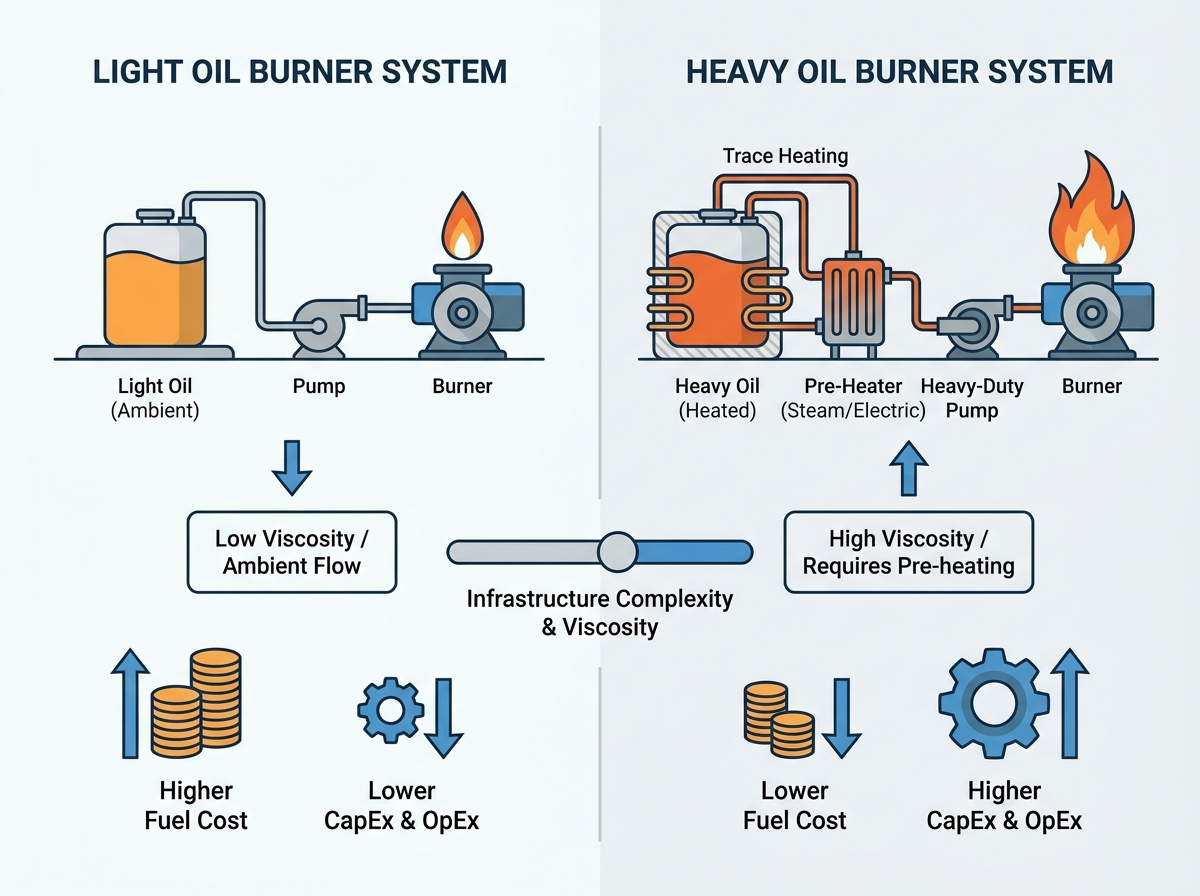
Evaluating long-term expenses requires looking beyond the raw price per barrel. You must account for utility overhead, maintenance labor, and the financial impact of potential downtime.
Heavy oil traditionally trades at a significant discount compared to highly refined diesel. When you analyze the baseline price gap per million British thermal units (MMBtu), heavy oil appears highly attractive for large consumers.
However, you cannot look at fuel prices in a vacuum. You must offset heavy oil fuel savings against the electrical and steam costs required to maintain it. Heating large storage tanks and running trace heating 24/7 consumes massive amounts of energy. If your plant does not produce excess waste steam, generating the heat to warm the fuel will heavily inflate your overall burner operating cost.
Maintenance routines differ wildly between the two systems.
Light oil systems enjoy predictable maintenance cycles. Operators typically perform standard nozzle replacements and basic filter swaps annually. The clean-burning nature of the fuel means boiler tubes require minimal soot blowing.
Conversely, heavy oil systems demand intense, continuous maintenance.
You must assess the operational risk of a "cold plug" in heavy oil systems. If trace heating fails during a plant shutdown, the heavy oil solidifies inside the pipes. Clearing a hardened pipeline requires massive labor hours, costly chemical treatments, or complete pipe replacement.
Light oil systems carry none of this risk. They offer rapid cold-start capabilities. You can leave a diesel system offline for months, strike a spark, and achieve full fire within minutes.
Environmental regulations strictly govern industrial combustion. Your choice of fuel directly impacts your facility's compliance strategy and emissions profile.
Light oil produces a relatively clean exhaust stream. It yields significantly lower particulate matter (PM), sulfur dioxide (SOx), and nitrogen oxides (NOx) during combustion. Many facilities can operate light oil boilers in moderately regulated zones without complex exhaust treatment.
Heavy oil combustion yields substantially higher SOx and PM levels. The concentrated residual elements in the fuel vaporize in the furnace and reform as hazardous air pollutants in the stack. Heavy oil also produces higher thermal NOx due to the intense flame characteristics required to burn residual hydrocarbons.
You must factor compliance overhead into your equipment strategy. Choosing a heavy fuel oil burner often necessitates installing expensive post-combustion pollution controls. To meet local EPA or regional environmental mandates, facilities routinely install:
These pollution control systems require their own maintenance, utility consumption, and hazardous waste disposal protocols. You must factor these secondary compliance costs into the total lifecycle ROI of heavy oil. Often, the cost of a scrubber system entirely negates the initial fuel savings.
Selecting the optimal equipment requires an honest assessment of your operational habits, geographic location, and maintenance bandwidth.
Light oil systems excel in specific operational environments. You should specify this technology for:
Heavy oil remains a powerful economic tool when applied correctly. A heavy fuel oil burner makes strategic sense for:
You do not always have to choose just one. Many plants install heavy/light dual-fuel burners as a transitional strategy. These systems allow operators to start a cold boiler on light oil. Once the boiler generates enough steam to warm the heavy oil storage tanks and pipelines, the burner automatically switches over to heavy oil. This approach combines the rapid startup benefits of light oil with the baseload economics of residual fuel.
Deciding between a light oil burner vs heavy oil burner is rarely a simple calculation of fuel prices. It represents a complex equation balancing your operational hours, fuel price differentials, and internal maintenance capacity. Light oil offers simplicity, reliability, and low upfront costs at a premium fuel price. Heavy oil demands heavy capital investment and intense maintenance but rewards continuous users with massive fuel savings.
Do not make this procurement decision based on a spreadsheet of current commodity prices alone. We strongly recommend conducting a site-specific Lifecycle Cost Analysis (LCCA). Partner with an industrial combustion engineer to model your exact fuel savings versus infrastructure and maintenance costs over a standard 10-year horizon. This precise modeling ensures you invest in a system that protects your bottom line and your production uptime.
A: Yes, if specified with a dual-fuel train. However, firing light oil through a heavy oil nozzle may require pressure and atomizing media adjustments. Without proper tuning, you risk severe flame instability and inefficient combustion.
A: It varies by specific grade, but you typically require heating to achieve a kinematic viscosity of 15–20 cSt. For most residual oils, operators must maintain the fuel between 90°C and 120°C (194°F–248°F) right at the burner inlet.
A: Heavy systems generally require daily checks of pre-heaters and strainers. You also face much more frequent boiler tube cleaning (soot blowing) due to ash buildup. Expect maintenance labor hours to increase by 30-50% compared to a diesel system.