lucy@zlwyindustry.com
+86-158-1688-2025
Please Choose Your Language
- All
- Product Name
- Product Keyword
- Product Model
- Product Summary
- Product Description
- Multi Field Search

Views: 0 Author: Site Editor Publish Time: 2026-07-23 Origin: Site


Upgrading or specifying industrial heating equipment forces a critical engineering choice. Where and how do you mix the fuel and air? You must answer this fundamental question before investing in new thermal infrastructure. The decision between a premixed and nozzle-mix design directly dictates your process efficiency, maintenance overhead, and regulatory compliance. Facility managers simply cannot afford to guess which configuration works best. A mismatched system often leads to excess emissions, wasted energy, and costly unplanned downtime. While both systems generate heat reliably, their physical mechanics and operational limits differ drastically. This comprehensive guide breaks down the precise engineering trade-offs of both combustion designs. We will help you navigate these complex choices to specify the right system for your facility's unique load profile, fuel type, and strict emission limits.
Understanding combustion performance starts with examining the physical fluid dynamics. Engineers must look closely at how the air and gas streams interact. This interaction dictates everything from flame shape to long-term reliability. We can categorize industrial burners by where this crucial mixing occurs.
A premixed gas burner combines air and gaseous fuel well before they reach the ignition zone. Operators usually inject the gases into an upstream manifold. Many systems use a specialized venturi mixer to blend the streams. This process creates a perfectly homogenous combustible mixture. The blended gas then travels through a pipe to the burner head.
This advanced upstream mixing yields a very specific set of physical outcomes. You get an incredibly uniform flame geometry. The combustion reaction completes rapidly. The flame burns shorter, sharper, and much more intensely. You do not see long, lazy flames here. Instead, the rapid energy release creates a tight, highly controlled heating envelope.
Nozzle-mix mechanics take the exact opposite approach. The air and fuel streams remain completely isolated throughout the delivery system. They travel through separate piping networks. They only meet exactly at the burner face. The mixing and the ignition happen simultaneously inside the combustion chamber.
This localized mixing provides exceptional structural flexibility. Operators can easily adjust the flame shape by altering the nozzle geometry. You can produce a long, luminous flame or a short, bushy one. Furthermore, this separation completely eliminates the risk of upstream ignition. Combustible gas never exists inside the delivery piping.
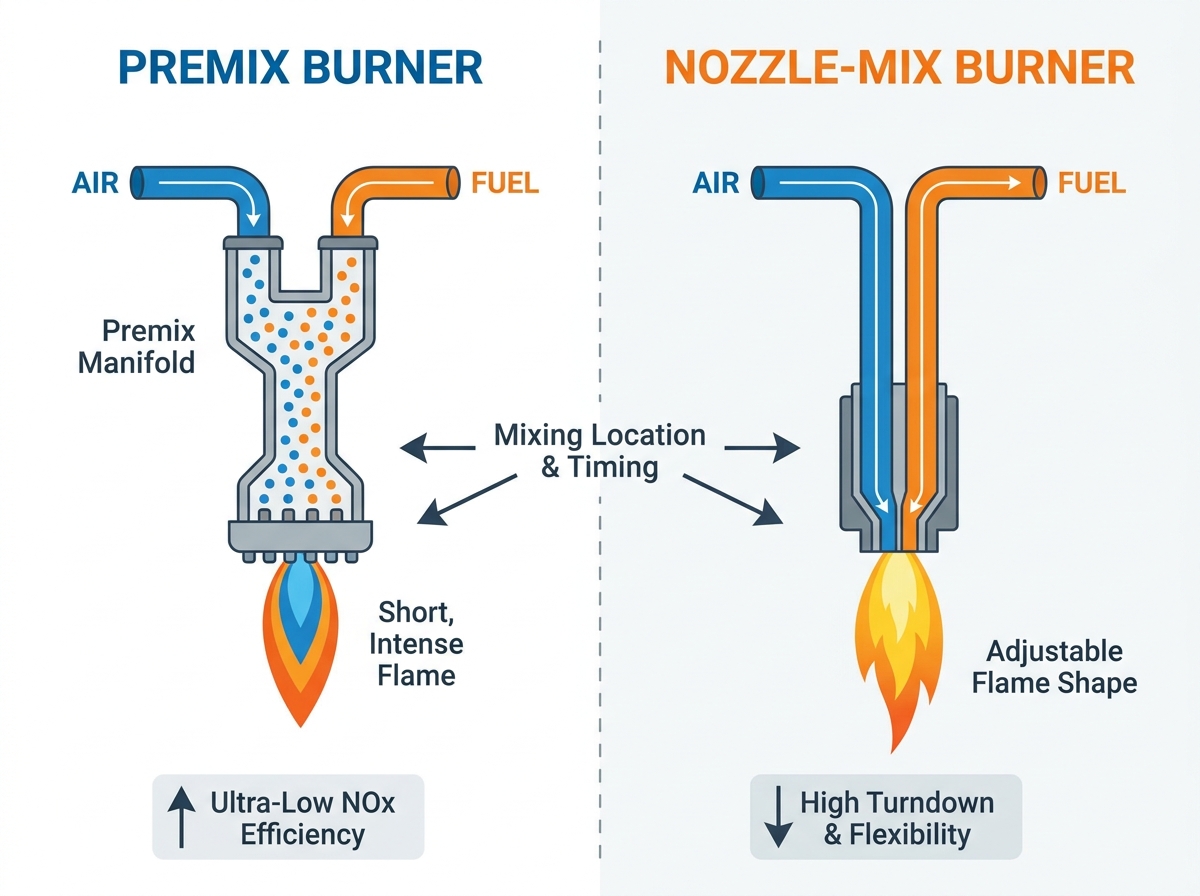
Choosing a premix vs nozzle mix gas burner fundamentally alters how your furnace behaves. You must evaluate these designs against your specific production demands. We will break down three critical performance metrics below.
Turndown ratio measures a burner's flexibility. It represents the maximum firing rate divided by the minimum firing rate. High turndown means the burner can idle low and ramp up high. Nozzle-mix designs offer a massive advantage here. Because they separate the air and fuel streams, they maintain excellent flame stability across vast operating ranges. Modern designs easily hit 40:1 turndown ratios. They handle highly variable batch processes effortlessly.
Premix systems face severe physical limitations regarding turndown. They usually operate within narrow 3:1 or 5:1 bands. The system must maintain precise mixture velocities. If the mixture travels too slowly, the flame burns backward into the pipe. We call this flashback. If it travels too fast, the flame pushes away and extinguishes. We call this blow-off. These strict velocity limits severely restrict how much you can adjust the firing rate.
Environmental regulators strictly monitor nitrogen oxide (NOx) emissions. Thermal NOx forms when localized flame temperatures spike too high. Premixing offers a profound thermodynamic advantage here. A fully blended mixture eliminates localized cold spots and hot spots. It lowers the peak flame temperature dramatically. Therefore, it remains the industry standard for meeting strict ultra-low NOx compliance. They frequently achieve sub-9 ppm levels straight out of the box.
Nozzle-mix reality looks quite different. The simultaneous mixing and burning creates unavoidable hot spots. While modern staging techniques help, nozzle-mix systems struggle to match premix baselines. You generally cannot classify a standard nozzle-mix unit as an elite low NOx burner. Meeting single-digit ppm limits usually requires costly secondary mitigation. Engineers often must add Flue Gas Recirculation (FGR) systems to achieve compliance.
Flashback represents a serious safety hazard for premix systems. A highly combustible mixture sits directly behind the burner face. If flow velocities drop, the flame can propagate upstream. It might reach the manifold and cause an explosion. Facility managers must implement stringent velocity controls. Industry standards, like NFPA 86, mandate specialized flame arrestors for these setups.
Conversely, nozzle-mix setups provide incredible peace of mind. The fuel and air only mix inside the firing chamber. No flammable mixture exists in the piping. This separation also makes them highly resilient to dirty fuels. If you burn variable-BTU biogas or syngas, nozzle-mix systems handle it smoothly. Premix manifolds, however, clog easily. They remain extremely sensitive to dust, particulates, and sudden gas composition changes.
Theoretical performance only tells half the story. You must consider what happens when you actually install these systems. The supporting infrastructure looks very different for each design.
| System Requirement | Premixed Design | Nozzle-Mix Design |
|---|---|---|
| Blower Pressure | Requires high static pressure blowers to force the blend through the matrix. | Operates effectively on lower pressure standard combustion air blowers. |
| Control Logic | Demands precise mass flow meters and electronic AFR controllers. | Often functions reliably on simpler mechanical linkage controls. |
| Air Filtration | Mandates absolute, rigorous filtration to prevent matrix fouling. | Tolerates standard industrial air quality with minimal filtration. |
| Fuel Flexibility | Requires clean, consistent, high-quality natural gas or propane. | Easily adapts to heavy oils, dirty biogas, and variable syngas. |
Premix configurations demand serious physical force. The blower must push the combined air-fuel mixture through tight burner heads. These heads often feature dense metal fiber matrices. Overcoming this resistance requires higher combustion air pressure. You will need larger blowers. This translates directly to higher electrical loads. Facilities must ensure their power grid can handle these heavier mechanical demands.
A homogenous blend requires surgical precision. You cannot rely on basic mechanical valves. Premix environments demand high-precision Air-Fuel Ratio (AFR) controllers. You must install sensitive mass flow meters. The programmable logic controller (PLC) must constantly monitor and adjust the blend. Nozzle-mix systems forgive minor calibration errors. You can often run a nozzle-mix burner on basic mechanical linkages. This dramatically simplifies maintenance and reduces the need for specialized instrumentation technicians.
Clean air matters heavily in premix applications. Industrial environments contain massive amounts of airborne dust. If dust enters a premix blower, it travels directly into the mixing manifold. The debris will rapidly foul the delicate burner matrix. This alters the mixture ratio and ruins efficiency. Rigorous air filtration becomes an absolute necessity. Facility teams must replace filter cartridges frequently. Neglecting this maintenance leads to catastrophic burner failure.
Matching the hardware to the application prevents costly engineering mistakes. Every production floor presents unique constraints. Use the following framework to align your process demands with the correct combustion technology.
Certain industrial environments heavily favor the isolated mixing approach. You should select this rugged design when facing specific operational challenges. Common use cases include:
Other scenarios demand surgical precision and strict environmental adherence. You should deploy premix technology when process stability and emissions rule the project. Ideal applications include:
Purchasing combustion equipment involves high stakes. A poorly specified system jeopardizes both production schedules and safety compliance. You must look far beyond standard promotional brochures. Engineering teams should adopt a rigorous validation process before signing any purchase orders.
Generic specification sheets hold very little value. They report performance under perfect, laboratory-controlled conditions. Your factory floor never matches a laboratory. You must require vendors to provide application-specific data. Demand Computational Fluid Dynamics (CFD) modeling tailored to your exact chamber geometry. A proper CFD model reveals how the flame actually behaves inside your specific furnace. It highlights potential hot spots, dead zones, and draft issues. Furthermore, ask for specific case studies. The vendor should prove their equipment works in similar draft conditions and similar industries.
Do not attempt this specification process blindly. Before committing to a specific design topology, initiate a comprehensive infrastructure review. Consult directly with an experienced combustion engineer. They will audit your current gas train capabilities. They will measure your existing draft conditions and assess your blower capacity. Taking this professional step guarantees your facility receives a safe, compliant, and highly efficient heating solution. Reach out to a certified engineering team today to schedule your comprehensive facility audit.
Selecting the right combustion technology shapes the future of your facility. Neither design holds the title of objectively "better" equipment. The right choice always depends on a delicate tension. You must balance strict emission compliance against rugged operational flexibility. Premix excels at clean, steady, highly efficient operations. Nozzle-mix dominates in harsh, variable, and demanding environments. Ultimately, buyers must prioritize reality. Evaluate your existing infrastructure honestly. Assess your maintenance team's capabilities thoroughly. Choosing a system that matches your real-world daily operations will always outperform theoretical efficiency gains.
A: Premix setups generally offer tighter combustion efficiency due to perfectly homogenous blending. However, actual system efficiency depends heavily on external factors. You must consider heat recovery systems, draft control, and how well the equipment matches your load profile. An oversized premix system will waste more fuel than a properly sized nozzle-mix unit.
A: Yes, but with limitations. Advanced nozzle-mix designs utilize sophisticated air and fuel staging techniques to suppress thermal NOx. However, they generally cannot achieve the ultra-low, single-digit ppm levels of an advanced premix unit. Reaching those strict limits usually requires external Flue Gas Recirculation (FGR) systems.
A: Stability depends on balancing the mixture velocity against the flame propagation speed. In premix setups, these variables must remain tightly matched. If the mixture slows down, the flame travels upstream, causing a flashback. If the velocity increases too much, the flame blows off the burner head completely.