lucy@zlwyindustry.com
+86-158-1688-2025
Please Choose Your Language
- All
- Product Name
- Product Keyword
- Product Model
- Product Summary
- Product Description
- Multi Field Search

Views: 0 Author: Site Editor Publish Time: 2026-07-25 Origin: Site


Operating HFO systems, such as No. 6 fuel oil or Bunker C, demands balancing immense energy potential against notoriously difficult handling characteristics. Industrial facilities rely heavily on these cost-effective fuels to power massive boilers and kilns every single day. However, pumping heavy oil to the combustion zone is only half the challenge you face on site. Achieving the precise fluid state required for efficient, clean combustion is exactly where most legacy mechanical systems fail.
Without highly accurate thermal management, plants suffer from frequent equipment blockages, wasted energy, and severe environmental compliance penalties. This article provides plant engineers and facility managers with an objective, decision-stage framework for evaluating heavy oil burner fuel preheating solutions. You will discover how to compare competing technologies, mitigate serious implementation risks, and optimize your entire combustion process. We will examine the core differences between steam and electric heating approaches. You can then make a fully informed upgrade decision for your specific facility requirements.
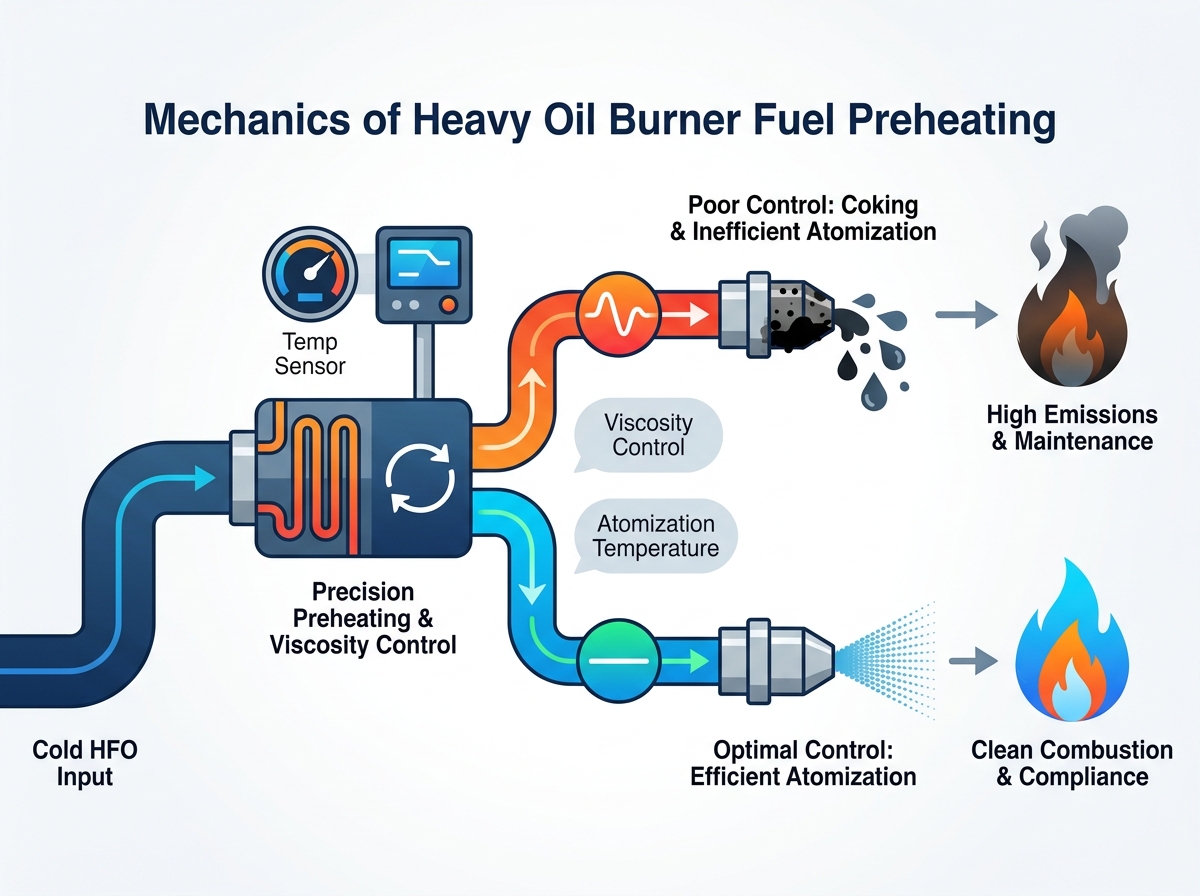
Heavy fuel oils possess a remarkably high molecular weight. They naturally resist shear forces during the pumping process. Without precise temperature control, they exit the nozzle in large, uneven droplets. These oversized fluid droplets cannot mix properly with combustion air. Poor mixing prevents complete combustion inside the chamber. This incomplete burn creates a cascade of expensive operational failures across your facility.
You will notice several distinct operational symptoms when thermal control fails:
These mechanical issues create a massive financial and compliance impact. Unburnt fuel causes a direct loss in overall thermal efficiency. You end up spending significantly more money on fuel per BTU generated. Furthermore, sub-optimal combustion spikes particulate matter (PM) emissions. It drives up NOx and SOx output far beyond acceptable limits. These elevated emissions quickly trigger unexpected EPA or local environmental audits. Regulators penalize non-compliant industrial operations heavily. A malfunctioning HFO burner drains your operating budget rapidly and damages your corporate reputation.
Most heavy oils require significant thermal energy input prior to combustion. They must achieve a highly specific kinetic viscosity. The target range usually sits between 100 to 300 SSU. This Saybolt Seconds Universal measurement applies directly at the burner tip. Achieving the correct atomization temperature ensures the fluid fragments into a microscopic mist.
Maintaining this thermal balance is critical for operational stability. You face distinct risks when deviating from the target zone. Underheating leads directly to poor mechanical atomization. You will see heavy black smoke exiting the stack immediately. Unburned fuel will begin pooling inside the lower combustion chamber. Overheating creates an entirely different set of dangerous problems. It causes the oil to vaporize prematurely before reaching the nozzle. The fluid might physically crack inside the heater housing itself. This thermal degradation creates severe vapor lock conditions. Pump cavitation and internal pipe fouling soon follow, forcing a complete system shutdown.
A modern setup requires a continuous, closed feedback loop. Real-time communication happens constantly between temperature sensors and the heating element. They work together to maintain a highly stable viscosity curve. The system must adapt instantly to ambient temperature drops. It must adjust power output dynamically to keep the fluid perfectly conditioned regardless of external weather variables.
Facilities generally choose between two primary thermal management methods. We will examine the legacy steam approach alongside the modern electric approach to clarify your options.
The legacy approach relies heavily on steam preheating systems. This mechanism utilizes excess plant steam generated elsewhere in the facility. It heats the oil indirectly through mechanical heat exchangers. The primary advantage is a low direct operating cost. This benefit applies only if excess steam remains abundantly available on site. However, the drawbacks are significant and numerous. The system suffers from frequent temperature fluctuations. These thermal shifts correlate directly with changing boiler loads. Maintenance requirements stay remarkably high due to continuous steam trap failures. Leakages occur regularly in aging, high-pressure pipework. You also face a frustrating operational paradox. The boiler must be active to generate steam. Yet, you need steam to start the burner itself.
The modern approach utilizes inline electric preheaters. This mechanism uses electrical resistance elements. Engineers immerse these specialized elements directly into the flowing oil path. You gain highly precise temperature modulation as a major benefit. The equipment executes independent cold starts effortlessly. It also requires a much smaller physical footprint on the plant floor. The main disadvantage involves higher direct energy costs for the electricity used. You must calculate the return on investment carefully. Reduced fuel waste and lowered maintenance costs often offset this electrical expense entirely over a typical fiscal year.
Below is a technical comparison outlining the fundamental differences between the two primary heating mechanisms.
| System Feature | Steam Preheating (Legacy Approach) | Electric Preheating (Modern Approach) |
|---|---|---|
| Startup Capability | Requires existing steam pressure (dependent) | Fully independent cold start ability |
| Temperature Precision | Variable, fluctuates heavily with boiler load | Highly precise, steady thermal output |
| Maintenance Burden | High (frequent steam trap and valve failures) | Low (solid-state relays, basic visual inspection) |
| Physical Footprint | Large, requires complex auxiliary piping | Compact, easily integrated directly inline |
Selecting the right equipment requires analyzing highly specific technical parameters. You must look beyond basic wattage and physical dimensions to ensure long-term reliability.
Watt density represents the most crucial metric for evaluation. High-watt density heaters destroy heavy oil rapidly. They burn the fluid directly on the hot element surface. This aggressive heating process causes severe coking. Decision-makers must demand low-density heating elements for their systems. Lo-Density CLHR technology provides an excellent example of this design philosophy. Low-density technology spreads the heat over a much larger surface area. This gentle heat transfer prevents fluid degradation entirely. These systems ensure longevity and demand minimal ongoing maintenance from your staff.
You must also evaluate flow rate handling and turndown capabilities. The heater must adapt seamlessly to changing operational states. It needs to maintain precise fuel viscosity control at full capacity. It must also perform perfectly during low-fire states. Flow rates drop significantly during these reduced operating periods. The heater must lower its electrical output proportionately to prevent localized overheating.
Pay close attention to the control panel and integration features. Evaluate how well the thermal system integrates logically. It should connect seamlessly to your existing PLC or Burner Management System. Look closely at the internal electrical switching components. Solid-state relays (SCR) perform much better than basic mechanical contactors. They deliver smooth, continuous temperature curves without sudden electrical spikes or mechanical wear.
Finally, verify all compliance and safety ratings. Industrial environments present serious operational hazards. Ensure the equipment meets strict ASME and UL standards. Check for localized hazardous area classifications if they apply to your specific site. Proper certification prevents devastating accidents and avoids costly regulatory fines during routine safety audits.
Even premium hardware fails if the installation process goes wrong. You must plan the physical rollout carefully to avoid disrupting plant operations.
Consider the piping and insulation realities first. The pipe run between the heater and nozzle needs aggressive protection. An uninsulated pipe ruins the entire thermal management effort instantly. A lack of heat tracing tape allows the oil to cool rapidly in transit. The fluid thickens quickly before it ever reaches the atomization stage. You must insulate every inch of the delivery line to guarantee proper droplet formation.
Assess the retrofit downtime carefully. You must measure the available physical footprint exactly. Electric inline units usually require very minimal repiping efforts. Upgrading from an old steam system proves much more complex. A steam-to-electric retrofit requires precise, hourly scheduling. You want to avoid an extended, unexpected plant shutdown. Coordinate closely with your mechanical contractors to map out the exact transition window.
Demand highly transparent maintenance assumptions from your vendors. A properly sized heavy oil preheater operates reliably for years. It should only require a basic, non-invasive annual inspection. You should never need to scrape carbon off elements monthly. Reliable systems keep your maintenance crews focused on proactive tasks rather than reactive emergency repairs.
Facilities need a structured approach to upgrade their critical systems. Use the following logical steps to begin your equipment procurement journey today.
Relying on outdated or imprecise heating methods creates immense facility risk. It turns affordable heavy fuel oil into an expensive operational liability. You lose the entire economic advantage of using cheaper residual fuels. Constant maintenance interventions drain your operational budget unnecessarily while placing your environmental compliance in jeopardy.
Upgrading to a precision-controlled, low-watt density system solves these structural issues permanently. It represents a strategic facility investment, not just a quick maintenance fix. This upgrade ensures strict EPA compliance moving forward. It maximizes combustion efficiency across all standard operating ranges. Ultimately, it drastically extends the functional lifespan of your critical combustion equipment. Take action by auditing your current fuel delivery parameters this quarter. Evaluate exactly how an electric inline heating upgrade aligns with your long-term production goals.
A: While it varies by exact chemical composition, No. 6 oil typically requires preheating to between 180°F and 250°F to achieve the optimal 100-300 SSU viscosity range for proper atomization.
A: Coking is almost always caused by a heater with a watt density that is too high for heavy oil. The surface of the heating element gets too hot, breaking down the oil before it reaches the burner.
A: No. Tank heaters (suction heaters) are only designed to make the oil fluid enough to pump. They cannot safely or efficiently reach the high temperatures required for burner atomization without destroying the bulk oil in the tank. An inline preheater near the burner is required.