lucy@zlwyindustry.com
+86-158-1688-2025
Please Choose Your Language
- All
- Product Name
- Product Keyword
- Product Model
- Product Summary
- Product Description
- Multi Field Search

Views: 0 Author: Site Editor Publish Time: 2026-09-29 Origin: Site


A flame detector that performs well near a fuel storage tank may not be suitable for a marine engine or an industrial burner. Although these devices share a common purpose—detecting the presence of a flame—their sensing methods, operating conditions, and control requirements can differ significantly.
For industrial buyers, comparing flame detector types involves more than checking detection range and response time. Fuel characteristics, environmental interference, installation conditions, certification requirements, and long-term maintenance costs all influence the final decision.
This guide explains the main flame detection technologies, compares their technical specifications, and examines the factors that affect equipment pricing. It also highlights the differences between general fire detection and flame supervision in combustion equipment.
Optical flame detectors identify characteristic radiation emitted during combustion. Different sensing technologies monitor ultraviolet radiation, infrared radiation, or combinations of spectral signals.
A detector's response depends on the fuel being burned, the intensity of the flame, the distance from the source, and environmental conditions.
For example, hydrocarbon flames produce combustion signatures that can be detected by suitable infrared sensors. Hydrogen flames require different consideration because their spectral characteristics differ from those of hydrocarbon fires.
Consequently, the sensing technology must match the expected fire hazard rather than simply offering the longest advertised detection distance.
Not all products described as flame detectors serve the same purpose.
| Application | Primary Function | Typical Equipment |
|---|---|---|
| Industrial fire protection | Detect unintended flames in a monitored area | UV, IR, UV/IR, and multi-spectrum IR detectors |
| Industrial burners | Confirm flame presence during controlled combustion | UV flame scanners, flame rods, and suitable optical sensors |
| Marine engines and combustion systems | Monitor combustion conditions and provide flame-status signals | Application-specific flame detection devices |
| Process heating equipment | Support burner safety and combustion control | Flame supervision systems integrated with burner controllers |
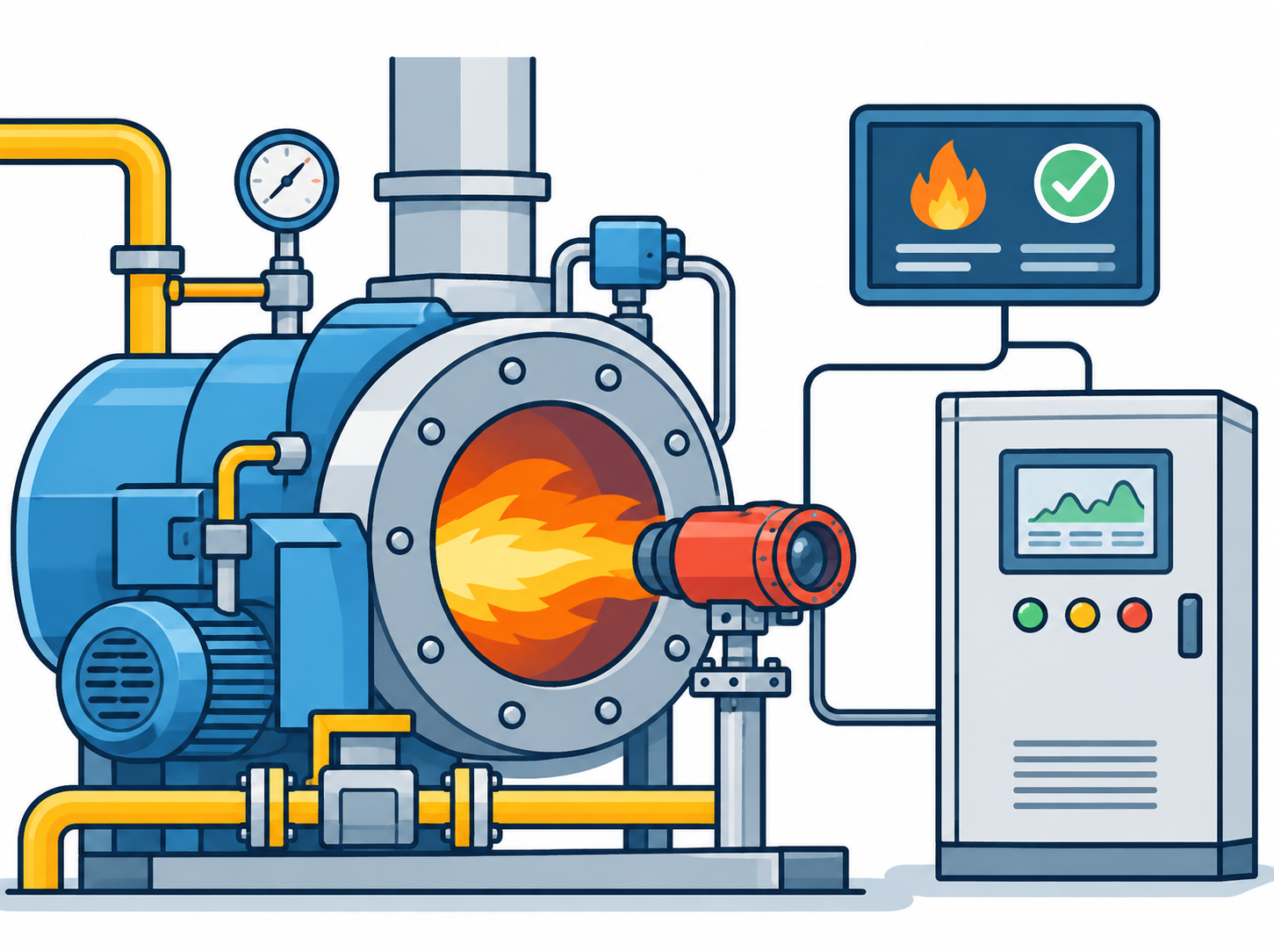
In burner and engine applications, flame monitoring is generally integrated with a combustion control or burner management system.
Buyers evaluating these applications can review an industrial flame detector designed for marine engine integration.
A burner flame supervision device should not be treated as interchangeable with an open-area fire detector without verifying its intended use, performance, and applicable approvals.
UV flame detectors monitor ultraviolet radiation associated with combustion. Many industrial UV sensors operate in a solar-blind spectral region, although the exact wavelength range depends on the device.
Their main advantages include rapid flame recognition and suitability for certain non-hydrocarbon flames.
However, UV detection can be affected by arc welding, electrical discharges, and other ultraviolet radiation sources. Smoke, oil mist, and contamination on the optical window may also reduce sensitivity.
Typical considerations:
Suitable fuel and flame characteristics
Exposure to welding or electrical interference
Optical window cleanliness
Required response time and detection coverage
UV technology is often considered when rapid detection is important, but the application must be checked against the manufacturer's tested performance.
Infrared detectors respond to selected wavelengths emitted during combustion.
Some single-spectrum IR detectors monitor radiation associated with hot carbon dioxide in hydrocarbon flames. Their signal-processing algorithms help distinguish flame characteristics from background radiation.
Advantages
IR detection can be useful in environments where ultraviolet sensing is less suitable. Certain designs also offer good resistance to sunlight-related interference.
Limitations
Hot equipment, reflected radiation, and moving heat sources can complicate detection. Performance varies according to the detector's spectral filters and signal-processing methods.
A single IR detector should therefore be evaluated against the actual fuel and background conditions rather than selected solely on price.
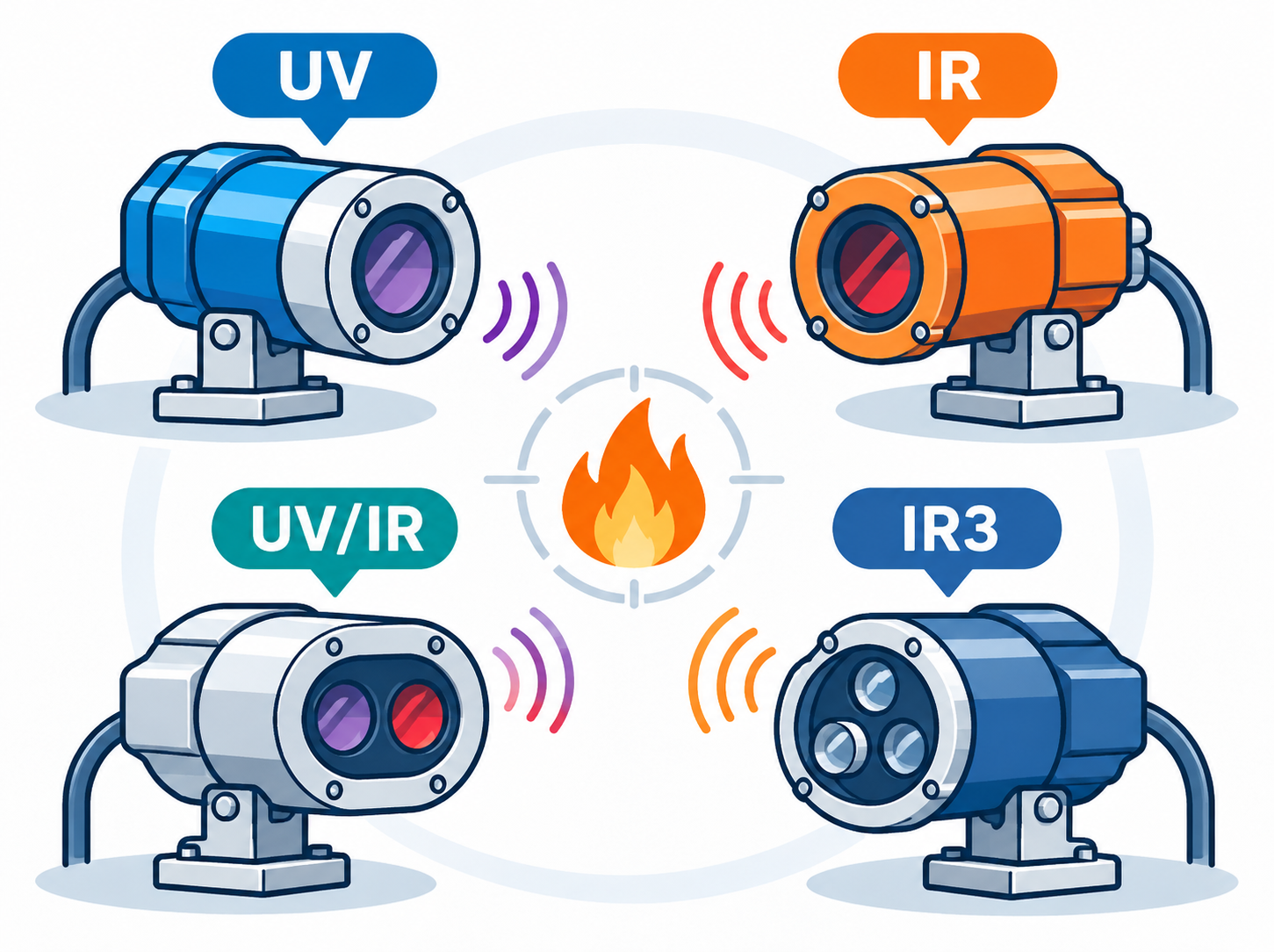
UV/IR detectors use ultraviolet and infrared sensing channels to evaluate potential flame events.
Depending on the product design, the alarm logic may require confirmation from both channels or use more complex signal processing.
This combined approach can improve resistance to certain nuisance alarm sources.
However, performance still depends on the target fuel, visibility conditions, and detector configuration.
For example, heavy smoke or contamination that significantly attenuates one sensing channel may affect detection when the alarm algorithm relies on that channel.
IR3 detectors analyze signals from multiple infrared bands to distinguish flames from selected sources of background radiation.
They are frequently considered for demanding industrial environments, including hydrocarbon processing facilities and outdoor installations.
Their main strengths are associated with spectral discrimination and application-specific resistance to nuisance alarms.
Standard hydrocarbon-focused IR3 detectors may not be suitable for fires that lack the expected combustion signature. Buyers handling hydrogen or other non-hydrocarbon fuels must verify compatibility with the exact detector model.
| Detector Type | Common Application | Main Strength | Main Limitation | Relative Price Level |
|---|---|---|---|---|
| UV | Selected industrial flames and burner applications | Rapid response to suitable UV-emitting flames | UV interference and optical attenuation | Low to medium |
| Single IR | Selected hydrocarbon fire hazards | Targeted infrared sensing | Background heat and spectral limitations | Low to medium |
| UV/IR | Industrial environments requiring combined sensing | Multiple detection channels | Performance depends on both channels and alarm logic | Medium to high |
| IR3 | Demanding hydrocarbon fire detection | Advanced spectral discrimination | Higher cost and fuel-specific limitations | High |
Price levels are general technology comparisons, not quotations. Actual costs vary by manufacturer, certification, housing, and configuration.
Detection range is one of the most frequently compared specifications, but the published value requires context.
A manufacturer may state a maximum detection distance based on a defined test fire, fuel, flame size, and sensitivity setting.
The same detector may provide different coverage when exposed to a smaller flame or installed in a location with significant background interference.
Field of view (FOV) describes the angular region within which a detector can respond to a flame.
When reviewing these specifications, check:
The reference fire used for detection-range testing
Horizontal and vertical viewing angles
Sensitivity at different positions within the field of view
Effects of obstructions and environmental conditions
A larger advertised detection range does not automatically mean better protection for every installation.
Response time is the interval between a defined flame event and the detector's corresponding output under specified test conditions.
The required response depends on the hazard assessment and the function of the protection system.
For some applications, rapid detection is essential. In others, nuisance alarm resistance and stable operation are equally important.
Manufacturers may offer adjustable sensitivity, alarm delays, or configurable output functions.
Buyers should request response-time data for the relevant fuel and test conditions rather than relying on a single general figure.
Industrial flame detectors may operate near high temperatures, moisture, dust, vibration, or corrosive substances.
The following specifications help determine installation suitability.
| Specification | What Buyers Should Verify |
|---|---|
| Operating temperature | Suitability for expected ambient conditions |
| IP or NEMA rating | Protection against dust and water ingress |
| Housing material | Corrosion resistance and mechanical durability |
| Power supply | Compatibility with the available electrical system |
| Output signals | Relay, analog, or digital communication requirements |
| Hazardous-area approval | Suitability for the installation's area classification |
| Diagnostic functions | Fault monitoring and available self-test features |
For outdoor and marine environments, housing materials and corrosion protection deserve particular attention.
The required protection level should be based on actual operating conditions, not on a universal specification.
Some flame detectors include built-in testing or diagnostic functions.
Depending on the design, these features may monitor electronic circuits, optical paths, sensor operation, or other internal conditions.
Their purpose is to help identify faults that could affect detection performance.
However, built-in diagnostics do not necessarily replace visual inspection, functional testing, or cleaning.
Maintenance procedures must follow the manufacturer's instructions and the facility's applicable safety requirements.
Flame detector prices vary because different sensing technologies require different optical components, processing systems, and protective features.
Basic devices intended for relatively simple applications may cost less than multi-spectrum detectors designed for demanding industrial environments.
A useful purchasing comparison separates products into three general groups.
Entry-level configurations
Typically focus on essential flame detection functions and straightforward integration. Their suitability depends on the application and required approvals.
Mid-range industrial configurations
May include combined sensing technologies, enhanced diagnostics, or additional communication options.
Specialized industrial configurations
May feature multi-spectrum detection, hazardous-area certifications, corrosion-resistant housings, and advanced signal processing.
These categories are indicative only. Actual pricing must be confirmed through supplier quotations.
The purchase price is only one part of the overall investment.
Consider the following cost components:
| Cost Category | Typical Expenses |
|---|---|
| Detector hardware | Sensor technology, housing, and selected options |
| Installation | Mounting brackets, wiring, and protective accessories |
| System integration | Connection to alarms, controllers, or safety systems |
| Commissioning | Functional verification and acceptance testing |
| Maintenance | Cleaning, inspections, testing, and replacement parts |
| Operational disruption | Costs associated with nuisance alarms or equipment downtime |
A lower-priced detector may not offer the lowest lifetime cost if it requires frequent maintenance or is poorly suited to the environment.
Conversely, a more expensive technology is not necessarily justified when a simpler approved detector can meet the actual requirements.
A detailed request for quotation helps suppliers recommend appropriate equipment and provide more comparable prices.
Include the following information:
Application: Open-area fire detection, industrial burner, marine engine, or another combustion system
Fuel: Expected combustible materials and operating conditions
Environment: Indoor or outdoor installation, temperature, humidity, dust, and vibration
Electrical interface: Available supply voltage and required output signals
Compliance: Required approvals and applicable standards
Quantity: Number of units and expected delivery schedule
For combustion equipment, also provide the burner or engine model and relevant control-system information.
Optical flame detectors generally require a clear line of sight to the monitored flame.
Pipes, storage vessels, structural supports, and moving machinery can obstruct detection.
A detector installed at a suitable distance may still leave portions of the hazard area unprotected if these obstructions are not considered.
For complex facilities, coverage studies can help determine detector positions and identify potential blind spots.
Several operating conditions can reduce detection performance or increase the risk of nuisance alarms.
Welding activity: Ultraviolet radiation and other signals may interfere with certain detectors.
Hot machinery: Background infrared radiation may affect some sensing technologies.
Dust and oil mist: Airborne contamination can reduce optical transmission or accumulate on detector windows.
Water spray and condensation: Moisture may interfere with the optical path, depending on the equipment and installation.
The appropriate response may involve changing detector location, selecting another sensing technology, or improving maintenance procedures.
A suitable mounting position must provide both effective coverage and safe access for maintenance.
Detectors should be installed on structures that meet the manufacturer's vibration and mechanical requirements.
The installation should also allow technicians to inspect the optical window, check electrical connections, and perform the required functional tests.
In areas with frequent contamination, maintenance access can be as important as the initial detection range.
Industrial buyers often encounter several different certification systems.
These approvals serve different purposes and should not be treated as interchangeable.
| Standard or Approval | General Relevance |
|---|---|
| EN 54-10 | Requirements and testing for point-type flame detectors in fire detection systems |
| FM approvals | Product approval under applicable FM requirements |
| UL certification | Evaluation against relevant product safety or performance standards |
| ATEX | Equipment intended for use in potentially explosive atmospheres within its applicable scope |
| IECEx | International certification framework for equipment used in explosive atmospheres |
| IEC 61508 / SIL | Functional safety assessment where applicable |
The correct combination depends on the product's intended use, the installation location, and the applicable regulatory framework.
A detector may have an appropriate enclosure rating but lack the approvals required for a particular hazardous location.
Similarly, a product with a stated safety integrity capability is not automatically suitable for every safety function.
Buyers should verify the exact model, certification scope, installation limitations, and supporting documentation.
For burner flame supervision, the relevant combustion equipment standards and burner management requirements may differ from those for open-area fire detection.
A structured purchasing process helps avoid unnecessary costs and technical mismatches.
Identify the hazard. Determine the fuel, expected flame characteristics, and required detection function.
Define the environment. Record temperature, moisture, vibration, contamination, and potential interference sources.
Compare technologies. Evaluate UV, IR, UV/IR, or IR3 devices against the application.
Review specifications. Check detection performance, response time, field of view, and electrical compatibility.
Verify approvals. Confirm certifications required for the installation.
Compare quotations. Consider equipment, installation, maintenance, and documentation.
The final decision should be supported by the manufacturer's specifications and, where necessary, an application-specific engineering assessment.
Choosing solely by detection distance
A long published range may be based on test conditions that do not represent the actual installation.
Assuming all fuels produce the same flame signature
Detection performance varies with combustion chemistry and sensor technology.
Ignoring background interference
Welding, hot equipment, and environmental contamination may affect reliability.
Comparing prices without matching specifications
Two products described as flame detectors may differ substantially in sensing technology, certification, and intended use.
Confusing flame supervision with area fire detection
A device intended to monitor an industrial burner should not automatically be selected for general fire protection.
Choosing a flame detector begins with understanding what the device must monitor. An open industrial area, a hydrocarbon processing facility, and a controlled combustion system may require different sensing technologies and safety functions.
Buyers should compare detector types using verified performance data, environmental requirements, certification scope, and total installation cost rather than relying on a single specification or advertised price. Shenzhen Zhongli Weiye Electromechanical Equipment Co., Ltd. provides product information that buyers can review when evaluating flame monitoring and combustion-related equipment. Confirming the intended application and control-system compatibility remains essential before procurement.
Common optical technologies include ultraviolet (UV), infrared (IR), combined UV/IR, and multi-spectrum infrared (IR3) detectors. Burner flame supervision may use additional sensing methods.
The best choice depends on the fuel, operating environment, required response, potential interference, and applicable certifications.
IR3 detectors often have higher purchase prices because of their multi-spectrum sensing and signal-processing systems. Actual prices depend on the model and configuration.
No. Detection capability depends on the sensing technology and the flame's spectral characteristics. Buyers should verify performance for the expected fuel.
Major factors include sensing technology, certification requirements, housing materials, output options, diagnostics, and installation conditions.
Yes. Inspection, cleaning, and functional testing should follow the manufacturer's instructions and the site's maintenance requirements.
Not automatically. These devices may have different functions, detection principles, interfaces, and certification requirements.