


A flame detector installed near a chemical processing unit may face very different conditions from one monitoring an industrial burner. Both must identify flame activity, but the expected fuel, background radiation, operating environment, and safety response can vary considerably.
Choosing between ultraviolet, infrared, combined UV/IR, and multi-spectrum infrared detectors requires more than comparing detection distance or response time. Buyers must also consider false alarm resistance, applicable safety standards, installation requirements, and long-term maintenance.
This guide compares the main flame detector types, explains their strengths and limitations, and examines how technical specifications relate to industrial safety requirements. It also distinguishes open-area fire detection from flame supervision in controlled combustion systems.
Key Takeaways
Fuel compatibility comes first. Hydrocarbon and non-hydrocarbon flames produce different radiation signatures, so detector performance must be verified for the expected fuel.
False alarm resistance depends on the environment. Welding, hot equipment, reflected radiation, and optical contamination can affect different technologies.
Safety certifications serve different purposes. Fire detection performance approvals, hazardous-area certifications, and functional safety assessments are not interchangeable.
Installation affects actual coverage. Detection range, field of view, obstructions, and maintenance access must be considered together.
What Should Buyers Evaluate When Comparing Flame Detector Types?
Before comparing individual technologies, establish the operating conditions and protection requirements. This prevents the selection process from becoming a simple comparison of advertised specifications.
Fuel Characteristics and Flame Detection Requirements
Different fuels produce different combustion products and radiation patterns. Hydrocarbon fires commonly generate infrared emissions associated with hot carbon dioxide, while hydrogen flames have different spectral characteristics.
A detector optimized for hydrocarbon fires may therefore be unsuitable for hydrogen or other non-hydrocarbon hazards. Even within the same fuel category, flame size, burning conditions, and detector sensitivity can affect performance.
Buyers should identify the combustible materials present and confirm that the selected detector has been tested for the relevant fire scenarios.
Detection Range, Response Time, and Field of View
| Specification | What It Measures | What Buyers Should Verify |
|---|---|---|
| Detection Range | Distance at which a defined test flame can be detected | Reference fuel, fire size, sensitivity setting, and test conditions |
| Response Time | Time required to generate an output under specified conditions | Performance for the intended hazard and operating configuration |
| Field of View | Angular area monitored by the detector | Horizontal and vertical coverage, including edge sensitivity |
| False Alarm Resistance | Ability to distinguish flames from interfering sources | Test results involving relevant environmental interference |
A detector's maximum published range does not guarantee equivalent sensitivity throughout its field of view. Coverage must account for the actual installation geometry and expected flame characteristics.
Environmental Conditions and False Alarm Sources
Industrial environments contain numerous sources of interference. Their effects vary with sensing technology and detector design.
Arc welding: Can produce ultraviolet radiation that interferes with certain UV detectors.
Hot machinery: May create infrared signals that complicate detection.
Oil mist and dust: Can accumulate on optical windows and reduce incoming radiation.
Water spray and condensation: May obstruct the optical path.
Vibration: Can affect mounting stability and equipment reliability.
These conditions should be documented during the hazard assessment rather than addressed only after installation.
Comparing the Four Main Optical Flame Detector Types
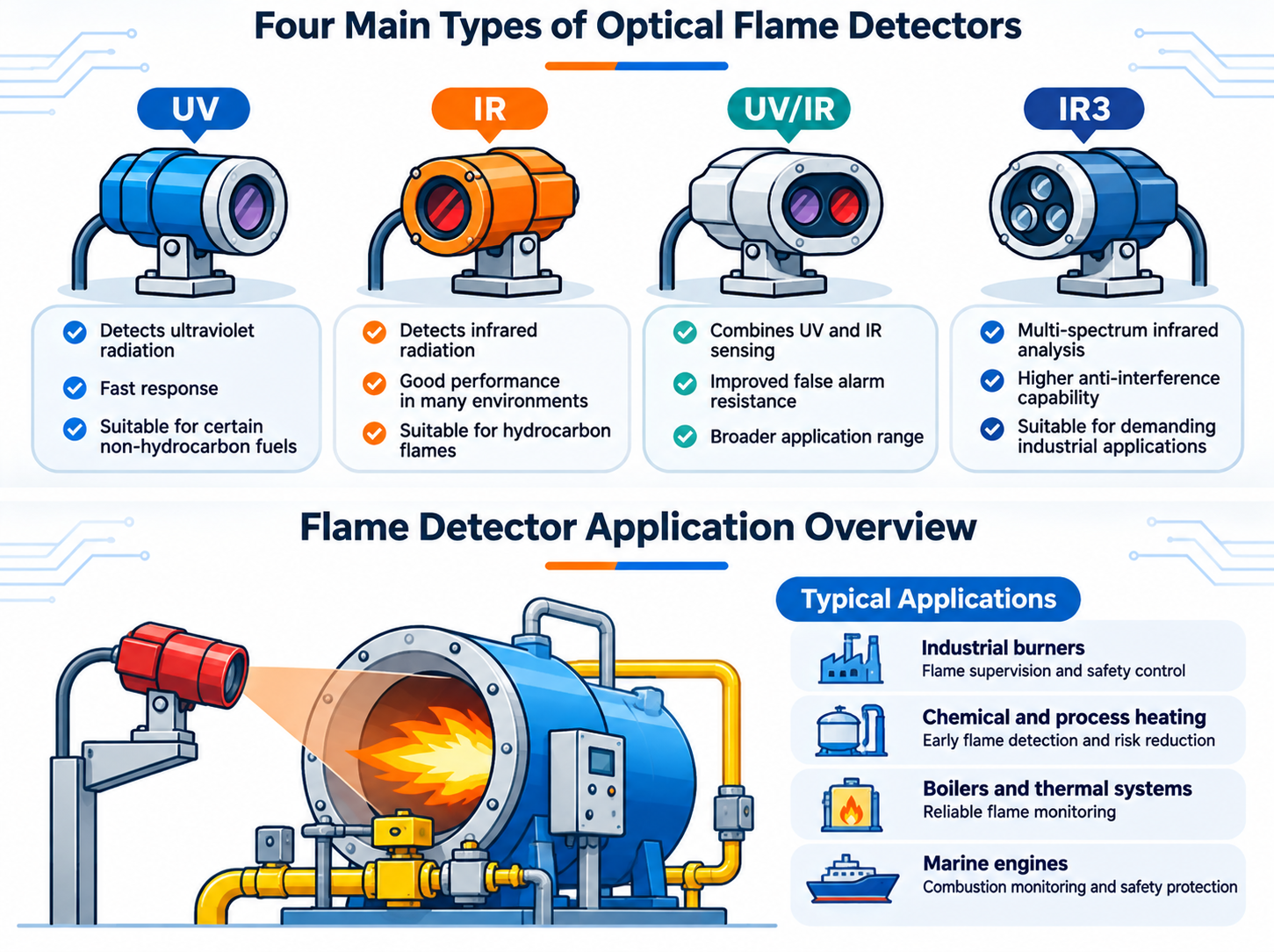
Ultraviolet (UV) Flame Detectors
UV flame detectors respond to ultraviolet radiation emitted during combustion. Many industrial designs monitor a solar-blind spectral region to reduce interference from ordinary sunlight.
Where UV detection is useful: Suitable UV detectors can provide rapid detection of certain hydrocarbon and non-hydrocarbon flames. They may be considered for applications involving hydrogen or other fuels that produce detectable ultraviolet radiation.
Important limitations: Arc welding, electrical discharges, and other UV sources may cause interference. Smoke, oil mist, and deposits on the optical window can also reduce sensitivity.
Response times vary by model, sensitivity setting, and test conditions. Buyers should not assume that every UV detector provides millisecond-level detection.
Infrared (IR) Flame Detectors
Single-spectrum infrared detectors monitor selected infrared wavelengths associated with combustion. Some designs focus on radiation emitted by hot carbon dioxide during hydrocarbon burning.
IR technology can be useful where the target fuel produces the expected spectral signature. However, background heat and modulated infrared radiation may create challenges.
For example, a rotating component reflecting radiation from hot equipment can produce a changing signal. Depending on the detector's processing method, such conditions may resemble certain flame characteristics.
Appropriate filtering and signal processing help distinguish real flames from interference, but the degree of protection depends on the specific detector.
Combined UV/IR Flame Detectors
UV/IR detectors combine two sensing technologies within one device. Their purpose is to evaluate flame characteristics using more than one spectral channel.
Typical detection process:
The UV sensor monitors radiation within its designated spectral range.
The IR sensor evaluates infrared radiation associated with combustion.
The detector's processing system compares the signals according to its programmed alarm logic.
An alarm output is generated when the required detection conditions are satisfied.
Using multiple channels can improve resistance to certain nuisance alarm sources. However, not all UV/IR detectors use identical alarm algorithms.
If a detector requires confirmation from both channels, interference or attenuation affecting either channel may influence its response. Buyers should review the manufacturer's detection logic and tested performance.
Multi-Spectrum Infrared (IR3) Flame Detectors
IR3 detectors use multiple infrared sensing bands to evaluate flame radiation and distinguish it from selected background sources.
They are commonly considered for demanding hydrocarbon fire detection applications, including outdoor processing facilities and industrial installations with significant background interference.
Advantages: Multi-spectrum analysis can provide strong resistance to certain false alarm sources while supporting detection over substantial distances under appropriate test conditions.
Limitations: Standard hydrocarbon-focused IR3 detectors may not detect hydrogen or other fuels that lack the expected combustion signature. Specialized designs may support different fuels, but compatibility must be verified for the exact model.
Flame Detector Technology Comparison Table
| Detector Type | Typical Application | Main Strength | Key Limitation |
|---|---|---|---|
| UV | Selected hydrocarbon and non-hydrocarbon hazards | Rapid response to suitable UV-emitting flames | UV interference and optical attenuation |
| Single IR | Selected hydrocarbon fire hazards | Targeted infrared detection | Background heat and spectral limitations |
| UV/IR | Industrial applications requiring combined sensing | Multiple detection channels | Performance depends on channel conditions and alarm logic |
| IR3 | Demanding hydrocarbon fire detection | Advanced spectral discrimination | Higher equipment cost and fuel-specific limitations |
No single technology is universally superior. Selection should be based on the actual fire hazard, environmental conditions, and verified performance data.
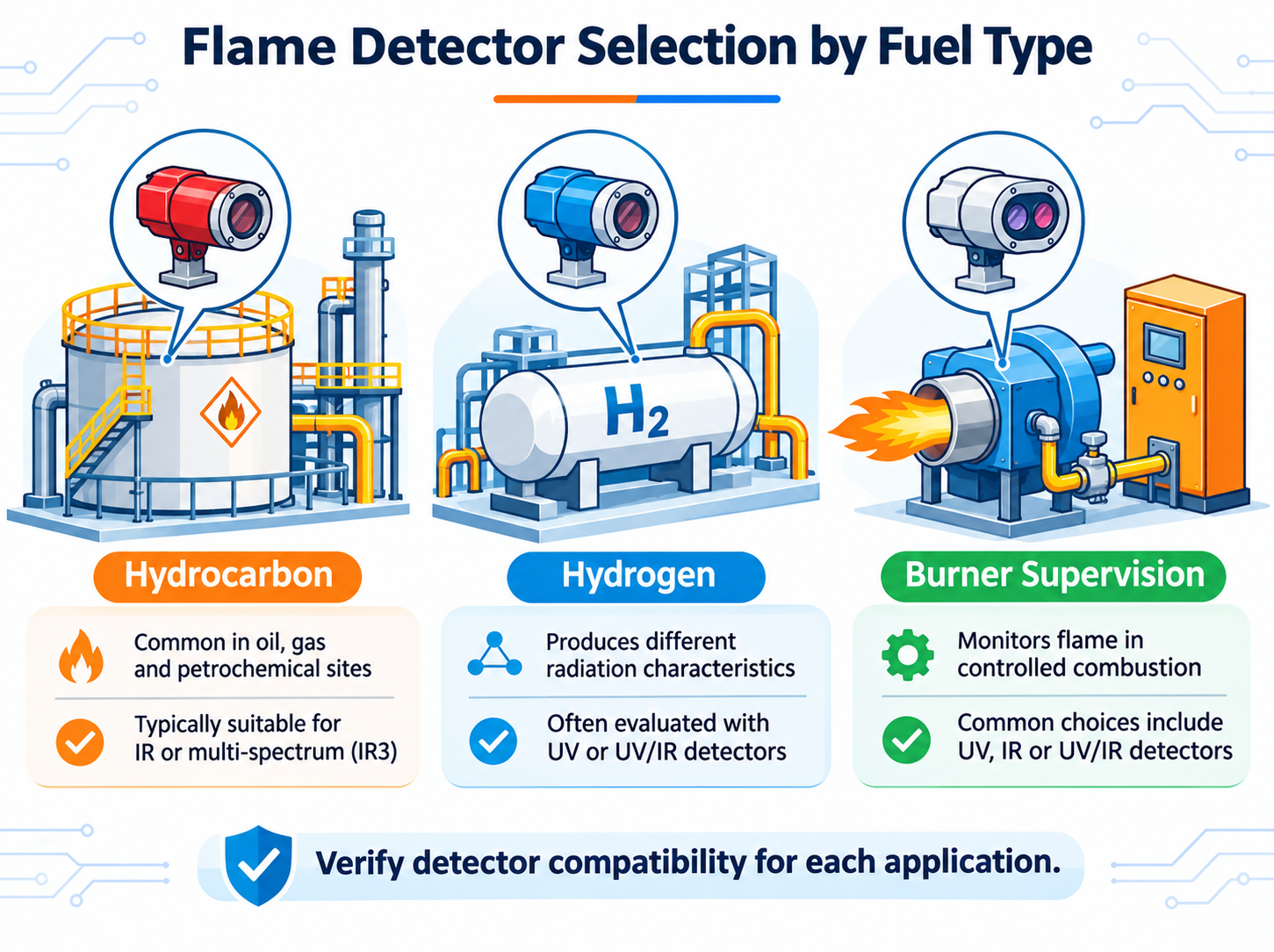
Matching Flame Detector Types to Industrial Applications
Oil, Gas, and Petrochemical Facilities
Hydrocarbon processing facilities may contain storage tanks, pumps, valves, loading stations, and other equipment associated with combustible materials.
Outdoor conditions introduce additional challenges, including sunlight, rain, vibration, and changing temperatures.
Multi-spectrum infrared detectors are often considered for these applications because their signal-processing methods can help distinguish hydrocarbon flames from selected sources of background radiation.
Nevertheless, detector placement and fire coverage studies remain essential. A suitable sensing technology cannot compensate for a blocked field of view.
Hydrogen Processing and Storage Areas
Hydrogen flames require particular attention because their combustion characteristics differ from those of hydrocarbon fires.
Standard IR detectors designed around carbon dioxide emissions may be unsuitable for hydrogen detection.
For these installations, the selection process should include:
Identification of the expected hydrogen fire scenarios
Verification of the detector's tested fuel compatibility
Assessment of background radiation and environmental conditions
Review of required detection coverage and safety response
UV detectors or specially designed multi-spectrum systems may be suitable, depending on their verified performance.
Aircraft Hangars and Industrial Manufacturing
Aircraft hangars and manufacturing facilities may contain combustible liquids, electrical equipment, welding operations, and complex physical obstructions.
The appropriate detector depends on the specific hazards. For example, a hangar handling aviation fuel may require different detection performance from a workshop containing metalworking fluids and welding stations.
UV/IR and multi-spectrum technologies may be considered where resistance to nuisance alarms is important.
Detector placement should also account for machinery, structural supports, and changing equipment arrangements that could obstruct the monitored area.
Industrial Burners and Combustion Equipment
Flame supervision in controlled combustion equipment differs from open-area fire detection.
In an industrial burner, the flame monitoring system confirms whether the intended combustion flame is present. Its signal is used by the burner control system to support the required operating and safety sequence.
For example, a flame detector for marine engine applications is intended for a specific combustion monitoring environment rather than general fire surveillance across a large industrial area.
Similarly, the flame supervision requirements of industrial gas burners depend on the combustion system, controller compatibility, fuel characteristics, and applicable burner safety requirements.
These devices should not be substituted for open-area fire detectors without verifying their intended functions and approvals.
Flame Detector Safety Standards and Certifications
Understanding SIL and Functional Safety
Safety Integrity Level (SIL) is associated with the required risk reduction of a safety function within a functional safety framework.
IEC 61508 provides a general framework for functional safety of electrical, electronic, and programmable electronic safety-related systems.
A detector may have supporting functional safety assessment documentation, but its suitability must be evaluated within the complete safety function.
A device's SIL capability does not automatically establish the SIL achieved by an entire fire detection or shutdown system. Architecture, diagnostics, proof testing, failure data, and other system factors also matter.
ATEX, IECEx, and Hazardous-Area Requirements
| Certification Framework | Primary Purpose | Buyer Consideration |
|---|---|---|
| ATEX | Requirements for equipment intended for potentially explosive atmospheres within the applicable regulatory scope | Check equipment marking, category, and intended installation zone |
| IECEx | International certification framework for equipment used in explosive atmospheres | Verify certificate scope and protection method |
| North American hazardous-location approvals | Evaluation for relevant classified locations | Confirm Class/Division or Zone suitability as applicable |
Hazardous-area certification addresses ignition risks associated with equipment operating in potentially explosive atmospheres.
It does not, by itself, demonstrate flame detection performance for a particular fuel or fire scenario.
Fire Detection Performance Standards
Several standards and approval programs may be relevant to optical flame detection systems.
EN 54-10: Addresses point-type flame detectors used in fire detection and fire alarm systems.
FM approvals: May provide independent product evaluation under applicable approval requirements.
UL certification: May demonstrate conformity with relevant product standards, depending on the certification.
NFPA 72: Provides requirements relevant to fire alarm and signaling systems within its scope.
These standards and approvals address different aspects of equipment performance and system design.
Buyers should verify the exact product certification rather than assuming that a manufacturer's general compliance statement applies to every model.
How to Verify Certification Documents
Before purchasing a detector for a safety-critical installation, check the documentation in the following order.
Confirm the exact detector model and configuration.
Identify the standards required by the project and local regulations.
Review certificates and their stated scope.
Check environmental and installation limitations.
Verify that the documentation matches the equipment being supplied.
Where functional safety is involved, the assessment should also consider the complete safety instrumented function rather than the detector alone.
Installation, Coverage, and Maintenance Requirements
Preventing Blind Spots Through Detector Placement
Optical flame detectors generally require a clear line of sight to the monitored flame.
Storage vessels, piping, structural supports, and moving equipment can create areas that remain outside the effective detection coverage.
For complex facilities, three-dimensional fire and gas mapping can help evaluate detector placement, field-of-view overlap, and potential obstructions.
However, coverage calculations should use appropriate detector performance data and realistic fire scenarios.
Optical Contamination and Built-In Testing
Dust, oil mist, salt deposits, and other contaminants can accumulate on optical windows and reduce the radiation reaching the sensor.
Some flame detectors include built-in testing (BIT) or diagnostic functions that monitor aspects of sensor operation or optical integrity.
These functions can help identify certain faults, but their capabilities vary between models.
Built-in diagnostics should not be assumed to replace cleaning, visual inspection, or manufacturer-approved functional testing.
Environmental Protection and Heated Optics
Outdoor detectors may encounter rain, condensation, frost, or other conditions that affect optical performance.
Depending on the installation, suitable environmental protection features may include:
Appropriate ingress protection ratings
Corrosion-resistant housing materials
Optical window heating where supported and necessary
Suitable mounting and protective accessories
Maintenance access for cleaning and inspection
Heated optics can help manage certain condensation or frost conditions, but they do not guarantee uninterrupted detection in every weather condition.
Inspection and Functional Testing
A maintenance program should reflect the detector manufacturer's instructions and the operating environment.
| Maintenance Activity | Purpose |
|---|---|
| Visual inspection | Identify damage, contamination, and mounting problems |
| Optical window cleaning | Remove deposits that may reduce sensitivity |
| Diagnostic review | Check reported faults and available self-test information |
| Functional testing | Verify operation using approved procedures and equipment |
| Documentation review | Maintain inspection and test records |
Testing intervals should be established according to manufacturer requirements, applicable standards, and the site's risk-based maintenance program.
How to Select the Right Flame Detector for Industrial Safety
A Practical Procurement Checklist
When comparing flame detector types, procurement teams should request enough technical information to evaluate each product against the same requirements.
Fuel compatibility: Confirm performance for the expected combustible materials.
Detection coverage: Review range, field of view, and applicable test conditions.
Response time: Compare verified performance against the required safety response.
Environmental suitability: Check temperature, ingress protection, and interference resistance.
Certifications: Verify approvals for the intended application and installation area.
System integration: Confirm power supply, output signals, and controller compatibility.
Maintenance: Review diagnostics, inspection requirements, and spare parts availability.
Common Selection Mistakes
Choosing the longest advertised detection range. Published distances are usually based on defined test fires and conditions. Actual coverage may differ.
Assuming one technology detects every fuel. Flame radiation characteristics vary, and detector compatibility must be verified.
Ignoring the installation environment. Background radiation, optical contamination, and physical obstructions can affect performance.
Treating certifications as interchangeable. Fire detection approvals, hazardous-area certifications, and functional safety documentation serve different purposes.
Confusing flame supervision with fire detection. A burner flame sensor and an open-area flame detector may have different functions and system requirements.
Final Equipment Evaluation
The final decision should be based on documented performance and a clear understanding of the intended application.
For large or complex industrial installations, a qualified fire protection engineer should evaluate the required coverage, safety response, and integration with other protective systems.
For combustion equipment, the burner manufacturer and qualified combustion specialists should confirm compatibility with the burner management system.
Equipment should be selected for its verified suitability, not simply its technology category or purchase price.
Conclusion
Comparing flame detector types is an important part of industrial safety planning, but no single sensing technology can meet every requirement. UV, IR, UV/IR, and IR3 detectors offer different advantages depending on the fuel, background conditions, and required detection function.
Reliable protection also depends on correct installation, appropriate certification, maintenance, and integration with the wider safety system. Buyers should therefore evaluate both detector performance and the operating conditions in which the equipment will be used.
For industrial combustion applications, Shenzhen Zhongli Weiye Electromechanical Equipment Co., Ltd. supplies burner equipment and related combustion components. Selecting compatible flame monitoring equipment is an essential part of maintaining the intended operating and safety functions of these systems.
FAQ
What are the main types of industrial flame detectors?
The main optical flame detector types include ultraviolet (UV), infrared (IR), combined UV/IR, and multi-spectrum infrared (IR3) detectors.
Which flame detector is suitable for hydrogen fires?
Suitable UV detectors and specially designed multi-spectrum detectors may detect hydrogen flames, but buyers must verify the exact model's tested performance for hydrogen.
Are IR3 flame detectors better than UV detectors?
IR3 detectors can offer strong false alarm resistance in suitable hydrocarbon applications, while UV detectors may be more appropriate for certain non-hydrocarbon hazards.
What safety certifications should a flame detector have?
Required certifications depend on the application and may involve fire detection performance approvals, hazardous-area certification, and functional safety documentation.
Can one flame detector monitor an entire industrial facility?
Coverage depends on detection range, field of view, obstructions, and hazard distribution, so multiple detectors may be necessary to achieve the required protection.
Do optical flame detectors require regular maintenance?
Yes, optical flame detectors require inspection, cleaning, and functional verification according to manufacturer instructions and applicable maintenance requirements.
Can an industrial burner flame detector replace an open-area fire detector?
Not automatically, because burner flame supervision and open-area fire detection serve different functions and may require different sensing methods, control interfaces, and approvals.