lucy@zlwyindustry.com
+86-158-1688-2025
Please Choose Your Language
- All
- Product Name
- Product Keyword
- Product Model
- Product Summary
- Product Description
- Multi Field Search

Views: 0 Author: Site Editor Publish Time: 2026-11-11 Origin: Site


Specifying industrial combustion systems remains a high-stakes engineering decision. The wrong choice inevitably leads to excessive fuel consumption. It can trigger severe regulatory fines for emissions violations. Often, it causes chronic, unplanned downtime across critical processes. Modern facility upgrades demand more than simply evaluating basic heat output. You must carefully balance fuel flexibility and advanced digital controls. Strict environmental compliance is equally crucial for long-term viability. Plant managers face mounting pressure to optimize every operational metric.
This guide provides a definitive, decision-stage framework for evaluating these critical systems. We strip away marketing claims entirely. Instead, we focus exclusively on technical specifications and implementation realities. You will learn how to match capacity to specific load dynamics. We will explore various fuel configurations, from standard gas to dual-fuel setups. Finally, we cover critical control technologies and vendor selection strategies. This knowledge ensures your next installation runs flawlessly from day one.
Engineers must define strict operational parameters before beginning the procurement process. You need equipment capable of satisfying core process heating needs. It must also handle peak steam generation demands flawlessly. However, you must avoid the common trap of over-specifying. Oversized equipment wastes energy and degrades rapidly. When assessing Industrial Burners, establish a rigorous baseline. This foundation guarantees optimal performance across all operational phases.
First, match the maximum capacity to your specific boiler or furnace. You typically measure this output in BTU/hr or kilowatts. The equipment must deliver enough energy to satisfy absolute peak demand. Yet, facilities rarely operate at peak capacity continuously. Load demands fluctuate throughout production cycles.
This reality makes the turndown ratio incredibly important. The turndown ratio compares maximum output to minimum output. A 10:1 ratio offers massive flexibility. A 4:1 ratio serves basic, steady loads adequately. High turndown ratios prevent dangerous short-cycling. Short-cycling occurs when equipment constantly fires and shuts down. This rapid cycling destroys components through thermal shock. It also wastes massive amounts of purge energy. Investing in a wider ratio saves fuel during partial loads.
Flame geometry must perfectly match your combustion chamber. A mismatched flame shape causes severe internal damage. If the flame touches the boiler tubes, impingement occurs. Impingement creates localized hot spots. These hot spots eventually cause catastrophic tube failure. You must review dimension drawings carefully.
Furthermore, the system must overcome existing furnace backpressure. Backpressure is the resistance pushing against the flame. Combustion air fans must generate sufficient static pressure. If the fan falls short, combustion becomes unstable. Unstable combustion causes dangerous pulsations. It also leads to heavy soot formation. Always verify draft fan curves against your specific chamber resistance.
Environmental compliance dictates many engineering decisions today. You must evaluate Ultra-Low NOx and carbon monoxide guarantees strictly. Many jurisdictions now mandate sub-9 ppm NOx levels. Manufacturers achieve this using Flue Gas Recirculation (FGR) or specialized mesh heads. You must understand which technology they deploy.
Always verify performance data against local environmental mandates. The EPA sets broad standards, but local air quality boards enforce stricter rules. Ask vendors for third-party emission test results. Do not accept theoretical calculations for compliance. Demand guaranteed emission curves across the entire firing range. This protects you from unexpected fines during annual inspections.
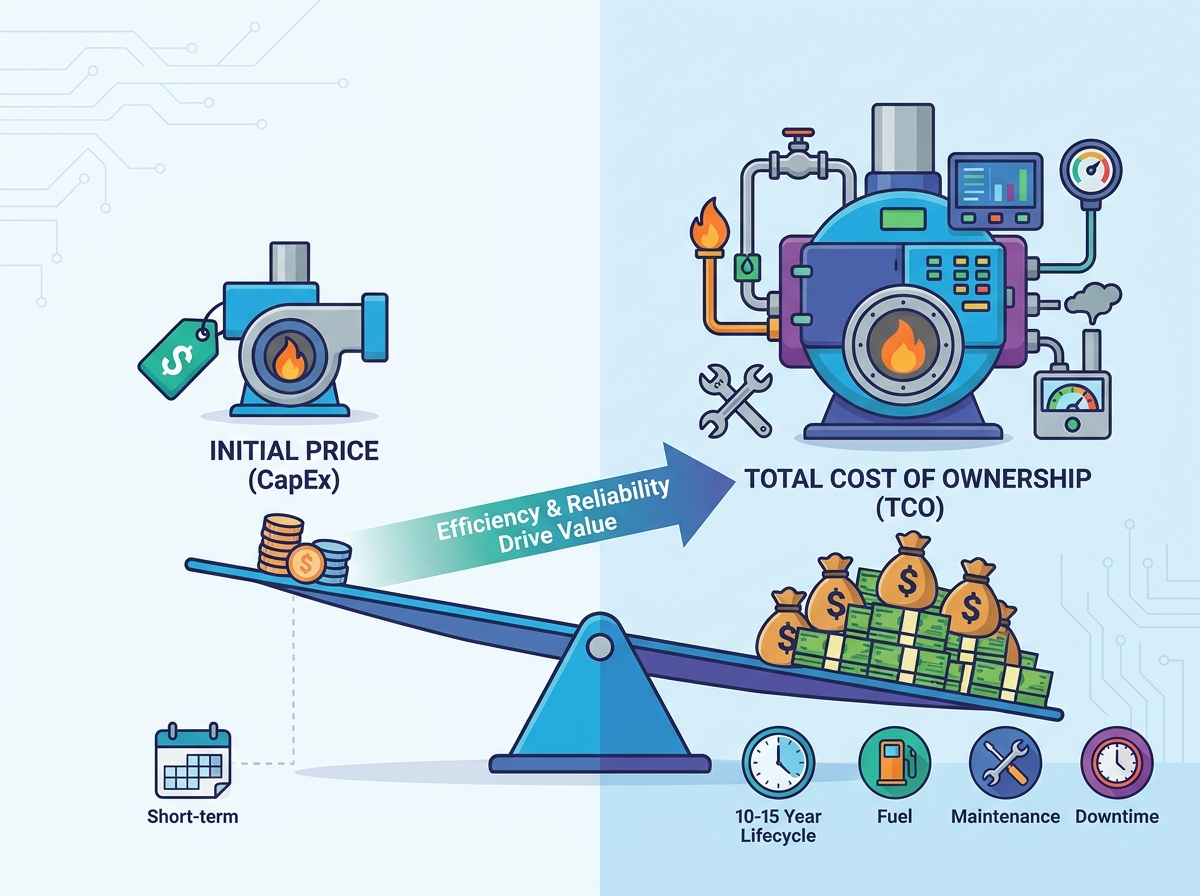
Your fuel strategy directly dictates your equipment design. You must compare primary fuel types based on operational realities. Evaluate your local supply chain risks carefully. Assess existing infrastructure capabilities before finalizing decisions. A cheaper burner burning expensive fuel quickly becomes a financial liability.
Fuel Configuration Comparison Chart
| Fuel Type | Primary Advantage | Major Vulnerability | Best Use Case |
|---|---|---|---|
| Natural Gas | Cleanest emissions profile | Grid pressure fluctuations | Urban, highly regulated areas |
| Heavy/Light Oil | Exceptional energy density | High maintenance demands | Remote, off-grid locations |
| Dual-Fuel | Ultimate energy security | Complex commissioning | Critical facilities (hospitals, data centers) |
Natural gas remains the dominant choice for most modern facilities.
Oil configurations serve specific industrial niches effectively.
Dual-fuel configurations represent a strategic energy-security play. They allow facilities to switch fuels instantly. You can react to spot pricing shifts immediately. If a natural gas pipeline fails, you switch to backup oil seamlessly. This prevents catastrophic production losses.
However, you must address the inherent trade-offs. Dual-fuel systems command a higher initial purchase price. They feature complex piping trains. Commissioning requires twice the tuning effort. Technicians must balance combustion curves for two entirely different fuels. Despite these challenges, critical operations consider this redundancy non-negotiable.
Buyers must shift their focus from mechanical hardware to software. Automation now dictates daily safety and long-term efficiency. The Burner Management System (BMS) acts as the operational brain. A superior mechanical design fails miserably under poor digital control. You must evaluate BMS capabilities rigorously.
Modern facilities actively abandon traditional mechanical linkages. Jackshafts and metal rods suffer from severe hysteresis. They wear down physically over time. This wear creates slop in the movement. Consequently, the air-to-fuel ratio drifts off target continuously.
Linkageless controls solve this problem completely. They utilize precise, independent servo motors. One motor controls the fuel valve. Another controls the air damper. The digital BMS coordinates their movements flawlessly. This separation allows highly customized tuning across the entire firing curve. You achieve absolute precision without mechanical degradation.
Atmospheric conditions change constantly. Morning air is dense and cold. Afternoon air is warm and thin. These changes ruin static combustion ratios. O2 trim technology actively fixes this issue. The system integrates oxygen and carbon monoxide sensors directly into the exhaust stack.
The BMS reads these sensor inputs continually. It performs real-time air-to-fuel ratio adjustments. If it detects excess air, it trims the fan speed. If it detects unburned fuel, it adds more air. This active compensation neutralizes ambient temperature shifts. It adjusts for barometric pressure changes automatically. The result is relentless, optimized efficiency.
Safety remains the absolute highest priority. You must demand SIL (Safety Integrity Level) certifications for the BMS. SIL ratings prove the software architecture resists dangerous failures. The system must execute automated pre-purge and post-purge cycles perfectly. These purges clear explosive gases from the chamber.
Furthermore, seamless plant integration is necessary. The BMS must communicate effortlessly with existing SCADA or DCS systems. Use standardized protocols like Modbus or Ethernet/IP. Operators need real-time visibility into flame strength and fault codes. Good integration allows predictive maintenance rather than reactive troubleshooting.
Buyers often struggle deciding between off-the-shelf and engineered solutions. You must guide this decision using operational facts, not assumptions. Sometimes, standard equipment serves perfectly. Other times, non-standard conditions demand heavy customization.
Standard vs. Custom Implementation Matrix
| Requirement | Standard Solution | Custom Engineered Solution |
|---|---|---|
| Lead Time | 4 to 8 weeks | 16 to 30 weeks |
| Fuel Source | Pipeline natural gas, #2 oil | Biogas, hydrogen blends, waste gas |
| Chamber Geometry | Standard cylindrical boiler | Asymmetrical kiln, narrow furnace |
| Spare Parts | Readily available locally | Often requires specialized ordering |
Standard models work best for typical firetube or watertube boilers. If your facility has predictable loads, standard units excel. They handle standard fuels and typical atmospheric conditions easily. The primary advantages are speed and support.
Manufacturers stock standard components widely. Lead times remain remarkably short. When parts fail, local distributors usually have replacements on the shelf. You benefit from proven, repeatable engineering. Do not force customization if your process does not truly require it.
Certain scenarios make custom engineering absolutely mandatory. Extreme operating temperatures destroy standard materials quickly. Non-standard kiln shapes require highly specialized flame shaping. If your draft is unusually restrictive, custom fan curves become essential.
Alternative fuels trigger immediate customization. Firing wet biogas requires specialized moisture-handling components. Hydrogen blends burn incredibly hot and fast. They require unique metallurgy to prevent melting. Note the inherent risks here. Custom builds demand significantly longer lead times. They also require rigorous Factory Acceptance Testing (FAT) before shipment.
Narrowing down suppliers requires a concrete roadmap. You cannot evaluate a vendor purely on their brochure. Preparation for installation matters just as much as equipment design. You must assess technical support and retrofit realities simultaneously.
Mating new technology to an aging boiler presents massive risks. You must assess physical compatibility thoroughly. Demand a detailed site audit from the vendor. They must measure the existing mounting plate precisely. Modifications are often necessary.
Additionally, evaluate the existing refractory. Modern, high-intensity flames can destroy old refractory brick. The vendor should advise if refractory upgrades are mandatory. Ignore this, and the new equipment might melt the old chamber wall. Ensure the vendor assumes responsibility for physical mating dimensions.
A high-end system fails without a qualified technician tuning it. Evaluate the vendor's local presence critically. Where is their nearest certified technician? You need someone available for setup, tuning, and warranty support.
Initial commissioning defines future success. The technician must set the combustion curves flawlessly. They must test every safety interlock under load. If the vendor relies entirely on outsourced, untrained contractors, walk away. Demand factory-certified support for the critical startup phase.
You must control the bidding process actively. Vague proposals lead to expensive change orders later. Demand a structured, highly detailed technical bid.
List exactly what the buyer must demand in the bid:
Specifying an industrial combustion system is a complex balancing act. You must align load dynamics with strict emission constraints. You also have to leverage the latest digital control technology. Modern equipment offers unprecedented precision, provided you choose the right configuration. Every facility possesses unique demands, making a generic approach highly risky.
We advise buyers to look far beyond the initial price tag. Prioritize long-term fuel efficiency above all other metrics. Insist on linkageless controls and robust O2 trim systems. Mandate a comprehensive site audit before finalizing any procurement. By doing so, you secure reliable, compliant, and highly efficient operations for decades to come.
A: While a 10:1 ratio is excellent for highly variable loads, it is not universally necessary. A 4:1 or 6:1 ratio may be entirely adequate for stable, continuous base-load operations. The ideal ratio depends entirely on your facility's specific steam or heat demand curve. Overspecifying turndown can add unnecessary complexity.
A: Upgrading from outdated mechanical linkages to a modern digital BMS with O2 trim yields significant results. Facilities typically see a 2% to 5% reduction in total fuel consumption. Because fuel is the largest operational expense, this reduction usually offers a rapid return on investment.
A: While retrofitting is sometimes mechanically possible, it is rarely recommended. It often requires replacing the entire burner head, the fuel piping train, and the control system. Due to this extensive modification, completing a full replacement is almost always more reliable and cost-effective.
A: With rigorous preventative maintenance and high-quality water and fuel treatment, these systems are highly durable. A commercial or industrial unit should perform reliably for 15 to 20 years. After this period, technological advancements usually make full replacement more logical than continued repairs.