lucy@zlwyindustry.com
+86-158-1688-2025
Please Choose Your Language
- All
- Product Name
- Product Keyword
- Product Model
- Product Summary
- Product Description
- Multi Field Search

Views: 0 Author: Site Editor Publish Time: 2026-11-13 Origin: Site


Unplanned downtime and fuel inefficiencies erode facility profit margins. Every single hour of lost production cuts into operational stability. Minor faults escalate quickly. Operators face sudden flame instability or gradual emissions increases. They need accurate diagnostics to determine the root cause. Without precise troubleshooting, facilities risk wasting capital on temporary fixes. Identifying problems early prevents standard mechanical wear from becoming a catastrophic safety hazard. This guide breaks down the most frequent operational failures. We detail how to resolve them safely. You will also get a clear framework for deciding when to repair, retrofit, or replace equipment. Proper intervention safeguards your operational budget. It also protects your environmental compliance standing. Whether managing a massive boiler or a localized kiln, heating precision matters. Failing to address these issues leads to ruined product batches. Reviewing these diagnostics ensures peak combustion performance.
Operators often miss early warning signs on the factory floor. They turn minor maintenance tasks into catastrophic production stops. Identifying symptoms early minimizes repair costs. Catching a fault before failure saves thousands in downtime. You must monitor visual and operational indicators daily.
Flame color provides immediate feedback on combustion health. An excessive yellow or orange flame indicates incomplete combustion. This specific color change warns of severe carbon monoxide risks. It also signals massive fuel waste. An uneven, lifting, or "lazy" flame points to insufficient draft. The fuel fails to mix properly. Unburned gases escape the stack. For example, in a commercial bakery, a lazy flame causes uneven product baking.
Audible warnings demand immediate attention. You might hear abnormal rumbling from the combustion chamber. High-pitched whining points to failing blower bearings. Ignition "booming" happens due to delayed fuel ignition. The fuel pools briefly before igniting violently. This booming stresses the mechanical casing. It poses a severe safety hazard to operators.
System alerts often precede total failure. Watch for these specific dashboard warnings:
These inconsistencies ruin product quality. Control systems shut down the unit to prevent explosions. Documenting these alerts helps technicians trace the root cause quickly.
Technicians categorize technical failures to streamline standard interventions. Approaching diagnostics methodically isolates the core mechanical fault. We break down the four most common operational problems below. Understanding these failure points helps you deploy the correct maintenance strategy.
Proper combustion requires an exact ratio of oxygen to fuel. Blocked air intakes disrupt this delicate balance entirely. Faulty dampers restrict the necessary primary airflow. Failing blower motors cannot provide adequate static pressure. Technicians resolve this by recalibrating linkage systems. They adjust control valves to restore exact setpoints. Cleaning primary combustion air pathways removes restrictive dust buildup. This immediate solution restores the intended thermal output.
Consistent fuel delivery drives reliable heating performance. Clogged gas nozzles restrict flow into the firing head. Degraded regulators cause sudden pressure spikes or drops. Compromised piping introduces dangerous leaks into the facility environment. Fixing this requires inspecting the entire gas train.
Follow this basic verification sequence:
Identifying blockages ensures consistent fuel volume during high-demand cycles.
A stable flame anchors the entire heating process. Soot buildup on flame rods blinds the safety scanner. Failing ignition transformers cannot produce a strong pilot spark. Improper draft conditions blow the flame off the firing head. Maintenance teams clean or replace the flame scanner assembly. They swap out degraded sensors causing nuisance trips. Verifying draft pressure ensures the exhaust stack pulls correctly. This prevents the primary flame from smothering itself.
Extreme heat takes a toll on physical components. Thermal shock cracks the protective internal linings. Aging burner tiles crumble under continuous high-cycle operation. This degradation exposes the outer metal casing to direct flame. Operators must patch or replace damaged refractory material. Repairing these linings prevents severe heat loss. It protects the primary casing from warping or melting. Proactive patching extends the lifespan of the entire unit.
Translating technical problems into business outcomes supports smart maintenance decisions. Equipment faults directly impact daily profitability. A mere five percent drop in combustion efficiency wastes massive capital. It translates to thousands of dollars in wasted natural gas annually. Alternative fuels drain operational expenditure (OPEX) just as quickly. Inefficient systems burn more fuel to reach target temperatures. This compounds daily fuel costs over the entire fiscal year. Managers must track OPEX data to justify immediate repairs. Using Industrial Burners efficiently protects the facility operating budget.
Unresolved issues lead to elevated NOx and CO levels. These emissions create massive compliance risks for the facility. Failed environmental audits trigger severe regulatory fines. Local authorities mandate strict limits on greenhouse gas outputs. Ignoring a rich fuel mixture invites mandatory production shutdowns. Ensuring clean combustion keeps the facility legally compliant. It also protects on-site workers from dangerous gas exposure.
Calculating the true cost of downtime reveals staggering losses. Stalled production lines cost far more than routine maintenance. A sudden shutdown stops product output completely. You must account for idle labor and missed shipping deadlines. Proactive maintenance requires a small, planned operational pause. Upgrading an aging system prevents unexpected overnight failures. Facility managers must weigh emergency repair rates against scheduled service fees. Planned interventions always cost less than catastrophic equipment failure.
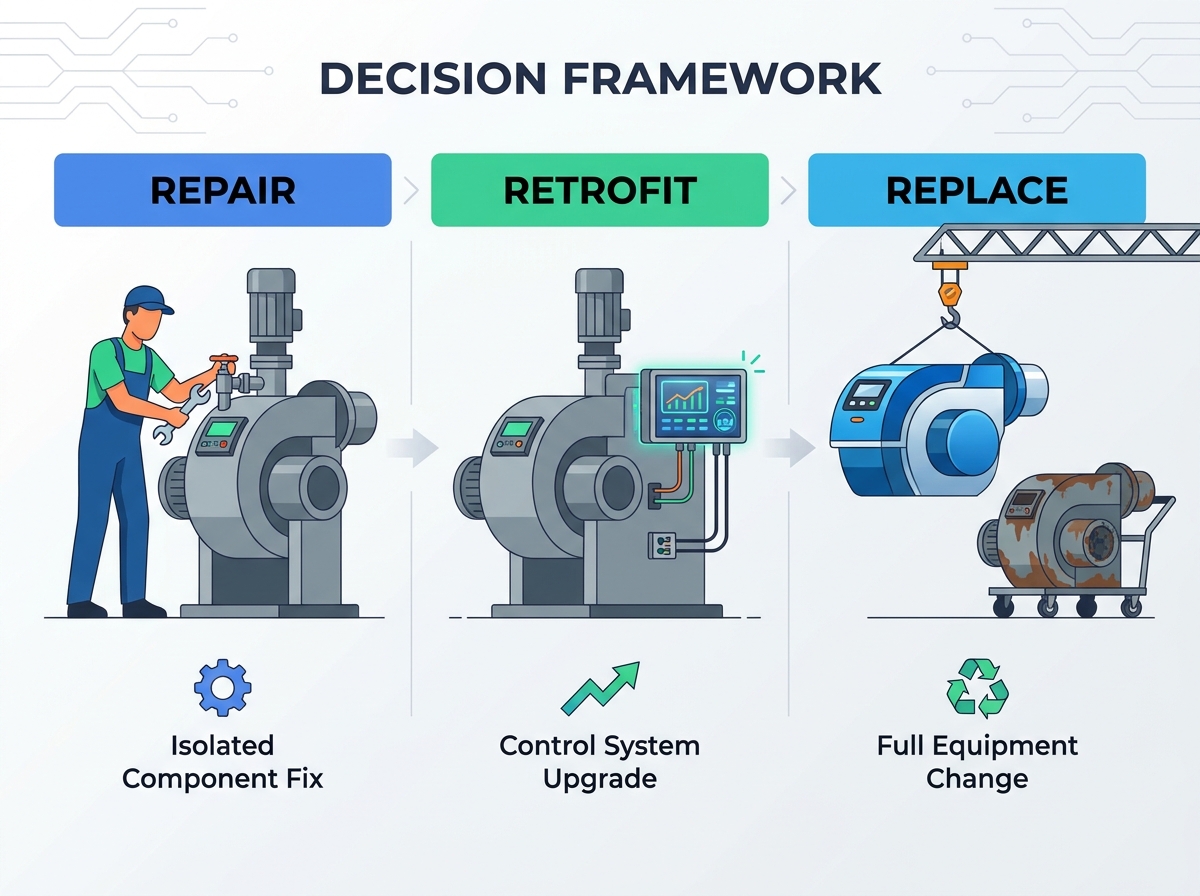
Operators need a transparent framework for making equipment decisions. You want to avoid pushing unnecessary capital expenditures. Analyzing evidence guides the most cost-effective intervention strategy. Understanding equipment lifecycles prevents wasted maintenance funds.
Routine servicing works best for newer equipment. Rely on repairs for units under ten years old. Isolated component failures require simple, low-cost fixes. Swapping a faulty gas valve solves the immediate problem. Cleaning a dirty nozzle restores optimal fuel spray patterns. However, band-aid fixes on aging units carry heavy risks. They often lead to repetitive downtime. Constant minor repairs disrupt steady production schedules.
Retrofitting upgrades the system without replacing the heavy body. You can add advanced burner management systems (BMS). Upgrading to parallel positioning controls maximizes operational efficiency. The main housing remains in place. This strategy suits facilities needing to meet stricter emissions standards. It provides a massive performance boost on a moderate budget. A retrofit modernizes the control sequence flawlessly. It also allows for advanced O2 trim integrations.
Full replacement offers the smartest ROI in specific scenarios. The existing unit might be mechanically compromised beyond repair. Obsolete parts make routine servicing completely impossible. Facilities scaling up capacity require entirely new heating capabilities. Evaluating transitions drives long-term sustainability goals. Moving from traditional gas to ultra-low-NOx models reduces emissions drastically. Evaluating electric or hybrid systems aligns corporate decarbonization mandates.
Burner Upgrade Decision Matrix
| Intervention Strategy | Equipment Age | Primary Trigger | Budget Impact |
|---|---|---|---|
| Component Repair | Under 10 Years | Isolated sensor or valve failure | Low OPEX impact |
| Control Retrofit | 10 to 15 Years | Poor efficiency, outdated linkages | Moderate Capital Expenditure |
| Full Replacement | Over 15 Years | Cracked casing, obsolete parts | High Initial Capital |
Hiring the right contractor prevents costly installation errors. You must evaluate potential partners using strict technical criteria. Do not hire generalists for complex combustion systems.
Look for technicians holding specific commercial combustion certifications. They must possess direct OEM training for your exact equipment. Safety compliance knowledge remains non-negotiable. Contractors must follow updated NFPA guidelines strictly. Ask for proof of ongoing training and safety records. Specialized expertise guarantees a secure, reliable installation process. A certified technician spots secondary issues quickly.
A trustworthy partner offers evidence-based audits. They perform a comprehensive combustion analysis on your active system. You should receive a clear ROI calculation before any recommendation. Legitimate engineers do not push full replacements blindly. They analyze fuel data to prove the financial benefit. They document the exact payback period for new controls. Their reports include specific O2 percentages and stack temperatures.
Your next steps require organized facility data. Document current equipment errors and recent lockout codes. Compile your most recent monthly fuel bills. Schedule a professional combustion audit immediately. Reviewing this data helps the contractor diagnose systemic issues faster. It ensures they bring the correct diagnostic tools to your site.
Industrial heating problems are highly solvable but require structured diagnostics. Uneven flames, whining blowers, and frequent lockouts demand immediate attention. Identifying the root cause prevents cascading mechanical failures. You cannot ignore shifting flame colors or persistent system alerts.
Prioritizing combustion efficiency protects your facility on multiple fronts. It ensures optimal worker safety around high-heat zones. It secures your environmental compliance standing with local authorities. Most importantly, it defends your bottom line from wasted fuel. Efficient heating translates directly to stable profit margins.
Take immediate action to secure your heating equipment today. Review your most recent maintenance logs for recurring faults. Check your quarterly combustion reports for sudden efficiency drops. If efficiency is trending downward, act quickly. Contact a certified combustion engineer to evaluate your system comprehensively. Proactive service keeps your production lines running smoothly year-round.
A: A yellow flame typically indicates a lack of primary air resulting in incomplete combustion. This is usually caused by clogged air intakes, incorrect damper settings, or dirty burner nozzles.
A: At a minimum, industrial combustion systems require annual comprehensive servicing and tuning. High-demand facilities often conduct quarterly combustion analyses to ensure peak efficiency and emissions compliance.
A: Yes. Flame instability is frequently resolved by cleaning the flame sensor, adjusting the air-to-fuel ratio, or replacing the pilot assembly, rather than replacing the core burner unit.
A: If the physical burner housing and refractory are in good condition but efficiency is low, a control retrofit (like adding an O2 trim system) is cost-effective. If the physical unit is heavily degraded or cannot meet new capacity/emissions requirements, replacement is necessary.