lucy@zlwyindustry.com
+86-158-1688-2025
Please Choose Your Language
- All
- Product Name
- Product Keyword
- Product Model
- Product Summary
- Product Description
- Multi Field Search

Views: 0 Author: Site Editor Publish Time: 2026-11-06 Origin: Site


When a winter chill sets in, a failing furnace oil pump means no heat. You immediately face a time-sensitive financial decision. Should you pay for a direct part replacement right now? Or should you leverage this breakdown to upgrade your aging system? Paying for a simple pump swap feels cheaper today. However, throwing money at older equipment often guarantees higher emergency bills tomorrow.
This guide breaks down upfront pricing and hidden labor fees. We also explore the long-term return on investment for different repair paths. You will learn the technical evaluation criteria needed to make a financially sound decision. We want to help you confidently weigh quick repairs against full system upgrades.
You must prevent unnecessary spending before calling a technician. Confirming the pump is the actual point of failure saves you money. Many homeowners assume the worst when a furnace stops firing. Sometimes, the problem stems from a much cheaper component. Properly diagnosing Burner Oil Pumps requires listening, observing, and understanding system dependencies.
Use this diagnostic checklist to evaluate your current situation. These specific symptoms point directly toward pump failure rather than peripheral issues.
You must carefully rule out basic system dependencies first. A clogged fuel filter easily mimics a dying pump. Filters starve the pump of oil, causing rough operation and lockouts. A bad motor coupling also prevents the pump from spinning. Couplings cost around twenty dollars to replace. Always rule out these inexpensive fixes before committing to a four-hundred-dollar repair. A licensed technician should verify the pump pressure using a specialized gauge before condemning the unit entirely.
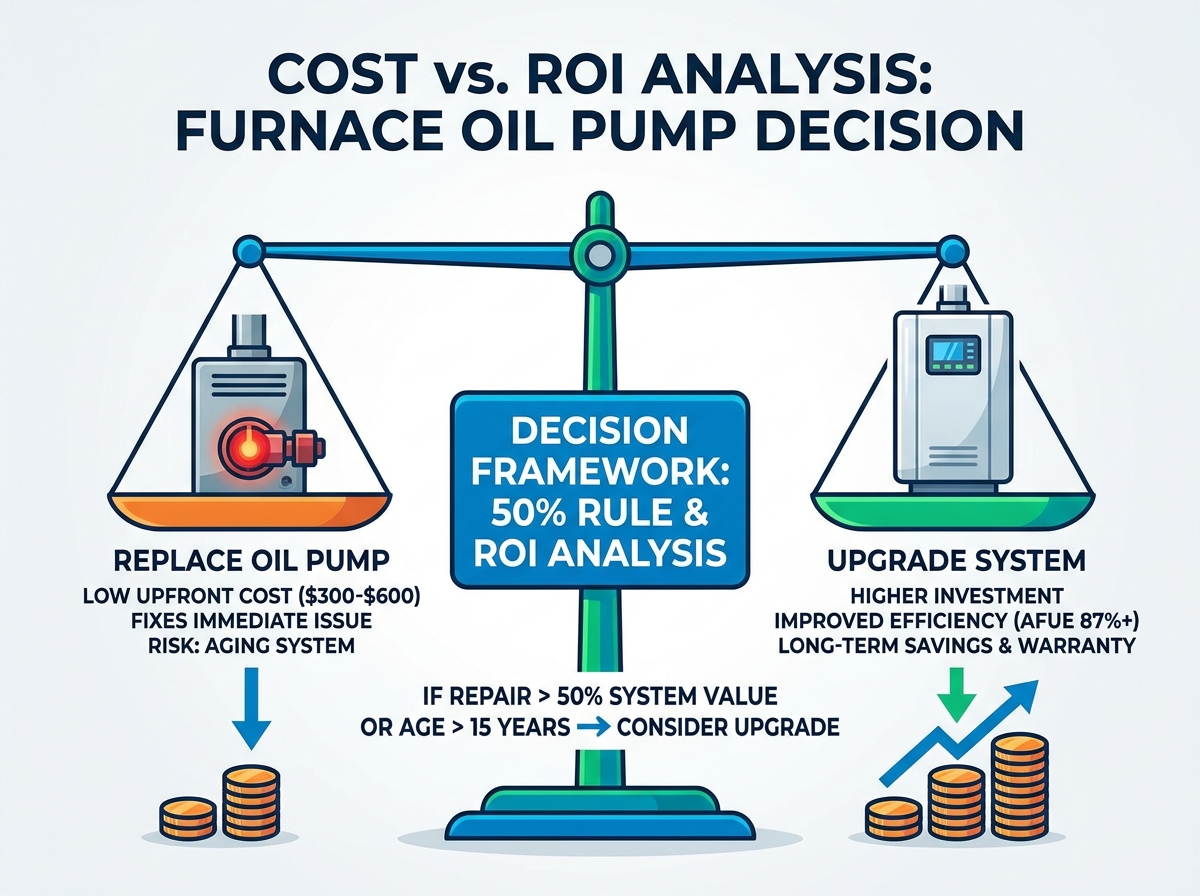
Direct replacement serves as the primary solution for relatively healthy furnaces. This approach restores your current system to baseline functionality. It works perfectly for units still in their prime operational years. You simply swap the defective component and restore heat. However, you must understand the complete financial picture before proceeding.
| Expense Category | Description | Estimated Cost Range |
|---|---|---|
| Parts (OEM) | Original manufacturer equipment. Highly reliable. | $120 – $150 |
| Parts (Universal) | Aftermarket brands fitting multiple systems. | $80 – $110 |
| Standard Labor | Hourly rate during normal business hours. | $150 – $250 |
| Emergency Labor | After-hours or weekend call-out fees. | $250 – $350+ |
Technical considerations dictate exactly which part you need. Technicians evaluate single-stage versus two-stage pumps. They must replace like-for-like parts to match the specific lift requirements of your oil tank setup. If your tank sits below the burner, you require a two-stage pump. Two-stage units create enough vacuum to pull oil upward. Single-stage units work flawlessly for gravity-fed tanks located above the burner assembly.
This repair path carries a specific risk profile. You enjoy a low upfront cost today. But you assume the risk of sequential part failures later. If your broader system is aging, the primary control board might fail next month. The blower motor could die next winter. You must assess the overall health of the equipment before spending hundreds of dollars on a single component.
A system upgrade offers a more comprehensive solution. You can replace the entire oil burner assembly. Alternatively, you can upgrade to a brand-new high-efficiency furnace. This path demands more upfront capital. However, it completely modernizes your heating infrastructure.
A burner-only upgrade usually costs between $800 and $1,500. This option replaces the pump, motor, fan, and transformer as one cohesive unit. It dramatically improves fuel atomization. It increases overall reliability. You achieve these benefits without replacing the expensive heat exchanger. This middle-ground option works wonderfully for solid, rust-free furnaces experiencing chronic burner faults.
A full furnace upgrade costs significantly more. Expect to invest between $4,000 and $8,000 or more. This investment grants you access to modern AFUE efficiencies exceeding 87 percent. You also receive extensive warranty coverage on all new components. A new furnace provides unmatched peace of mind during harsh winter months.
You must evaluate these choices using specific feature-to-outcome dimensions. First, look at fuel savings. Calculate your expected annual gallon reduction based on current local fuel prices. Modern equipment burns oil much cleaner and extracts more usable heat. Second, evaluate reliability. Upgrading resets the clock on all mechanical components. You effectively eliminate the threat of expensive emergency winter repair premiums for the next decade.
Homeowners often struggle to objectively weigh repair versus replacement. Industry experts utilize a specific evaluation matrix to simplify this choice. You need hard numbers and logical rules to avoid emotional spending during a heating crisis.
The "Age vs. Cost Formula" provides an excellent baseline metric. First, determine the age of your equipment. A typical oil furnace lasts roughly twenty years. If your furnace is past three-quarters of its life expectancy, it enters the danger zone. If your unit is over 15 years old, and the pump repair exceeds one-third of a full replacement cost, you should lean toward upgrading.
You must actively avoid the dreaded sunk cost trap. Many homeowners decide to fix a dying pump simply because they recently replaced another minor component. They feel too invested to walk away. Do not let a recent $300 fan motor repair trick you into keeping a failing system. You must evaluate the heat exchanger's integrity first. If the heat exchanger shows signs of soot buildup or hairline cracks, stop repairing individual parts. The core system is already compromised.
Finally, factor in compliance and rebates. Local energy efficiency programs frequently offer substantial rebates. Tax credits exist for upgrading to Energy Star-rated systems. These financial incentives effectively lower the gross cost of a full upgrade. Always research your state and utility incentive programs before finalizing your decision. You might find that upgrading costs far less than the initial sticker price suggests.
Deciding to upgrade or repair is only half the battle. You must navigate real-world implementation challenges to restore your heat successfully. Managing these practical hurdles ensures you do not overpay or suffer prolonged freezing temperatures.
You need to consider mid-winter implementation realities. Lead times vary wildly depending on your chosen path. Sourcing specific replacement Burner Oil Pumps in January can sometimes take days. Supply chain issues occasionally delay aftermarket parts. Full furnace installations require even more logistical planning. Contractors must secure municipal permits. They must schedule a multi-person crew. A full replacement might leave you relying on space heaters for several days while the team prepares.
Contractor vetting remains absolutely essential. You must ensure the technician performs a thorough combustion analysis after any major work. They must test the draft. They need to measure smoke levels. They must verify CO2 output. This analysis verifies safety and efficiency after either a simple pump replacement or a full burner upgrade. Skipping this step risks poor performance and carbon monoxide hazards.
Use this shortlisting logic to guide your immediate next steps:
Replacing a burner oil pump offers a pragmatic, low-cost fix for healthy mid-life furnaces. It restores heat quickly and limits immediate out-of-pocket expenses. Conversely, upgrading the entire system is the most financially sound move for deteriorating, inefficient units. Upgrades stop the cycle of endless emergency repairs and drastically lower your monthly fuel consumption.
There is no universal right answer for every homeowner. Your final decision must be dictated by your current system age, local oil prices, and available household capital. Never let a contractor pressure you into a choice without providing clear math and diagnostic proof.
We advise you to take immediate action if you suspect pump failure. Schedule a diagnostic inspection from a licensed HVAC professional today. Ask them to confirm the exact point of failure. Gather hard estimates for both repair and replacement paths so you can make a fully informed choice.
A: Burner oil pumps typically last between 10 and 15 years. Their lifespan heavily depends on fuel quality and routine maintenance. Consistently changing your fuel filter prevents sludge from entering the pump. Clean oil protects the internal gears and bearings, maximizing the component's operational life.
A: We strongly advise against DIY pump replacements. This job poses significant safety risks. It requires specialized pressure gauges to set the correct output. You also must perform complex fuel line bleeding procedures. Improper installation can cause fuel leaks, severe fire hazards, or deadly carbon monoxide buildup.
A: The difference involves lift capacity. Single-stage pumps work for gravity-fed systems where the oil tank sits higher than the burner. Two-stage pumps generate a stronger vacuum. They are required when the oil tank sits below the burner, allowing them to pull fuel efficiently against gravity.
A: A new pump restores proper operation and ensures clean combustion. It stops fuel waste caused by poor atomization. However, it does not raise the intrinsic AFUE rating of the furnace. An 80% efficient furnace remains an 80% efficient furnace, even with a brand-new pump installed.