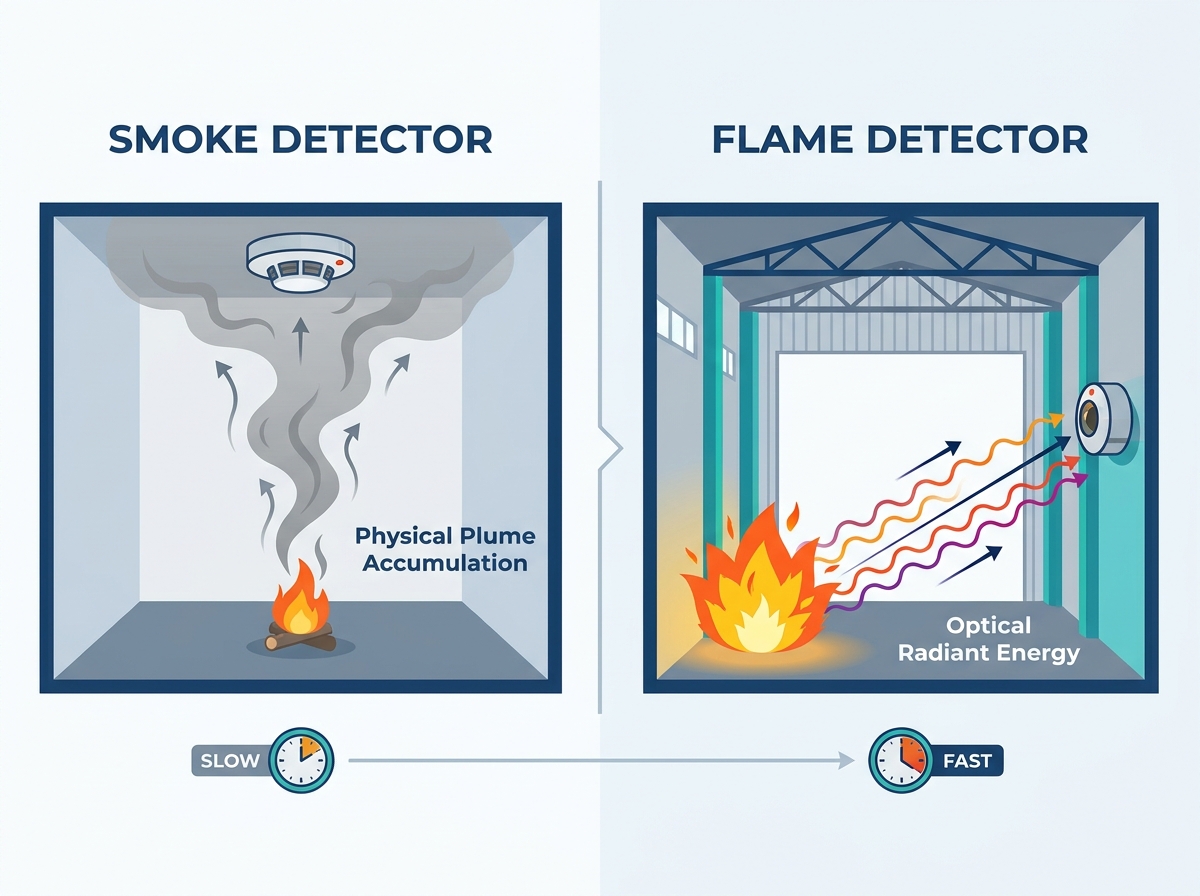
Choosing the wrong fire detection technology carries massive business and safety risks. A delayed response in a high-hazard industrial area invites catastrophic facility damage. The fire can spread before the alarm even sounds. Conversely, overly sensitive systems cause costly production shutdowns from nuisance false alarms. This guide rigorously evaluates industrial and commercial fire protection applications. Standard residential smoke detection simply cannot handle these complex, volatile environments. We focus entirely on matching specialized detection mechanisms to specific facility hazards. The bottom line comes down to fundamental physics. Smoke detectors inherently wait for combustion byproducts to physically travel upward to a sensor. In stark contrast,
Flame Detectors instantly analyze the radiant energy emitted by a fire across a direct line-of-sight. You will learn exactly how these critical systems differ. We explore environmental tolerances, response times, and compliance frameworks. You can then specify the right life safety equipment for your exact risk profile.
Key Takeaways
- Detection Method: Smoke detectors detect airborne particulates (smoldering fires); flame detectors optically detect UV/IR radiation (rapid, explosive fires).
- Environmental Tolerance: Flame detectors excel in harsh, drafty, or outdoor environments where smoke dissipates; smoke detectors are ideal for enclosed, controlled indoor spaces.
- Response Time: Flame detectors offer sub-second response times for flash fires, while smoke detectors inherently lag as they wait for smoke plume accumulation.
- Cost vs. Coverage: Smoke detectors have a lower per-unit cost but require dense spacing; flame detectors are highly engineered, higher-cost units that can cover vast, open areas if unobstructed.
1. The Core Mechanisms: How Each Technology Identifies Fire
Understanding how these devices work is critical. They rely on completely different principles of physics.
Smoke Detectors (Physical Particulate Detection)
Smoke detectors require physical contact to initiate an alarm state. Combustion particles must travel from the fire source to the sensor element. Ionization detectors use a small radioactive source to ionize the air within a chamber. They detect invisible particles effectively. They generally work faster for active, flaming fires producing low particulate matter. Photoelectric detectors use a targeted light beam inside a sensing chamber. They detect visible smoke particles scattering the light. They trigger much faster during slow, smoldering fires. However, physical detection carries severe structural limitations. The smoke plume must physically reach the ceiling to trigger the device. Heavy HVAC airflow easily disrupts this upward travel. Thermal stratification also creates invisible barriers in large rooms. Hot air cushions form near the ceiling. This prevents rising smoke from entering the sensor housing. The alarm never sounds, and the fire burns unchecked below.
Flame Detectors (Optical Radiant Energy Detection)
Flame Detectors operate entirely differently. They rely on line-of-sight optical technology rather than physical interaction. They do not wait for smoke plumes to rise. These specialized sensors utilize Ultraviolet (UV), Infrared (IR), or Multi-Spectrum IR (MSIR) technologies. They analyze specific spectral bands of light. For example, modern IR sensors look for distinct CO2 emission spikes at exactly 4.3 microns. This sophisticated analysis differentiates actual flames from harmless blackbody radiation. They actively ignore artificial lighting, welding arcs, or hot manufacturing machinery. Their primary advantage is unprecedented speed. They literally see the fire at the speed of light. They trigger alarms and suppression systems before visible smoke even forms. This rapid response is crucial for volatile environments.
Comparison of Fire Detection Technologies | Feature | Physical Particulate Detection | Optical Radiant Detection |
| Trigger Mechanism | Airborne Particulates | UV/IR Radiation |
| Detection Speed | Minutes (depends on airflow) | Milliseconds |
| HVAC Vulnerability | High | None |
| Line-of-Sight Needed | No | Yes |
2. Framing the Threat: When to Specify Flame Detectors Over Smoke Detectors
Choosing the right device depends heavily on your environment. Smoke sensors fail predictably in specific industrial scenarios.
High-Volume, Open-Air Facilities
Massive facilities expose the physical limitations of particulate detection. Aircraft hangars, large logistics warehouses, and outdoor tank farms are prime examples. Warehouses often feature extremely high ceilings reaching over forty feet. Smoke cools rapidly as it rises in these cavernous spaces. It loses thermal buoyancy and stratifies. It dissipates completely before reaching a ceiling-mounted sensor. Optical devices easily monitor these vast, open areas. They watch the floor level directly from high vantage points. They ignore the empty airspace above the hazard entirely.
High-Hazard and Flash Fire Environments
Some heavy industries simply cannot afford any smoldering phase. Petrochemical plants handle highly combustible liquids and pressurized gases. Oil and gas refineries face similar existential threats. Chemical manufacturing facilities house volatile industrial solvents. Fires ignite instantly in these high-hazard zones. A flash fire engulfs an entire processing area in seconds. Waiting for smoke accumulation causes catastrophic structural failure. You need instant optical recognition here. Fast detection allows deluge systems to suppress the blast immediately.
Drafty and High-Airflow Areas
Heavy environmental airflow actively defeats traditional particulate sensors. Industrial extraction fans push combustion byproducts outside quickly. Wind scatters particulates across outdoor processing areas. Heavy HVAC cycling pushes rising smoke away from ceiling-mounted units. Smoke detectors cannot analyze what they never physically touch. Optical sensors remain entirely unaffected by intense airflow. They monitor the radiant light signature emitting from the flames. Wind does not blow light away. The optical sensor maintains constant vigilance regardless of extreme ventilation rates.
3. Performance Evaluation Criteria: Speed, Accuracy, and Environmental Tolerance
Engineers evaluate life safety equipment against rigorous performance metrics. Speed and accuracy prevent widespread disasters.
Response Time vs. Fire Growth Curve
Detection speed must align perfectly with your required safety outcomes. You must map the sensor response time directly to the anticipated fire growth curve. Standard commercial office spaces tolerate slower responses. Personnel can safely evacuate while the fire remains small. High-hazard zones demand instant, automated action. Your ultimate goal might involve triggering specialized suppression systems. High-speed deluge systems must activate instantly to prevent cascading explosions. You absolutely need optical detection for these rapid, unforgiving timelines. Every millisecond counts when handling hydrocarbons.
False Alarm Immunity (The Cost of Downtime)
False alarms halt critical manufacturing production. They force unnecessary evacuations and erode personnel confidence in life safety systems. Each technology faces unique environmental triggers.
- Smoke detector triggers: Airborne dust, manufacturing steam, high humidity, and exhaust fumes routinely cause nuisance alarms.
- Optical detector triggers: Arc welding operations, direct sunlight reflections, and hot heavy machinery emit deceptive radiation.
Modern mitigation strategies actively solve these nuisance issues. Multi-Spectrum IR (MSIR) devices use complex, proprietary algorithms. They cross-reference multiple optical signals simultaneously. They analyze flame flicker frequencies alongside spectral peaks. They reject false optical signatures automatically. This ensures continuous production is not halted unnecessarily by a passing forklift or a welding spark.
Environmental Degradation
Harsh industrial environments degrade sensitive safety electronics. Smoke detectors fail rapidly in dirty, heavy manufacturing facilities. Airborne dust clogs their internal particulate chambers. High humidity ruins their delicate circuitry. Frequent manual cleaning becomes a massive maintenance burden. Optical units are built specifically for harsh, unforgiving conditions. They generally feature heated optics housed in ruggedized, explosion-proof casings. The internal heaters prevent condensation, fogging, and ice buildup. They also run continuous automatic self-testing routines. An internal light source reflects off the lens to verify optical clarity. This guarantees the lens remains perfectly clear without constant manual inspections.
4. Implementation Constraints and Regulatory Compliance
Designing a fully compliant fire detection system requires strict attention to physical limitations. You cannot just place sophisticated sensors randomly around a warehouse.
Line-of-Sight Requirements
Optical devices have one primary engineering constraint. They cannot see through solid objects. Their line-of-sight must remain completely unobstructed at all times. Facility managers must mandate 3D flame mapping during the initial installation phase. This specialized software accurately models the exact viewing angle and coverage cone of each sensor. It eliminates dangerous blind spots before installation begins. Storage racks, temporary scaffolding, and heavy machinery create dangerous shadow zones. Proper 3D mapping guarantees complete, overlapping coverage across the entire hazardous area.
Regulatory and Compliance Lenses
Life safety systems must satisfy rigorous legal and engineering standards. The National Fire Alarm and Signaling Code (NFPA 72) dictates strict rules for American facilities. It governs sensor spacing, mounting heights, and selection protocols. Engineers must rigorously classify the specific hazard of the facility. NFPA 72 requires optical sensors for certain flammable liquid and gas hazards. You must also consult local Authority Having Jurisdiction (AHJ) representatives. Meeting these codes ensures personnel safety. Strict compliance prevents massive legal liability following an incident.
5. Decision Framework: Choosing the Right Detection Strategy for Your Facility
Facility managers need a structured, objective approach to fire protection. Selecting life safety equipment requires analyzing your specific risks without bias.
Hazard Profiling
You must profile your primary fuel sources carefully. Does the facility store hydrocarbons, industrial solvents, or military munitions? You should strongly lean toward optical detection. These specific fuels ignite explosively without a smoldering phase. Is the hazard primarily paper, wood, or electronics? Enclosed server control rooms behave differently. You should lean toward smoke or aspirating smoke detection. Slow, smoldering fires generate heavy particulates that traditional sensors catch early.
The Hybrid Approach
Industrial life safety is rarely an absolute either/or choice. Best-in-class protection systems utilize both technologies simultaneously. Administrative offices and enclosed electrical rooms receive traditional particulate sensors. The high-hazard production floor receives robust, ruggedized optical monitoring. This hybrid design philosophy maximizes overall facility safety. It matches the specific sensor technology directly to the localized threat profile. You do not force one technology to protect environments it was never designed for.
Next Steps for Evaluation
Facility managers should take immediate, proactive action. Follow these concrete steps to evaluate and upgrade your current life safety systems:
- Conduct a localized, room-by-room fire risk assessment identifying distinct fuel sources.
- Audit your existing optical systems for dangerous machinery blind spots.
- Evaluate airflow patterns and HVAC placement near existing ceiling-mounted sensors.
- Consult a certified fire protection engineer to perform comprehensive 3D optical mapping.
- Review your facility compliance profile with current NFPA 72 regulations.
Conclusion
Facility safety depends entirely on precise engineering choices. Particulate sensors remain the reliable standard for standard enclosed spaces. They handle slow-building fire risks exceptionally well. However, optical sensors are essential, highly specialized instruments. They dominate rapid, explosive, and outdoor hazard environments. You simply cannot compromise on detection speed in combustible zones. Take action today to secure your facility. Request a comprehensive hazard assessment from a certified professional. Connect with a technical sales engineer immediately. They will specify the exact combination of detectors needed. This proactive approach ensures you meet your facility's strict compliance and safety goals.
FAQ
Q: Can a flame detector replace a smoke detector?
A: Not universally. They serve entirely different risk profiles. Optical units cannot detect deep-seated smoldering fires. These slow fires produce heavy particulates but no visible light. You must match the technology to the specific fuel hazard.
Q: Do flame detectors work in the dark?
A: Yes. They detect UV and IR radiation emitted directly by the fire itself. They do not rely on visible light. They function perfectly regardless of ambient lighting conditions.
Q: How does ceiling height impact smoke vs. flame detection?
A: High ceilings cause rising heat to cool and stratify. Particulates often never reach a ceiling-mounted sensor. Optical devices are completely unaffected by ceiling height. They monitor the floor area directly as long as it remains within their optical range.
Q: Are flame detectors prone to false alarms from sunlight?
A: Older UV models sometimes triggered false alarms from sunlight. However, modern Multi-Spectrum IR (MSIR) devices solve this issue. They use multiple overlapping frequency bands. Engineers specifically designed these algorithms to reject sunlight and blackbody heat sources.