lucy@zlwyindustry.com
+86-158-1688-2025
Please Choose Your Language
- All
- Product Name
- Product Keyword
- Product Model
- Product Summary
- Product Description
- Multi Field Search

Views: 0 Author: Site Editor Publish Time: 2026-10-30 Origin: Site


Industrial and commercial facilities still rely heavily on traditional leak detection methods. Operators frequently use simple soap bubble tests and olfactory checks. These legacy methods remain popular due to their straightforward application and negligible upfront expenses. Plumbers and pipefitters have utilized them for decades. However, relying exclusively on manual checks poses severe risks today. Regulatory non-compliance, workplace safety incidents, and undetected fugitive emissions create escalating financial burdens. Unseen leaks can quickly escalate into hazardous situations. Toxic gas build-ups threaten human life rapidly. While manual methods certainly have a place in secondary verification, using them for primary safety monitoring exposes your facility to unacceptable dangers. You need reliable, continuous coverage across all operational hours. This guide provides a neutral, evidence-based framework. We will help you evaluate engineered Gas leak detectors against long-standing legacy practices. You will learn how modern sensor technologies work and why upgrading your detection strategy protects both your personnel and your bottom line.
Legacy detection forms the historical baseline of industrial safety. Soap bubble testing, often called snoop testing, remains incredibly common. Technicians apply a specialized liquid solution to pipe joints. They watch carefully for expanding bubbles. Acoustic checks involve listening closely to equipment. Technicians try to hear the high-pressure hisses of escaping vapor. Olfactory monitoring relies entirely on human smell. Utility companies deliberately add mercaptan to natural gas lines. This creates a distinct, recognizable rotten egg odor.
These methods maintain several notable operational strengths:
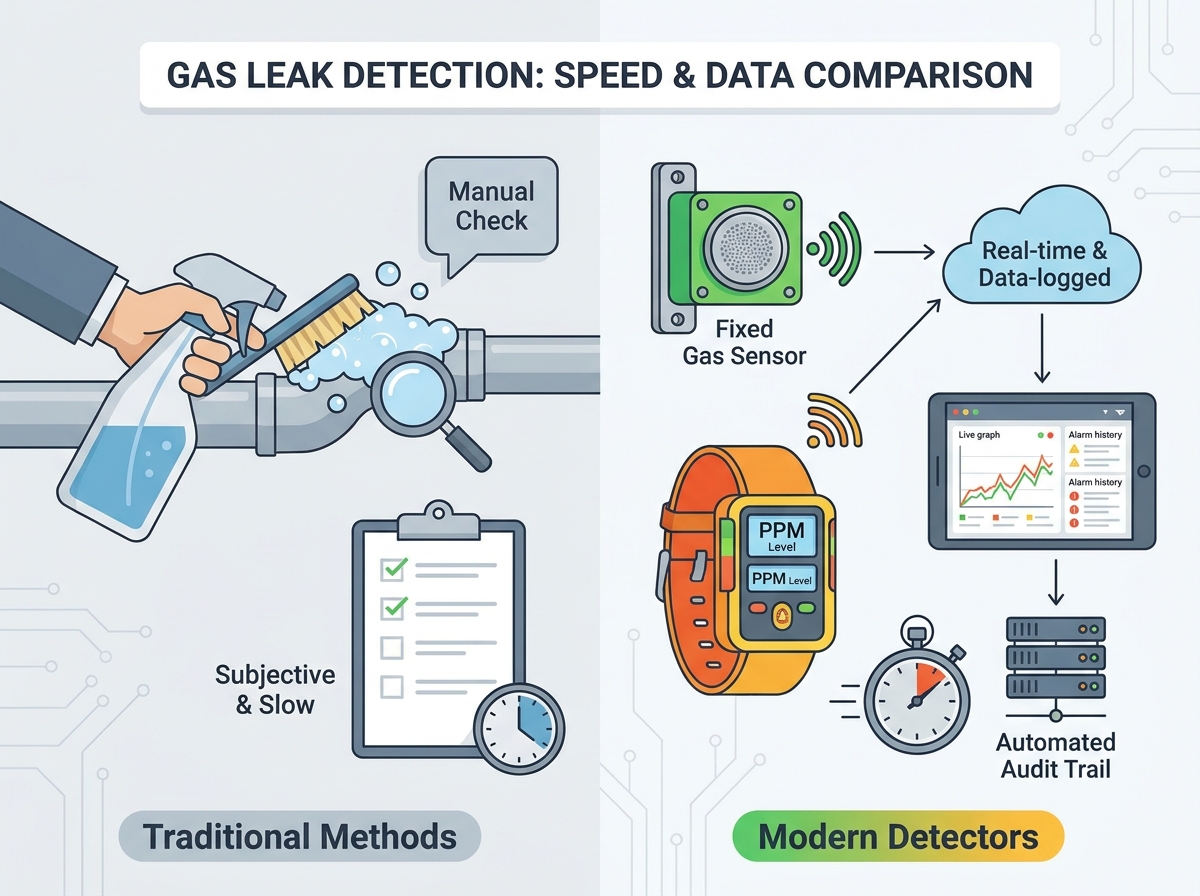
However, the critical limitations create massive, unacceptable business risks. Subjectivity and human error plague these historical methods. The entire process relies entirely on human senses. Operators suffer from olfactory fatigue surprisingly quickly. The human nose becomes desensitized to constant odors within minutes. Environmental background noise easily masks small hissing sounds. A bustling factory floor drowns out acoustic clues entirely.
Furthermore, these manual methods cannot detect odorless or toxic gases. Carbon Monoxide provides absolutely no smell or taste. Nitrogen displaces breathable oxygen silently. Un-odorized natural gas goes entirely unnoticed until ignition occurs. Workers receive zero warning before collapse.
Manual checks also lack continuous monitoring capabilities. They only capture a single snapshot in time. A technician inspects a valve at eight o'clock. A leak develops at nine o'clock. Leaks occurring between inspection rounds go completely undetected.
Finally, traditional methods provide zero verifiable audit trail. You cannot log data accurately. Relying on clipboard records fails modern ESG standards. OSHA documentation requirements demand verifiable, digital records. Paper logs offer no concrete proof of compliance.
Engineered solutions categorize into several highly distinct groups. Different sensor types match specific operational risks perfectly. Facility managers must understand these technological differences. Choosing the wrong sensor creates a false sense of security.
Electrochemical and catalytic bead sensors are highly prevalent. Chemical reactions occur inside the tiny sensor housing. Escaping gas interacts directly with the internal elements. These reactions generate tiny electrical currents. The current remains directly proportional to the ambient gas concentration. Higher gas levels create stronger electrical signals.
These sensors are best for monitoring toxic gases. They detect Hydrogen Sulfide and Carbon Monoxide highly effectively. They also handle basic combustible gas detection reliably. Confined spaces benefit greatly from this specific technology.
However, you face distinct operational trade-offs. The sensors degrade naturally and inevitably over time. Specific environmental contaminants can poison the chemical element. Silicones, heavy metals, and high sulfur concentrations destroy catalytic beads. Best Practice: Implement a strict bump testing schedule daily. Bump tests verify sensor responsiveness before operators attempt confined space entry.
Infrared and laser gas detectors offer premium, non-depleting performance. The mechanism measures gas concentration optically instead of chemically. It analyzes light absorption at specific, targeted wavelengths. Target gases absorb this light predictably. The detector measures the drop in light intensity.
These detectors are best for detecting hydrocarbons. They detect volatile organic compounds (VOCs) exceptionally well. Facilities use them extensively for large-area scanning. You can integrate them into aerial drones easily. Fixed long-range cameras also utilize this advanced IR technology. They monitor entire tank farms from a safe distance.
The primary trade-off remains the high capital expense. IR technology costs significantly more than electrochemical alternatives. Additionally, they cannot detect certain elemental gases. Hydrogen does not absorb IR light at all. Therefore, an IR sensor remains completely blind to hydrogen leaks.
Ultrasonic Gas leak detectors operate on an entirely different principle. The mechanism essentially hears escaping gas at frequencies above human hearing. Pressurized leaks create distinct high-frequency acoustic noise. The sensor detects this exact sound signature instantly. It does not wait for a gas cloud to physically form. It measures sound propagation rather than chemical composition.
These devices are best for outdoor environments. Well-ventilated offshore rigs disperse gas rapidly. Wind blows gas away before chemical sensors can react. High-pressure systems create incredibly strong acoustic signatures. Ultrasonic detectors excel in these specific, challenging conditions. Common Mistake: Do not install ultrasonic detectors near intentional pressure relief valves. Routine, safe valve venting will trigger false emergency alarms constantly.
Procurement and safety managers need hard, verifiable facts. Direct evaluations clarify complex procurement decisions. We must compare dimensions affecting daily industrial operations directly.
Table: Comparative Analysis of Detection Modalities
| Performance Feature | Traditional Manual Methods | Modern Electronic Detectors |
|---|---|---|
| Detection Speed | Severely delayed (Requires gas pooling) | Instantaneous real-time alerts |
| Sensitivity Limit | Requires high volume/concentration | Parts-per-million (PPM) accuracy |
| Operator Safety | Requires physically entering hazard zones | Enables remote, off-site monitoring |
| Audit & Compliance | Manual paper logs (Prone to error) | Automated, time-stamped digital logging |
Speed and detection limits differ drastically between methodologies. Traditional methods require significant gas volume to register. Gas must pool in sufficient quantities first. Bubbles need adequate pressure to form physically. Odors must reach noticeable thresholds before humans react.
In stark contrast, engineered Gas leak detectors provide real-time alerts. They offer extreme parts-per-million (PPM) sensitivity. High-end models achieve parts-per-billion (PPB) accuracy. You can identify microscopic micro-leaks immediately. You address mechanical problems before they reach hazardous Lower Explosive Limits (LEL). Early warning prevents catastrophic explosions entirely.
Safety and remote monitoring showcase further critical disparities. Traditional tests require physical, immediate human presence. A technician must physically walk into hazardous locations. They expose themselves to potentially explosive environments directly. They risk inhaling concentrated toxic fumes during inspections.
Modern electronic detectors keep personnel completely out of hazard zones. Fixed area monitors watch dangerous areas continuously. Drone-mounted sensors inspect high-elevation piping safely from afar. Personal Gas leak detectors offer another vital layer of safety. They clip to a worker's lapel. They alert workers instantly upon accidental exposure.
Regulatory compliance relies entirely on accurate data logging today. Traditional methods utilize manual paper checklists predominantly. This analog process remains highly vulnerable to human errors. Pencil-whipping forms a massive, hidden liability risk. Tired workers might sign off without performing thorough checks.
Modern detectors eliminate this vulnerability completely. They feature automated, incorruptible data logging. They record time-stamped alarm histories permanently in the cloud. They offer seamless integration capabilities via wireless networks. You can connect them to facility SCADA or DCS systems easily. This creates bulletproof audit trails for strict OSHA inspectors.
Facilities must analyze upfront versus hidden costs carefully. Buying a comprehensive fleet of electronic detectors requires initial capital. The initial invoice often surprises conservative procurement teams. However, traditional manual methods hide massive, recurring labor expenses. You must pay technicians for manual inspections continually. They spend hundreds of hours walking miles of piping annually. This labor cost compounds dramatically over time. Conversely, automated sensors monitor these pipes twenty-four hours a day without salaries.
You must frame ROI around comprehensive financial loss prevention. Escaped refrigerant costs thousands of dollars monthly to replace. Natural gas leaks represent lost product revenue directly. Undetected leaks eventually trigger severe EPA and OSHA fines. Significant safety incidents cause incredibly expensive facility downtime. Plant shutdowns cost millions of dollars in lost production. A reliable sensor network prevents these financial catastrophes entirely.
You must maintain realistic expectations regarding ongoing maintenance. Electronic devices require dedicated, scheduled servicing. You must purchase mandatory calibration gases regularly. Sensor elements do not last forever. Replacement cycles typically span two to five years. You must budget for these hardware replacements proactively. Software management also requires dedicated personnel time. IT departments must update firmware and manage data storage securely. Despite these maintenance realities, the overall financial return remains highly favorable.
Upgrading your detection strategy requires careful, methodical planning. Follow these structured steps for successful, facility-wide implementation.
First, conduct a comprehensive site risk assessment. Hire an industrial hygienist if necessary. Map out all hazard zones meticulously. Identify every specific chemical and gas type present onsite. Evaluate prevailing ventilation patterns carefully. Wind and HVAC systems alter gas dispersion significantly. Locate all potential leak points accurately. Focus heavily on valves, aging flanges, and temporary connections.
Second, select the correct deployment models. A hybrid approach often yields the best results.
Third, address change management and adoption risks proactively. Alarm fatigue threatens facility safety severely. Operators might ignore overly sensitive alarms over time. They become dangerously desensitized to constant acoustic beeping. You must establish strict alarm thresholds rationally. Do not set alarms to trigger at negligible background levels. Create clear, documented evacuation protocols for every single alarm tier. Train your staff thoroughly on proper emergency response procedures.
Traditional manual methods are no longer sufficient. You cannot rely on them as a standalone safety strategy. Modern industrial operations involve highly complex, pressurized processes. Risks escalate rapidly in industrial environments.
We strongly advise treating manual methods strictly as supplementary tools. Use soap bubbles exclusively for pinpointing identified leaks visually. They work perfectly during active, hands-on pipe repairs. However, rely completely on engineered Gas leak detectors for primary monitoring. They guarantee continuous safety and ensure strict regulatory compliance.
Take proactive safety steps immediately. Schedule a comprehensive site hazard audit today. Consult a certified industrial safety specialist soon. Determine the exact sensor technology required for your facility's specific hazards. Protect your personnel and secure your operational continuity confidently.
A: Calibration frequency depends on manufacturer guidelines and OSHA standards. Workers must perform daily bump tests before use. A bump test briefly exposes the sensor to gas. This verifies sensor response and alarm functionality. Full calibrations are typically required monthly or bi-annually. Full calibration adjusts the sensor's accuracy using a certified concentration gas. Strict adherence to this schedule ensures optimal safety and regulatory compliance.
A: No. Soap solutions are excellent for verifying a newly tightened fitting. They visually confirm a secure seal instantly. However, they fail entirely at monitoring spontaneous leaks. Vibration, thermal expansion, or mechanical wear cause unpredictable failures. Soap provides only a temporary snapshot. Electronic monitors provide continuous, real-time surveillance. You need automated sensors to catch leaks occurring between manual inspection rounds.
A: Industrial sensors have varying lifespans based on their core technology. Electrochemical sensors typically last two to three years. They deplete chemically over time. Catalytic bead sensors share a similar timeline. Infrared and laser sensors last much longer. They often exceed five years of continuous service. Facility managers must plan realistic replacement budgets. Routine maintenance extends lifespans, but chemical degradation is inevitable.
A: Laser gas detectors justify their cost in specific scenarios. They are highly cost-effective for facilities requiring long-range detection. They integrate perfectly into drone surveillance programs. They excel where traditional sensors fail frequently due to harsh conditions. If you monitor massive outdoor areas, laser technology reduces the need for hundreds of fixed point-sensors. For small, confined indoor spaces, cheaper electrochemical sensors usually suffice.