lucy@zlwyindustry.com
+86-158-1688-2025
Please Choose Your Language
- All
- Product Name
- Product Keyword
- Product Model
- Product Summary
- Product Description
- Multi Field Search

Views: 0 Author: Site Editor Publish Time: 2026-11-04 Origin: Site


Selecting the right component for your industrial heating system is not a simple swap. It represents a critical operational decision for your facility. Choosing the wrong unit often causes improper fuel atomization. You will quickly notice reduced boiler efficiency. Facilities also face costly, unplanned downtime when components fail. We understand industrial heating systems demand precise fluid handling. This precision remains especially true as fuel compositions change. Industry compliance standards evolve constantly too. You must adapt your hardware to meet these new realities. This guide gives you a strictly technical framework. We focus entirely on evaluating core specifications. You will learn to narrow down hardware options effectively. We help you select a unit matching your exact system architecture. Keep reading to secure reliable, long-lasting combustion performance. Proper evaluation prevents catastrophic boiler failures. It guarantees your facility meets production demands safely.
Operators must accurately assess the required Gallons Per Hour (GPH). You cannot simply guess this metric. Calculate your maximum firing rate first. The pump capacity must exceed this firing rate significantly. Why does it need excess capacity? The system needs extra flow for proper fluid bypass. It also requires capacity for continuous fuel recirculation. A pump lacking sufficient flow will starve the burner nozzle. This starvation leads to highly unstable flames. It also causes heavy soot buildup inside the combustion chamber. Selecting reliable Burner Oil Pumps requires precise mathematical calculations.
Industry standards recommend sizing the unit for at least twenty percent more capacity than the maximum firing rate. This excess ensures the internal bypass valve functions correctly. The bypass valve regulates the output pressure smoothly. Without this extra flow, the pressure fluctuates wildly. A fluctuating pressure creates a dangerous situation. You risk flooding the combustion chamber during low demand. You also risk starving the burner during peak demand periods. Always calculate this metric meticulously before purchasing new hardware.
Industrial applications use specific pressure ranges. Most systems operate between 100 and 300 PSI. Some specialized setups exceed 300 PSI. You must match the pressure to the exact nozzle design. Over-speccing pressure creates significant mechanical risks.
It places unnecessary stress on internal seals. You will experience premature gear wear. Always consult the burner design specifications first.
Fuel type drastically changes hardware requirements. You must differentiate between light oils and heavy fuel oils. Number 1 and Number 2 oils are very light. They flow easily at standard room temperature. Number 4 and Number 6 oils are extremely heavy. They possess high viscosity. High viscosity fluids demand robust internal gear sets. You must push thick fluids forcefully through the lines. These heavy oils often require internal system heaters. Heaters keep the fluid moving smoothly through the gears. If you ignore viscosity, the unit will cavitate. Cavitation destroys internal components quickly.
Fuel Viscosity and Hardware Requirements Chart
| Fuel Grade | Viscosity Level | Typical Application | Hardware Requirement |
|---|---|---|---|
| No. 1 & No. 2 | Low / Light | Standard Commercial Heating | Standard Gear Sets |
| No. 4 | Medium | Medium Industrial Boilers | Heavy-Duty Gears, Optional Heaters |
| No. 6 | High / Heavy | Large Power Generation | Reinforced Gears, Mandatory Pre-Heaters |
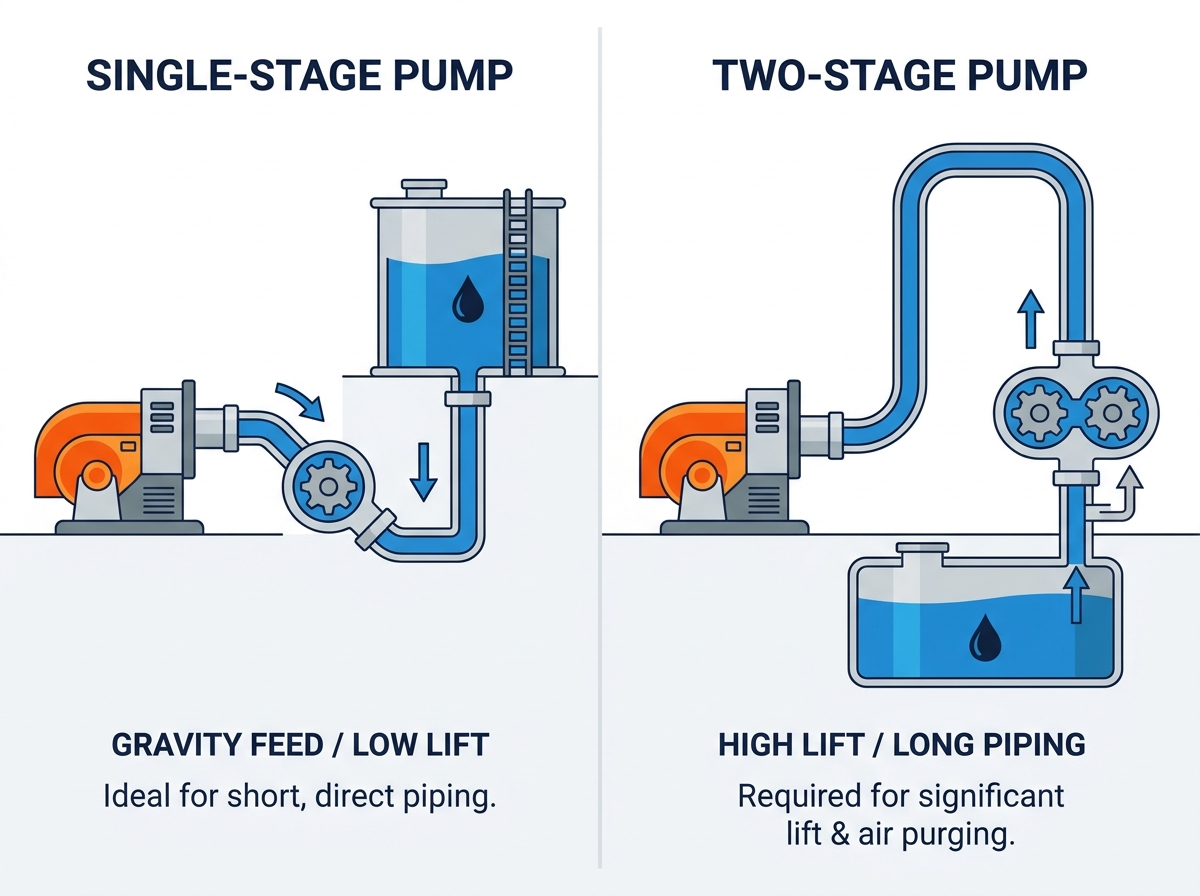
Choosing between single-stage and two-stage designs requires careful structural alignment. Your system piping design dictates the correct choice. You must audit your infrastructure thoroughly. Gravity feed layouts simplify fluid dynamics significantly. The weight of the fluid pushes it toward the unit. The gear set only needs to pressurize it for atomization. However, gravity feeds pose environmental risks. A broken line can drain the entire tank. High lift systems utilize subterranean tanks for improved safety. These setups require aggressive suction capabilities. The unit must pull heavy fluid vertically against gravity. This requires immense mechanical effort.
Single-stage units work best for specific layouts. Use them when the storage tank sits above the burner. This setup provides a highly reliable gravity feed. They also suit systems having minimal lift requirements. We define minimal lift as under eight feet of vacuum. However, these units have strict mechanical limitations. They are highly susceptible to sudden air locks. Long horizontal pipe runs trap air easily. A single gear set cannot purge this air efficiently. The system will lose its prime. You will face frequent manual bleeding procedures. This causes unnecessary maintenance downtime.
Two-stage units solve complex piping challenges effectively. They are best for systems requiring significant vertical lift. Facilities using subterranean storage tanks need them. Long overhead piping architectures also demand two-stage units. Let us examine the internal mechanical mechanism. The first gear set pulls the fluid from the tank. It simultaneously purges trapped air from the suction line. It routes this air back to the storage tank. The second gear set then takes over the process. It delivers highly pressurized fluid directly to the nozzle. This dual-action mechanism ensures highly stable combustion. You never have to worry about flame flickering.
Facility managers must audit current piping infrastructure. Do not default to a direct hardware replacement. Follow this brief checklist before authorizing procurement:
Industrial environments demand incredibly rugged equipment. You must consider motor speed and overall durability carefully. High-quality Burner Oil Pumps rely on precise mechanical alignment. Every component must handle extreme industrial conditions.
Every unit must perfectly match the burner motor’s rotational speed. Standard electric motors operate at either 1725 or 3450 RPM. You must verify this specification on the motor nameplate. Running a high-speed unit on a low-speed motor causes poor atomization. The output pressure will never reach the required threshold. Conversely, running a low-speed unit on a high-speed motor is extremely dangerous. It results in catastrophic mechanical failure immediately. The internal gears will shatter into pieces. The seals will blow out entirely. Always double-check RPM compatibility before installation.
Evaluate construction materials based on boiler cycling schedules. Systems operate on either continuous or intermittent duty cycles. Intermittent boilers turn on only when the thermostat calls for heat. They run for twenty minutes and shut off. The internal components have adequate time to cool down. Standard aluminum bodies handle intermittent duty adequately. Continuous industrial boilers fire constantly. They maintain steam pressure for manufacturing processes continuously. The internal temperatures remain extremely high. Aluminum housings warp under these constant high temperatures. Cast iron maintains its dimensional stability perfectly. You also need heavy-duty shaft bearings. Upgraded bearings prevent shaft deflection during continuous operation. We highly recommend over-engineering for continuous applications.
Duty Cycle Material Comparison
| Duty Cycle Type | Operating Pattern | Recommended Housing Material | Bearing Requirement |
|---|---|---|---|
| Intermittent | Frequent On/Off Cycling | Standard Aluminum | Standard Bearings |
| Continuous | 24/7 Constant Firing | Heavy-Duty Cast Iron | Reinforced Shaft Bearings |
Upstream filtration remains an absolute necessity for all systems. Even clean fluid contains microscopic abrasive debris. High-quality units feature easily accessible internal strainers. These strainers protect the delicate gear teeth from particulate damage. Look for high-micron internal strainers. They catch abrasive particles before they enter the gear chamber. You must manage contaminants aggressively. A single metal shaving can score the internal housing. This scoring destroys the pressure-building capability completely. Regular filtration maintenance prevents sudden unexpected failures.
Fuel compositions are changing rapidly across the global industry. You must understand how new fuels affect existing hardware. Upgrading your equipment ensures environmental compliance and operational safety.
The industrial sector is experiencing a massive biofuel shift currently. Facilities are transitioning rapidly to renewable blended fuels. You will commonly see B20 and B100 blends. Environmental, Social, and Governance mandates drive this specific trend. Strict emissions regulations force facilities to adapt immediately. You cannot ignore this industry-wide shift. Traditional fossil fuels are slowly phasing out in many regions. Your hardware must handle these new chemical compositions flawlessly.
Biofuels introduce severe chemical compatibility issues. Standard hardware seals consist of Nitrile or Buna-N rubber. These standard seals degrade rapidly when exposed to biofuels. The biological solvents break down the rubber polymers chemically. The seals swell, crack, and eventually fail entirely. This degradation leads to critical fluid leaks. It also causes a sudden drop in operating pressure. You must address this seal compatibility risk immediately. Never process B20 or B100 through standard Buna-N seals.
B20 fuel contains twenty percent biodiesel and eighty percent petroleum. B100 is pure biodiesel. These renewable fuels act as aggressive internal solvents. They clean the inside of your existing pipes. They loosen decades of sludge and scale. This sludge travels directly into your primary strainer. You must change strainers frequently during the first month of transition. This prevents massive clogs and system starvation.
Buyers must explicitly verify internal seal materials. Ensure the unit uses Viton® or similar bio-compatible elastomers. Viton is a fluoroelastomer synthetic rubber. It withstands severe chemical exposure easily. It handles high temperatures without degrading. Upgrading to Viton seals prevents disastrous facility leaks. Environmental agencies issue massive fines for accidental spills. A simple seal upgrade prevents these costly environmental incidents. Furthermore, request official manufacturer documentation. Ask for proof of specific UL listings. The unit must hold a UL listing for the exact fuel grade used. Do not accept mere verbal confirmations. Require written documentation before installation. This protects your facility from serious liability and fire hazards.
Procurement involves much more than just selecting technical specs. You must evaluate long-term implementation risks thoroughly. Smart buyers look at maintenance ergonomics and supply chain factors.
Assess how easily maintenance teams can perform routine tasks. Equipment design dictates future maintenance speed. Technicians frequently need to bleed air from the lines. They must clean internal strainers regularly. They also need to check vacuum and pressure ports. Can they perform these tasks easily? Or do they have to dismantle the entire burner housing? Difficult accessibility leads to neglected maintenance. Neglected maintenance always causes unexpected failures. Choose units offering simple side-access panels. Prioritize external pressure port locations. Ergonomic designs save countless hours of labor. If bleeding the air takes two hours, technicians will avoid it. Air bubbles remain trapped in the system. These bubbles cause severe cavitation and gear pitting. Excellent designs place the bleeder valve on top. They angle the pressure ports toward the technician. You can attach test gauges in seconds.
Supply chain reliability is crucial for modern industrial operations. Warn your procurement team against proprietary architectural designs. Proprietary units often have incredibly long lead times for replacement parts. If a unique seal fails, you might wait weeks. This wait causes unacceptable facility downtime. Some foreign manufacturers produce excellent equipment. However, they lack domestic distribution centers. Shipping replacement parts takes three weeks. Your production line cannot wait three weeks. Instead, choose units utilizing standardized flange mountings. Look for standard shaft hub sizes. Standardization greatly reduces dangerous vendor lock-in. It allows you to source aftermarket parts locally. You can drive to a local distributor. You can purchase a replacement component immediately. Standardization is the ultimate operational risk mitigation strategy.
Understand what a standard industrial warranty actually covers. Most warranties only cover initial manufacturing defects. They rarely cover fluid-related wear and tear. They will not cover chemical degradation from incorrect biofuels. Always read the fine print carefully. Encourage your team to prioritize transparent manufacturing brands. Look for brands publishing historical failure-rate data. Robust technical support is also essential. A responsive support team helps diagnose issues quickly. Good warranty terms reflect high manufacturing confidence. Avoid manufacturers refusing to disclose failure statistics.
Choosing the right component is a delicate balance. You must match fluid dynamics perfectly. You must balance desired flow rate and operating pressure. You must also align perfectly with infrastructure realities. These realities include vertical piping lift and fuel chemistry. Never treat this hardware selection as an afterthought. It dictates your overall operational efficiency and safety.
We strongly advise cross-referencing your existing OEM specification sheet. Do this before authorizing any new procurement. The OEM manual provides the baseline requirements for safe operation. Deviating from these baselines invites mechanical disaster.
Your next steps involve immediate expert consultation. Consult with a specialized sales engineer or distributor today. They will confirm hardware compatibility for your specific application. This step is especially vital if your facility is transitioning to bio-blended fuels. It is also crucial if you are upgrading structural tank locations. Take action today to audit your current system infrastructure. Prevent unexpected failures by making data-driven procurement decisions.
A: Yes, but it requires converting the system to a two-pipe configuration. You must install a dedicated return line back to the tank. Using a two-stage pump in a single-pipe setup is highly dangerous. It will immediately blow the internal shaft seal due to trapped pressure. Always update the piping infrastructure when upgrading the pump stage.
A: Look for specific mechanical symptoms. You will likely see fluctuating pressure at the burner nozzle. You might hear a whining noise coming from the gears. This noise indicates harmful cavitation. You will also notice an unusually high vacuum reading on the inlet side. Clean the strainer immediately if these signs appear.
A: The biological solvents in the fuel will likely degrade standard rubber seals. This degradation happens over just a few months. The Buna-N seals will swell and crack. This leads to dangerous fuel leaks and a total loss of pressure. It creates severe potential fire hazards. Always upgrade to bio-compatible seals like Viton.
A: Loss of prime is typically caused by vacuum leaks in the suction line. An empty tank or a severely clogged filter will also cause it. A failing shaft seal allows air to enter the chamber. Two-stage units handle minor air intrusion much better. However, severe vacuum leaks will cause any system to drop prime.