lucy@zlwyindustry.com
+86-158-1688-2025
Please Choose Your Language
- All
- Product Name
- Product Keyword
- Product Model
- Product Summary
- Product Description
- Multi Field Search

Views: 0 Author: Site Editor Publish Time: 2026-11-15 Origin: Site


Selecting the right safety equipment is never a simple guessing game. When industrial fires break out, every passing millisecond dictates whether you face a minor incident or a complete disaster. We know the stakes are incredibly high. Selecting a flame detector requires balancing life safety, asset protection, and operational continuity. Getting this decision wrong carries severe consequences. You risk catastrophic failure to detect an actual fire, which endangers lives. Conversely, you risk crippling downtime from endless nuisance alarms, costing thousands of dollars per hour. This guide strips away marketing noise to help you make the best choice. We provide a strictly objective, engineering-focused framework for your facility. You will learn how to match optical flame detection technologies to your specific hazards and ignition scenarios. We break down the exact steps needed to protect your people and safeguard your physical assets properly.
We must start by defining your facility's unique hazards. Finding the proper safety solution begins with a thorough environmental analysis. You cannot protect a space until you understand how a fire might behave inside it.
You must categorize your primary combustible materials first. Your fuel source directly dictates the required optical sensor type. Different materials emit unique spectral signatures while burning. We generally divide these fuels into two main categories:
You must audit your facility carefully. If you install a hydrocarbon-specific sensor in a hydrogen storage area, it will fail to alarm during a fire.
Map out potential false alarm triggers in your facility next. Industrial environments constantly generate background radiation. These background emissions often trick basic sensors into triggering false alarms. You should watch out for several common culprits.
Arc welding produces intense ultraviolet light. Lightning strikes cause similar electromagnetic spikes. Hot rotating machinery and industrial ovens emit heavy infrared radiation. Halogen lamps and direct sunlight also cause serious issues. Even sunlight reflecting off wet surfaces can easily trick older sensors. You must document these interferents before selecting a technology.
Airborne particles frequently blind optical sensors. Heavy smoke, airborne dust, and thick oil mist block radiation signals. If the signal cannot reach the lens, the device cannot alarm. Corrosive vapors also degrade unprotected lenses over time.
You need specific mitigation features for dirty environments. Look for devices featuring heated optics. Heated lenses prevent condensation and ice buildup. You might also need protective air shields. Air shields continuously blow clean air across the lens. This action repels airborne dust and sticky oil mist. Always assess your air quality during the hazard analysis phase.
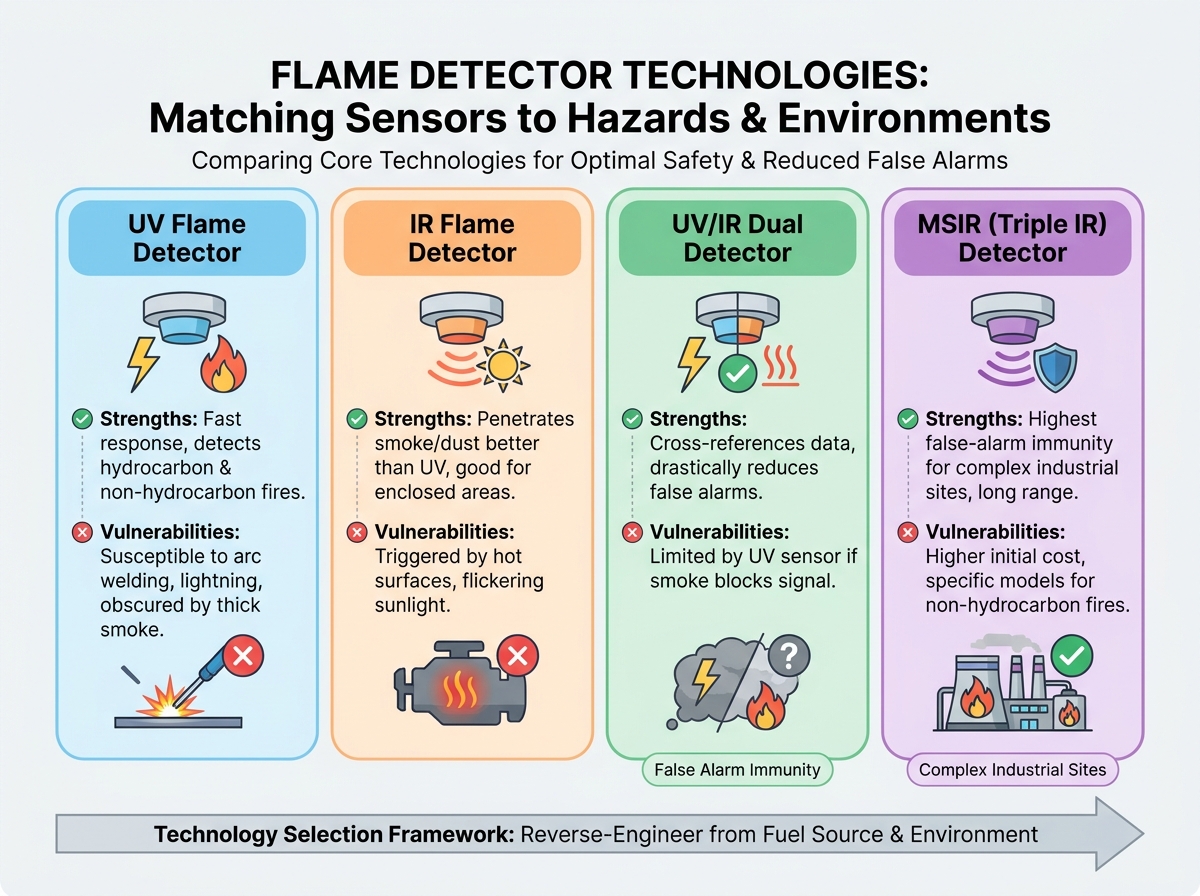
Different hazards require different optical technologies. Flame Detectors rely on specific spectral bands to identify fires. You must match the technology to your hazard profile exactly.
UV detectors monitor the ultraviolet spectrum. They look for the high-energy radiation produced at the exact moment of ignition.
Strengths: UV units offer extremely fast response times. They typically alarm within milliseconds. They remain highly sensitive to both hydrocarbon and non-hydrocarbon fires. This makes them versatile for clean, indoor applications.
Vulnerabilities: They suffer from high susceptibility to arc welding. Lightning and corona discharges also trigger frequent false alarms. Furthermore, thick smoke or oil films easily absorb UV radiation. A dirty lens completely blinds a UV sensor.
Infrared detectors monitor the thermal radiation emitted by hot gases. Most single-frequency IR units look specifically for the 4.4-micron band. This band matches burning carbon dioxide.
Strengths: IR sensors offer better penetration through smoke and dust compared to UV sensors. They resist blinding from oil films. They work well for enclosed areas like gas turbine enclosures.
Vulnerabilities: Hot surfaces, industrial ovens, or flickering sunlight can trigger them. They cannot detect non-hydrocarbon fires effectively. A pure hydrogen fire goes completely unnoticed by a standard carbon dioxide IR sensor.
Dual detectors combine both spectrums into a single housing. They cross-reference data from both sensors before triggering an alarm.
Strengths: This combination drastically reduces false alarms. Both the UV and IR thresholds must breach simultaneously. Arc welding might trigger the UV side, but the IR side remains calm. This voting logic ensures reliable performance in moderate environments.
Vulnerabilities: The unit remains limited by the weaknesses of the UV sensor. If thick smoke blocks the UV signal, the entire unit fails to alarm. The IR sensor might see the fire, but the required UV confirmation is missing.
MSIR detectors use multiple IR bands simultaneously. They isolate the unique spectral signature of a fire while aggressively filtering out background thermal noise.
Strengths: MSIR represents the industry gold standard for complex industrial sites. They offer the longest detection range available. They provide exceptional immunity to sunlight, welding, and hot machinery. They also penetrate heavy smoke effortlessly.
Vulnerabilities: They require a higher initial capital expenditure. Additionally, you need specific hardware variations for non-hydrocarbon fires. A standard MSIR unit will not see a hydrogen flame.
Optical Sensor Technology Comparison| Technology Type | Core Strengths | Main Vulnerabilities |
|---|---|---|
| Ultraviolet (UV) | Ultra-fast response; detects both fuel types. | Blinded by smoke/oil; triggered by welding. |
| Single Infrared (IR) | Penetrates smoke; ignores welding. | Triggered by hot machinery; misses hydrogen. |
| UV/IR Dual | Strong false alarm immunity; logical voting. | Fails if smoke blocks the UV sensor. |
| Multi-Spectrum IR (MSIR) | Longest range; industry-best false alarm rejection. | Higher initial cost; requires specific models for hydrogen. |
Choosing the right optical technology solves only half the problem. You must evaluate several mechanical and operational features. These dimensions dictate long-term reliability.
The cone of vision dictates device placement. Every detector has a specific Field of View, usually between 90 and 120 degrees. You must understand how this angle interacts with the detection range.
Maximizing range isn't just about covering more physical area. It directly reduces the total number of detectors required. Fewer detectors mean lower installation and cabling costs. However, you must verify the range for your specific fuel. A device might detect a gasoline fire at 200 feet, but only detect a methane fire at 100 feet.
Continuous self-testing remains an absolute necessity for modern safety systems. Decision-makers should prioritize units featuring automated optical integrity checks.
These systems automatically check for optical fouling. They project an internal signal through the lens to confirm clarity. If dirt or oil blocks the lens, the unit sends a fault signal to the control panel. This eliminates the need to climb scaffolding manually with test lamps every week. It ensures your safety system remains online continuously.
Engineers constantly trade off ultra-fast response times against programmed time delays. While a millisecond response sounds ideal, it often causes problems.
A momentary flash of lightning might trigger a hyper-sensitive device. To prevent nuisance trips, manufacturers implement alarm verification algorithms. These algorithms delay the alarm by three to five seconds. They verify the fire signature remains constant before shutting down the process. You should adjust these settings based on your facility's tolerance for false trips.
You must address the physical build quality. Industrial environments destroy fragile equipment quickly. Your housing material choice determines the device's lifespan. Consider the following housing options:
Always verify the ingress protection rating. We recommend IP66 or IP67 ratings for any outdoor installation. These ratings guarantee protection against heavy rain and high-pressure washdowns.
Industrial safety is highly regulated. You cannot install arbitrary hardware in a classified zone. You must prove compliance through third-party certifications.
You must match the detector's explosion-proof rating to your facility's classified zones. A flammable atmosphere requires specialized hardware. The enclosure must contain any internal electrical spark, preventing an external explosion.
Check your local electrical codes carefully. In North America, you will encounter Class I, Division 1 or Division 2 requirements. Internationally, you will work with ATEX or IECEx Zone 1 or Zone 2 classifications. Verify these certificates before procurement. Installing an uncertified device in a classified zone violates federal safety laws.
Mission-critical applications require extreme reliability. You measure this reliability through Safety Integrity Level (SIL) ratings.
A SIL rating quantifies the probability of failure on demand. Choosing a SIL 2 or SIL 3 capable flame detector is often mandatory for regulatory compliance. It provides statistical proof regarding the device's reliability. If your facility utilizes a Safety Instrumented System (SIS), you must purchase SIL-certified hardware. Standard commercial detectors will not meet these strict risk mitigation requirements.
You must connect new detectors to your existing infrastructure. This creates significant integration challenges. You will likely connect to legacy Fire and Gas (F&G) panels, Distributed Control Systems (DCS), or PLC networks.
Evaluate your required communication protocols early. Standard installations use a 4-20mA analog output. Modern smart facilities often require HART or Modbus protocols for advanced diagnostics. Simple relay contacts remain popular for basic alarm panels. Ensure your chosen hardware communicates seamlessly with your control room. A communication mismatch causes severe commissioning delays.
You need a structured approach to finalize your decision. Do not buy hardware based solely on specification sheets. You must validate the design practically.
We highly recommend utilizing software-based mapping studies. You should perform this study before finalizing a purchase order.
Engineers input your facility's 3D CAD model into specialized software. They simulate fire scenarios based on your hazard analysis. The software determines optimal device placement and identifies dangerous blind spots. It calculates the exact quantity of Flame Detectors needed to achieve target coverage grades. This scientific approach prevents dangerous under-coverage. It also prevents wasteful over-purchasing.
Always evaluate the manufacturer beyond the hardware itself. Even the best hardware fails without proper support.
Review their standard lead times and warranty terms. Verify the availability of localized technical support. You may also need certified commissioning engineers during startup. If a device fails, you need a replacement quickly. Waiting six weeks for an overseas shipment leaves your facility unprotected. Strong vendor support ensures long-term operational success and minimizes safety vulnerabilities.
Selecting flame detectors is a strict matching exercise. You must align facility hazards, environmental interferents, and optical technology perfectly. A mismatch guarantees either a catastrophic failure to alarm or endless nuisance trips. We strongly advise against "one-size-fits-all" procurement strategies. What works for a clean indoor warehouse will fail miserably on an offshore drilling rig.
Take the time to audit your fuel sources and map your blind spots. We encourage you to consult with a certified fire protection engineer. You should also request an on-site hazard assessment from a reputable manufacturer. Validating your selection through professional engineering ensures your people and assets remain fully protected.
A: Solid-state IR and MSIR sensors often last 10 to 15 years in the field. They lack consumable parts. Conversely, UV tubes degrade faster due to background radiation exposure. You typically need to replace UV sensors every 3 to 5 years to maintain optimal sensitivity.
A: They require a direct line of sight to the fire. Physical obstructions completely block detection. While MSIR technology can penetrate moderate to heavy smoke effectively, a solid wall or large piece of machinery will create a permanent blind spot.
A: Modern units feature continuous self-diagnostics to monitor optical clarity. However, NFPA and local fire codes typically mandate annual or semi-annual functional testing. You must use a specialized, manufacturer-approved test lamp to verify the alarm output physically.
A: Flame detectors protect high-risk, open, or drafty areas. In these environments, fires ignite rapidly. Smoke and heat would dissipate into the atmosphere before ever reaching a traditional ceiling sensor. Optical sensors detect the radiant energy instantly, regardless of wind conditions.