lucy@zlwyindustry.com
+86-158-1688-2025
Please Choose Your Language
- All
- Product Name
- Product Keyword
- Product Model
- Product Summary
- Product Description
- Multi Field Search

Views: 0 Author: Site Editor Publish Time: 2026-11-10 Origin: Site


Facility managers and process engineers face mounting operational pressure today. Rising fuel costs squeeze operating budgets tightly. Stricter emission mandates require immediate compliance action from plant leaders. The demand for higher throughput exposes the severe limitations of legacy heating systems. Industrial production cannot afford thermal bottlenecks. We are currently at a critical transition point. Facilities face a choice. They can maintain traditional heating methods. These include legacy boilers, standard convection heaters, and basic resistance systems. Alternatively, they can upgrade to advanced Industrial Burners. These modern solutions include low-NOx, oxy-fuel, and precision-controlled units. This equipment decision shapes long-term operational success and profitability. This guide provides an evidence-based, techno-economic framework. You will learn to evaluate both approaches thoroughly. We base this comparison on lifecycle costs, thermal efficiency, compliance capabilities, and implementation realities. We will help you navigate this complex equipment transition confidently and safely.
Let us look closely at the hidden costs of aging heating setups. Traditional systems often suffer from severe thermal inefficiency. Uneven heat distribution frequently causes inconsistent product quality on the line. You end up scrapping valuable materials due to poor temperature control. Your maintenance teams spend rising hours fixing failing mechanical components. Relying on legacy technology drains operational budgets quietly but consistently.
Inaction carries a very heavy financial price tag. Fluctuating fuel prices hit inefficient legacy systems especially hard. Every wasted BTU multiplies your monthly energy bills. If you delay necessary upgrades, you risk major financial leaks. Competitors utilizing efficient systems will gain a distinct pricing advantage over you.
What exactly defines a successful system upgrade? You need clear success criteria before ripping out old equipment. First, look for a measurable ROI timeline. Second, ensure you secure strong emission compliance margins for the future. Third, aim for zero unplanned downtime post-commissioning. Hitting these specific targets ensures your new setup delivers real, lasting value. Best practices dictate writing these performance criteria directly into vendor contracts.
We must first define the baseline equipment clearly. Traditional heating methods typically include standard convection heaters. They also feature basic direct-fired units and legacy atmospheric boilers. They rely on simple, highly mechanical operations. They pull ambient air naturally without complex forced-draft mechanisms.
Now let us examine the modern standard in detail. Advanced Industrial Burners include high-efficiency forced draft systems. They also feature modulating mechanisms, oxy-fuel combustion, and radiant tube designs. They leverage digital controls alongside precise aerodynamic engineering.
You need a structured way to evaluate these complex systems. We use a techno-economic framework to assess them accurately. This prevents focusing solely on the upfront hardware price tag.
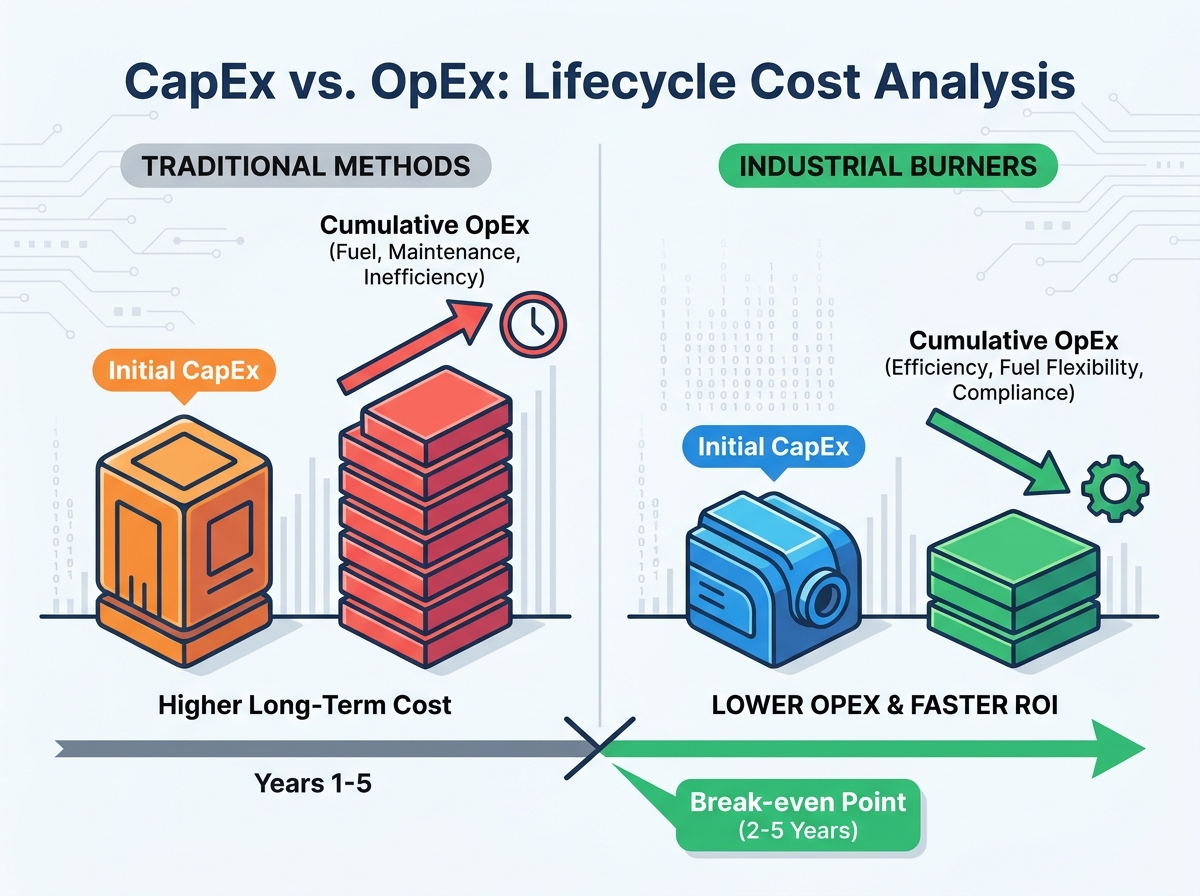
Let us break down the initial investment versus operational savings. Traditional setups have low initial hardware and installation costs. However, operational expenses quickly erase those perceived savings. Consider replacing a legacy furnace oil system. If you retrofit it using a high-efficiency model, the economics shift dramatically. You might pay double upfront for the modern hardware. Yet, you can achieve 15% to 30% fuel-saving percentages annually. The operational savings usually pay for the hardware within two to five years. After that period, the fuel savings become pure operational profit.
Thermal efficiency dictates your long-term energy consumption heavily. Standard convection heating wastes significant heat into the surrounding facility environment. It heats the ambient air rather than the product. In contrast, modern direct and indirect-fired systems deliver targeted heat. They apply thermal energy exactly where the specific process demands it.
Turndown ratio capabilities also play a massive role here. Legacy boilers often run at full capacity or turn off completely. They suffer from short-cycling, degrading mechanical components rapidly. Modern systems scale their energy use to match exact real-time demand. This continuous modulation reduces cyclical waste significantly.
We must also evaluate environmental compliance capabilities. Stringent emission targets push facilities to upgrade rapidly. Modern systems feature specific engineering for ultra-low NOx output. They handle transitional fuels efficiently and safely. You will find options utilizing SCO2 recirculation or hydrogen-ready configurations. These features future-proof your facility against tightening local and federal regulations.
Table: Heating Efficiency and Compliance Comparison
| Metric | Legacy Boiler Systems | Advanced Industrial Burners |
|---|---|---|
| Fuel Efficiency | 60% - 75% | 85% - 95%+ |
| Turndown Ratio | Limited (often 3:1) | High (up to 10:1 or more) |
| NOx Emissions | High baseline levels | Ultra-low NOx capabilities |
| Energy Modulation | On/Off or basic staging | Continuous precision modulation |
Replacing critical infrastructure involves clear, measurable operational risks. You must quantify the realistic operational pause required. Ripping and replacing a traditional boiler causes extended facility downtime. It often stops production entirely for several weeks. You must disconnect heavy piping, alter foundations, and re-route exhaust stacks. Conversely, retrofitting an existing boiler minimizes this massive disruption. You can often complete a retrofit during a standard planned plant outage.
Control system integration presents another major technical hurdle. Connecting advanced electronic burner management systems (BMS) to older facility logic causes friction. Legacy relays often fail to communicate seamlessly with modern digital sensors. You might need intermediate PLCs to bridge this technology gap effectively. We highly recommend testing PLC communications offline before full installation.
Workforce readiness is a vital operational reality you cannot ignore. Your team must shift their daily troubleshooting routines. They previously relied on mechanical maintenance for traditional systems. They used wrenches and visual flame inspections. Now, they must perform sensor diagnostics and software-driven troubleshooting.
Here are common mistakes to avoid during this transition:
Every facility possesses unique operational constraints and production goals. We can map specific technical solutions directly to your operational profile.
Sometimes, retaining traditional methods makes strict financial sense. You might operate a facility possessing an extremely short remaining lifespan. Perhaps your specific process requires minimal thermal cycling overall. If you operate in regions boasting exceptionally low energy costs and lax emission standards, legacy equipment remains viable. It keeps your short-term cash flow highly stable.
However, you should invest in advanced Industrial Burners under the following conditions:
You should take deliberate next steps before buying anything. First, conduct a comprehensive baseline thermal energy audit. Measure exactly how much fuel you waste today. Next, request a techno-economic analysis from a certified combustion engineer. Complete these critical tasks before you ever request vendor quotes.
The choice between traditional heating and advanced setups is rarely just a hardware decision. It acts as a long-term energy strategy for your entire business. Your heating infrastructure dictates your future profitability and regulatory standing.
Legacy systems certainly offer comforting familiarity to older operators. However, the compounding costs of inefficiency and non-compliance destroy profit margins silently. Modern setups stand as the pragmatic choice for long-term viability. They give you proactive control over volatile global fuel costs. They ensure your facility remains strictly compliant as environmental laws tighten.
Do not wait for legacy equipment to fail catastrophically. Schedule a specific process heating assessment this quarter. Assess your current fuel-to-steam or fuel-to-product efficiency accurately. Alternatively, download a detailed ROI calculation worksheet to start mapping your operational savings today. Take charge of your thermal energy future now.
A: The standard ROI timeline typically ranges between 18 and 36 months. Upgraded systems achieve this rapid payback primarily through massive fuel savings. By modulating energy use to match real-time demand, facilities cut wasteful cyclical heating. Operational cost reductions quickly offset the initial hardware investment.
A: Yes, you can successfully retrofit them onto many existing boilers. However, you must carefully evaluate physical footprint compatibility. You also need to ensure the existing combustion chamber handles new flame geometries safely. Finally, retrofits require precise integration between the new burner management system and older facility controls.
A: Direct-fired systems expose the product directly to combustion gases. They offer maximum thermal efficiency but require processes tolerating exhaust exposure. Indirect-fired systems use heat exchangers isolating the combustion process from the product. They provide clean, untainted heat, making them ideal for food production or sensitive chemical applications.
A: Yes, they require updated training protocols. Operators must shift from making mechanical adjustments to managing digital control interfaces. Maintenance teams need to understand sensor calibration, software troubleshooting, and electronic air-to-fuel ratio tuning. Investing in workforce readiness ensures you capture the full efficiency benefits.