lucy@zlwyindustry.com
+86-158-1688-2025
Please Choose Your Language
- All
- Product Name
- Product Keyword
- Product Model
- Product Summary
- Product Description
- Multi Field Search

Views: 0 Author: Site Editor Publish Time: 2026-11-01 Origin: Site


Commercial facilities face immense liabilities and severe operational risks from undetected atmospheric hazards. This urgent reality moves the conversation quickly from basic worker safety to comprehensive, facility-wide risk management. Unlike simple residential sensors, modern commercial environments require highly robust, seamlessly integrated monitoring systems. These advanced networks must prevent disruptive false alarms and ensure strict regulatory compliance at all times. Crucially, they must achieve this level of protection without disrupting your daily operational workflow.
Evaluating commercial Gas leak detectors requires looking far beyond basic manufacturer specifications. You must truly understand how these systems perform under intense industrial stress and unpredictable environmental conditions. We will show you exactly how they integrate with your existing digital infrastructure. Furthermore, you will learn how the right features actively support ongoing safety audit readiness.
Complex chemical environments constantly challenge facility managers. Standard sensors frequently trigger false alarms when exposed to non-target gases. For example, common cleaning solvents might trip a basic methane sensor. Every false alarm forces unnecessary evacuations. These interruptions destroy productivity and breed complacency among your workforce. When alarms sound too often, personnel may start ignoring them entirely.
You need detectors utilizing advanced sensor technologies tailored specifically to your facility profile. Look into Catalytic Bead, Non-Dispersive Infrared (NDIR), or Photoionization Detectors (PID). Assess the sensor's specific cross-sensitivity profile before purchasing anything. Verify its ability to detect multiple distinct gases within a single integrated network. You should monitor combustible gases, volatile organic compounds (VOCs), and toxic gases like carbon monoxide simultaneously.
No sensor is completely immune to chemical interference. Proper specification requires you to match the sensor type strictly to your facility's ambient baseline. We highly recommend mapping out all ambient gases present during your normal operations. Ask vendors for a detailed cross-sensitivity chart. This chart will show exactly how their sensor reacts to interfering chemicals in your specific workspace.
Common Sensor Technologies and Applications Summary
| Sensor Technology | Primary Target Gases | Key Advantage | Common Limitation |
|---|---|---|---|
| Catalytic Bead | Combustibles (LEL) | Cost-effective and widely proven | Can be poisoned by silicones or lead |
| Non-Dispersive Infrared (NDIR) | Hydrocarbons, CO2 | Functions well in low-oxygen environments | Cannot detect hydrogen gas |
| Photoionization Detector (PID) | Volatile Organic Compounds (VOCs) | Highly sensitive to toxic low-level VOCs | Struggles in extremely high-humidity areas |
| Electrochemical | Toxic gases (H2S, CO, Ammonia) | Highly specific to target gases | Shorter operational lifespan (2-3 years) |
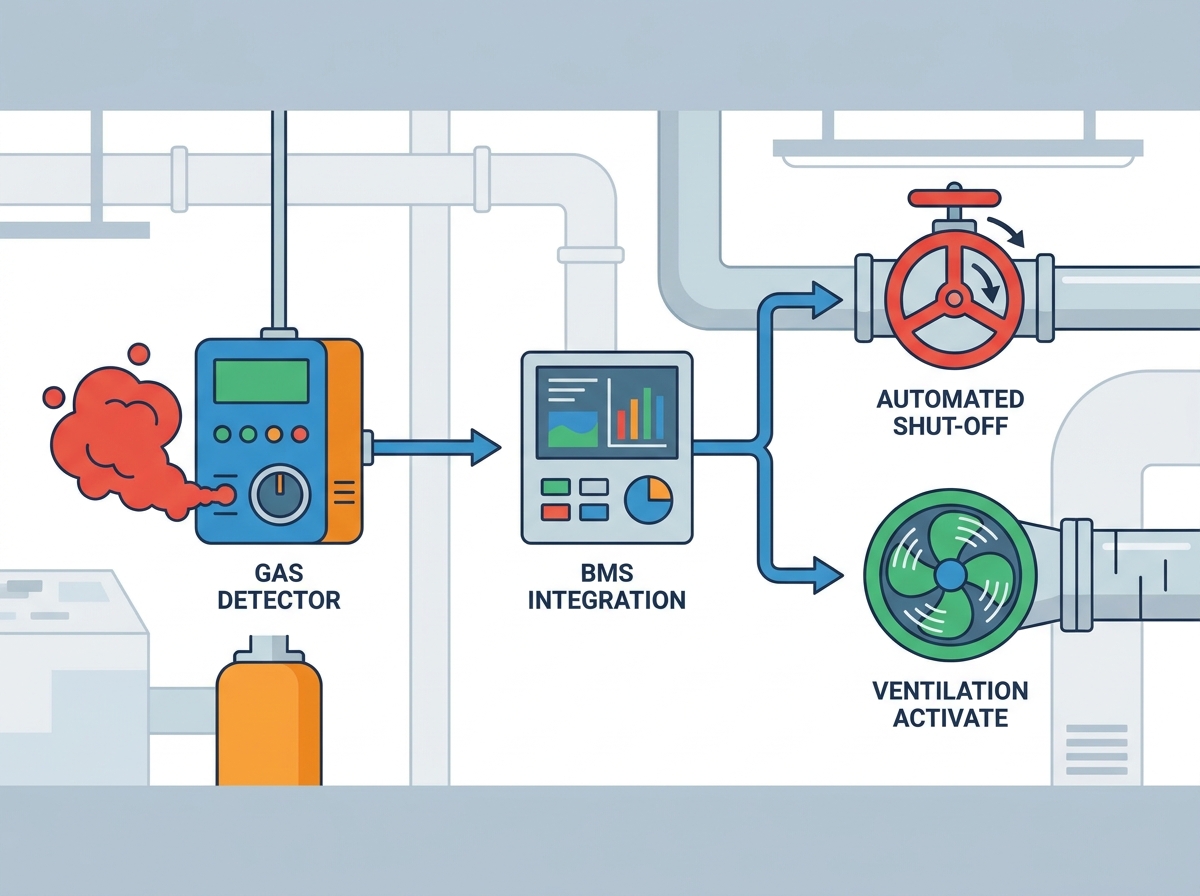
Standalone alarms fail to provide true commercial scalability. Your system must communicate real-time threat levels to central control rooms instantly. Centralized monitoring fundamentally reduces emergency response times. Furthermore, zoned alert systems prevent facility-wide panic during localized, minor incidents. If a small leak occurs in an isolated utility room, you can manage it without evacuating the entire manufacturing floor.
Explore different solution categories carefully. You can choose hardwired communication protocols like 4-20mA, Modbus, or BACnet. Alternatively, wireless options like WirelessHART and ISA100 offer incredible topological flexibility. Hardwired setups typically provide unmatched, continuous reliability. They never drop signal due to heavy machinery interference. Conversely, wireless networks save massively on installation labor. They suit hard-to-reach areas perfectly.
Legacy BMS platforms frequently struggle to interpret data from modern digital systems. This represents a significant implementation risk. You might require expensive middleware or gateways to bridge this communication gap. We suggest auditing your current BMS architecture beforehand. Ensure native compatibility before you commit to a specific sensor network. Forcing incompatible systems to communicate often leads to dropped signals and dangerous blind spots.
Human response times remain far too slow during a catastrophic line failure. Relying solely on manual intervention invites disaster. When a high-pressure pipe ruptures, explosive gases fill a room in seconds. Modern safety infrastructure requires automated, immediate physical intervention.
Evaluate detectors based heavily on their built-in relay contacts. These contacts must trigger secondary mechanical actions instantly upon detecting hazard thresholds. Prioritize fail-safe designs above all else. For instance, relays should automatically trigger if the detector suddenly loses power or experiences a critical fault. These units must automatically shut off gas solenoid valves. They should simultaneously engage emergency exhaust ventilation. Disabling nearby ignition sources is another critical automated function.
Automated shut-offs demand rigorous, precise commissioning. Misconfigured relays can cause unnecessary total-facility shutdowns. Such errors lead to significant revenue loss, ruined production batches, and operational chaos. You must calibrate action thresholds carefully. Set low-level pre-alarms for physical investigation and high-level main alarms for actual mechanical shutdowns.
Installation realities strictly dictate the lifespan of your equipment. Facilities often install these units in heavy wash-down areas, humid boiler rooms, or extreme temperature zones. Commercial-off-the-shelf units fail rapidly under such environmental stress.
Focus heavily on Ingress Protection (IP) ratings during your evaluation. Demand a minimum of IP65 for basic industrial dust and water resistance. Require IP66 or IP67 ratings for harsh wash-down environments commonly found in food and beverage processing. Hazardous locations necessitate robust explosion-proof housings. Look for Class I, Div 1 or 2 certifications if explosive atmospheric mixtures are present normally.
Built-in temperature compensation is another vital characteristic. It prevents dangerous sensor drift in fluctuating, unpredictable climates. If a sensor drifts, it either triggers false alarms or fails to trigger real ones.
High IP ratings primarily protect the outer protective housing. However, the actual sensing element remains directly exposed to the surrounding environment to sample the air. We advise carefully evaluating sintered filters for maintenance accessibility. If dust clogs this filter, the sensor cannot breathe the ambient air. It will fail to detect leaks completely. Regular inspection and cleaning of these filters remains a non-negotiable maintenance task.
Regulatory bodies like OSHA, the EPA, and local fire marshals demand absolute proof of functional safety. They require documented evidence of regular maintenance and testing. Relying on disorganized paper logs creates massive compliance risks and liability exposure.
Onboard event logging records your complete alarm history. It tracks exact peak gas concentrations, exposure durations, and specific fault codes. Automated calibration reminders streamline your routine safety audits. Modern digital certificates provide instant, unarguable proof of your compliance efforts.
Look for systems featuring secure cloud-based reporting dashboards. Local software generating unalterable compliance reports is equally valuable. These tools prove your system remained active and properly calibrated during any specific timeframe. When inspectors arrive, you can hand them a digital report instead of searching through filing cabinets.
Compliance Documentation Comparison
| Feature Dimension | Manual Paper Logging | Automated Data Tracking |
|---|---|---|
| Data Accuracy | Prone to human error and omission | Timestamped and unalterable |
| Audit Preparation | Requires hours of physical document gathering | Generates instant compliance reports |
| Event Granularity | Only captures manually noticed events | Records peak concentrations second-by-second |
| Calibration Reminders | Relies on calendar notes or memory | Pushes automated alerts to facility managers |
Choosing the right vendor is just as critical as selecting the hardware itself. Begin your shortlisting process by excluding vendors who cannot provide transparent data on expected sensor lifespans. Hidden replacement costs will quickly consume your maintenance budget. Prioritize manufacturers offering modular, plug-and-play designs. Replacing a modular sensor block takes mere minutes. This approach drastically reduces maintenance downtime.
Placement strategy dictates system effectiveness entirely. Gas specific gravity strictly determines correct sensor placement. You must mount sensors near ceilings for lighter gases like hydrogen or methane. Conversely, mount them near floor trenches for heavier gases like propane or butane. Poor placement completely negates even the most expensive technological features. A propane leak will never trigger a ceiling-mounted detector until the entire room is saturated.
Consider calibration gas sourcing early in the process. Ensure the required calibration gases are readily available in your specific geographic region. Check whether they remain cost-effective over the long term. Exotic sensor types often require expensive, hard-to-source calibration cylinders.
We recommend specific next-step actions to ensure success. Conduct a comprehensive, facility-wide gas hazard assessment first. Audit your current BMS protocol compatibility alongside your IT department. Finally, always request pilot testing for a single isolated zone before authorizing a full-scale facility rollout.
Selecting commercial systems is not simply about buying the most sensitive equipment on the market. It is about deploying the most reliable, easily integratable system possible for your specific environment. Prioritize specific features actively reducing false alarms, like proper cross-sensitivity management. Ensure immediate physical mitigation capabilities through robust automated relays. Simplify your ongoing regulatory burdens via automated data logging.
Begin improving your facility safety today by taking these actionable steps:
A: Most manufacturers and safety regulations require bump testing monthly and full calibration every 3 to 6 months, depending on the sensor type and environmental harshness.
A: Lower Explosive Limit (LEL) sensors are designed to detect combustible gases to prevent explosions, while Photoionization Detectors (PID) are used for detecting low levels of Volatile Organic Compounds (VOCs) for toxicity and health monitoring.
A: While wireless systems reduce installation costs and offer flexibility, hardwired systems are generally preferred in life-critical commercial applications for their continuous power and fail-safe reliability, unless the facility topology makes wiring impossible.
A: Electrochemical sensors (for toxic gases) typically last 2-3 years, while catalytic bead and infrared (IR) sensors (for combustibles) can last 3-5 years or up to 10 years, respectively, before requiring replacement.