lucy@zlwyindustry.com
+86-158-1688-2025
Please Choose Your Language
- All
- Product Name
- Product Keyword
- Product Model
- Product Summary
- Product Description
- Multi Field Search

Views: 0 Author: Site Editor Publish Time: 2026-11-17 Origin: Site


In high-risk industrial environments, waiting for smoke or heat to reach a ceiling-mounted sensor is not a viable safety strategy. Seconds matter immensely when handling highly combustible materials. Delayed hazard responses often lead to catastrophic human and structural consequences. Flame Detectors provide rapid, line-of-sight hazard identification to mitigate these exact risks immediately. However, deploying the wrong sensor technology often leads to dangerous blind spots. Incompatible sensors also trigger costly operational shutdowns due to frustrating false alarms. Evaluating these industrial safety devices properly requires careful attention. You must map the specific spectral signatures of your facility's fuel sources against daily environmental interference. Here is an objective breakdown of the five primary flame detector types. We also explore exactly how to evaluate them for your specific industrial infrastructure.
Traditional smoke and thermal detectors rely entirely on passive environmental changes. Standard smoke alarms require physical particle drift to trigger an alert. Heat detectors wait passively for rising thermal plumes. These traditional methods fail routinely in open-air facilities and high-ceiling aircraft hangars. Thermal energy dissipates too quickly in large volume spaces. Heavy industrial drafts easily blow smoke away from ceiling-mounted sensors. These passive systems simply respond too slowly to protect highly combustible environments adequately.
Optical flame detection offers a distinct line-of-sight advantage. They actively monitor the surrounding electromagnetic radiation. A live fire continuously emits ultraviolet, visible, or infrared light. Optical sensors read these specific light emissions instantly. They register a confirmed hazard in milliseconds rather than minutes. This speed prevents localized combustion from escalating into uncontrolled facility-wide fires.
Spurious trips carry an enormous operational business cost. A single false alarm in a chemical plant halts production entirely. Automated alerts can trigger massive chemical deluge systems accidentally. Refineries lose millions of dollars per shutdown hour. You cannot afford sensors tripping over background noise. Establishing highly accurate sensor selection shields both your personnel and your profit margins. False alarm immunity remains the cornerstone of modern industrial safety engineering.
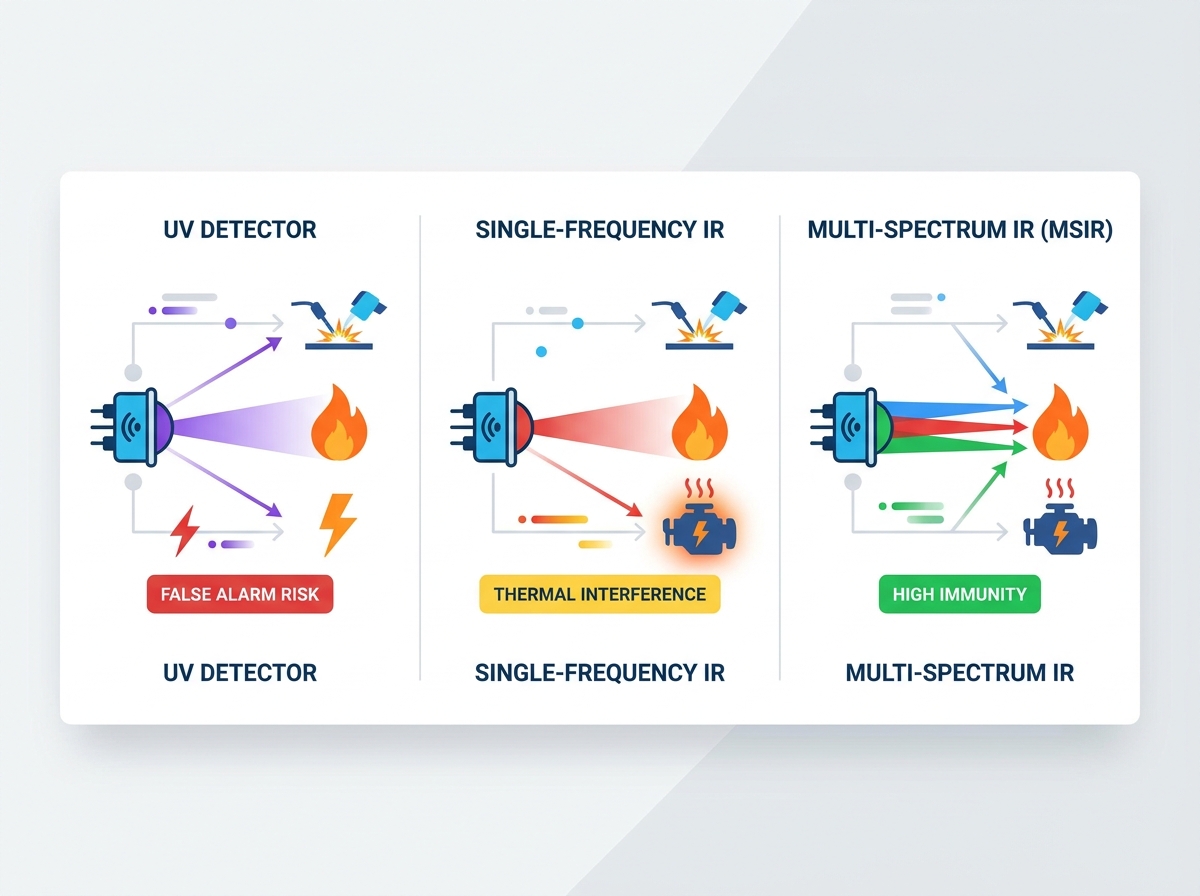
Ultraviolet sensors operate by detecting radiation in the UV spectral range. They typically target wavelengths between 180 and 260 nanometers. Fires emit intense bursts of UV radiation at the moment of ignition. These sensors process this electromagnetic shift almost instantaneously. They act as the fastest optical detection method currently available.
They suit specific indoor environments perfectly. They excel at identifying invisible hydrogen fires. Engineers deploy them heavily in areas requiring hyper-fast response times. Munitions manufacturing plants rely on them to trigger suppression systems before explosive chain reactions occur.
However, UV technology carries severe limitations. It remains highly susceptible to costly false alarms. Arc welding, lightning strikes, and halogen lamps all emit competing UV radiation. Furthermore, heavy smoke can block UV wavelengths completely. Even a thin oil film settling on the sensor lens blinds the device quickly.
Single-frequency infrared detectors monitor a specific infrared spectral band. They usually focus around the 4.3 to 4.4 micron wavelength. Burning hydrocarbon fuel sources emit peak radiation naturally at this exact wavelength. The sensor looks for both this specific heat band and the characteristic flicker of a fire.
These detectors perform best in enclosed industrial areas. They handle known hydrocarbon fuel risks exceptionally well. They ignore atmospheric particulates, making them ideal for environments expecting heavy smoke. Paint booths and enclosed engine testing rooms utilize them frequently.
Background thermal radiation creates their biggest vulnerability. Hot engines, heavy machinery, industrial ovens, and reflected sunlight can all trigger false alarms. Additionally, they remain useless for detecting non-hydrocarbon combustion. A pure hydrogen fire emits no carbon dioxide, leaving standard IR sensors completely blind to the hazard.
Multi-spectrum detectors utilize three or more distinct infrared sensors simultaneously. Each sensor measures a different infrared wavelength. The device uses complex algorithms to cross-reference the incoming spectral data constantly. It isolates the actual flame signature while actively filtering out surrounding background noise.
They dominate heavy industrial applications. Offshore oil rigs depend on them almost exclusively. Petrochemical plants and outdoor fuel storage tank farms also benefit greatly from their reliability. They process chaotic environmental data better than any single-sensor alternative.
This advanced technology requires a higher upfront unit cost. While highly immune to common false alarms, they face specific environmental challenges. They can still experience degraded range during severe weather conditions. Heavy rain, dense fog, or thick snow can block infrared transmission significantly.
Combination units house both a UV and an IR sensor in one casing. The device requires both sensors to register a verified fire signature simultaneously. The internal logic circuit will not trigger an alarm unless both wavelengths confirm the threat. This dual-verification method virtually eliminates nuisance tripping.
They shine in highly active industrial zones. Aircraft hangars and loading racks represent prime applications. Facilities housing both arc welding operations and hot moving machinery need them urgently. They provide maximum false alarm rejection without sacrificing overall facility safety.
Their detection distance remains strictly limited to the weakest internal sensor. Usually, the UV component dictates the maximum functional range. They also register a noticeably slower response time than standalone UV units. The dual-verification processing inevitably adds critical milliseconds to the alert cycle.
Visual detectors process live, high-definition video feeds continuously. They utilize advanced machine learning algorithms to identify hazards visually. The software analyzes the exact shape, flicker rate, and motion of smoke and flames. It spots developing fires by recognizing visual patterns rather than invisible radiation.
They protect large open-air spaces efficiently. Waste processing facilities use them to scan massive debris piles. They excel in areas where human operators require immediate visual confirmation before deploying emergency resources.
Complete darkness renders them completely useless. You must pair them with external IR illumination for night operations. They demand heavy computational power to process video data locally. They also rely entirely on perfectly clean sightlines to function.
Flame Detector Capabilities Summary
| Detector Type | Detection Speed | Smoke Penetration | False Alarm Risk | Best Fit Application |
|---|---|---|---|---|
| Ultraviolet (UV) | Milliseconds (Hyper-fast) | Poor | High (Welding, lighting) | Indoor munitions, Hydrogen |
| Single IR | Fast | Excellent | Medium (Hot machinery) | Enclosed hydrocarbon storage |
| Multi-Spectrum (IR3) | Fast | Excellent | Low | Offshore rigs, outdoor fuel |
| UV/IR Combination | Moderate | Fair | Very Low | Hangars, active loading racks |
| Visual / CCTV | Moderate | Varies (Needs light) | Medium | Waste processing, open spaces |
Selecting the right safety equipment demands precision. You must differentiate clearly between hydrocarbon fires and non-hydrocarbon fires. Wood, plastics, oil, and natural gas all represent hydrocarbon fuels. They burn and release heavy carbon dioxide emissions. Single IR and MSIR sensors track these fires perfectly. Non-hydrocarbon fuels behave differently. Hydrogen, ammonia, and silane burn without releasing carbon. You must use UV sensors or highly specialized multi-spectrum units calibrated for these specific invisible hazards.
Auditing your space for environmental triggers is equally critical. You must identify what background noise exists on your factory floor daily. Solar glare reflecting off wet concrete triggers basic sensors quickly. Unshielded flare stacks confuse older IR monitors. Daily arc welding activities routinely blind UV receivers. Moving hot machinery mimics the thermal footprint of a developing fire. You must map these triggers before purchasing any hardware.
Understanding field of view (FOV) limitations prevents fatal engineering errors. A sensor does not see a perfect square. It sees a cone. Detector sensitivity drops significantly at the outer edges of this FOV cone. Furthermore, the inverse-square law strictly limits detection range. Doubling the distance from the fire requires the flame to be four times larger to trigger an alert. You must account for this mathematical reality during installation planning.
Do not ignore compliance and safety integrity ratings. Select devices featuring appropriate SIL (Safety Integrity Level) ratings for your specific industry. Ensure they meet proper hazardous area classifications, such as Class I, Division 1 or 2. Confirm strict compliance with NFPA 72 standards. Meeting these recognized industry benchmarks ensures your safety infrastructure functions reliably when disaster strikes.
You must solve the critical blind spot problem proactively. Implementing an ad-hoc installation strategy creates dangerous unmonitored zones. Conducting formal 3D fire mapping remains an absolute necessity. Structural shadows block line-of-sight sensors easily. Intersecting pipes, massive steel columns, and moving transport vehicles all obscure a detector's vision. You must design an overlapping FOV layout. If one sensor gets blocked by a parked forklift, a secondary unit must cover the exposed zone.
Industrial environments destroy optical clarity rapidly. Factories deposit heavy oil films, airborne dust, and corrosive salt directly onto detector lenses. A dirty lens effectively unplugs the sensor from the safety network. Manual cleaning is necessary but insufficient. Emphasize purchasing hardware featuring automated optical integrity (OI) self-testing features. These smart units routinely beam a calibrated light signal through their own lens. If grime blocks the internal light, the unit flags a maintenance alert immediately.
Connecting fast-acting sensors to automated suppression systems introduces distinct risks. Facility managers often connect optical detectors directly to deluge valves or clean-agent gas systems. This integration saves precious seconds during a real emergency. However, a false alarm will dump thousands of gallons of suppression chemicals onto active machinery accidentally. You must guarantee your chosen detector possesses absolute false-alarm immunity before authorizing automated suppression integration.
Start your procurement process correctly. Stop buying ad-hoc safety hardware based purely on basic cost comparisons. We recommend starting with a formal fire and gas (F&G) mapping study. Professional mapping software models your unique facility digitally. It calculates exact sensor placement. It ensures comprehensive coverage while minimizing hardware redundancy.
Evaluate your safety vendors rigorously. Demand transparent testing data. Look for manufacturers providing verified response times. Request detailed field-of-view cone charts for specific fuel sources. Ask for documented false-alarm immunity testing results. Trustworthy vendors publish this data openly. They understand you rely on empirical evidence to protect human life.
Always implement localized pilot testing first. Do not deploy a new detector model facility-wide immediately. Suggest a limited rollout in the most complex zone of your facility instead. Monitor it closely for several weeks. Validate the sensor performance against real-world background noise. Confirm it ignores your daily operational triggers before committing to a larger capital expenditure.
The total credibility of your safety system relies entirely on consistent accuracy. Flame Detectors must alert personnel flawlessly during true emergencies while remaining perfectly silent during normal daily operations. Ignore basic cost comparisons. Prioritize evidence-based site mapping. Match your sensor technology directly to your specific industrial fuel sources. This disciplined approach ensures reliable asset protection and safeguards human life permanently.
A: UV sensors detect the electromagnetic radiation emitted directly from the flame itself. They react incredibly fast. IR sensors detect the specific infrared heat bands emitted by the hot combustion gases. They respond slightly slower but ignore background lighting issues effectively.
A: IR and MSIR detectors can generally penetrate dense smoke very well. They track the heat signature behind the particulate cloud. Conversely, UV detectors are easily blinded by heavy smoke and airborne oil films.
A: Modern units feature automated optical self-testing to verify lens clarity daily. However, physical bump testing using a specialized flame simulator is typically required annually to ensure strict compliance with standard NFPA maintenance protocols.
A: NFPA 72 governs exactly how these devices are installed and tested. However, the actual requirement to use them is usually dictated by specific industry standards, heavy insurance requirements, or local fire codes based on a formal hazard analysis.