lucy@zlwyindustry.com
+86-158-1688-2025
Please Choose Your Language
- All
- Product Name
- Product Keyword
- Product Model
- Product Summary
- Product Description
- Multi Field Search

Views: 0 Author: Site Editor Publish Time: 2026-11-09 Origin: Site


Upgrading or replacing industrial combustion equipment is a high-stakes decision. It directly impacts facility fuel expenditures, production uptime, and environmental compliance. You need the right technology to maintain a competitive edge in today's demanding market. Aging combustion equipment often masks hidden operational costs. You might experience degraded turndown ratios and excessive emissions without even realizing it. These inefficiencies drain maintenance budgets and invite regulatory scrutiny from local authorities. Ignoring these equipment degradation signs often leads to unexpected and costly downtime.
This guide bypasses typical marketing claims to provide an objective breakdown. We explore the five primary industrial burner types available on the market today. You will learn the exact criteria needed to match burner technology to your specific operational constraints. We also cover critical implementation risks and mitigation strategies. You will discover how to evaluate control system readiness properly.
Industrial facilities face a complex trilemma every day. You must reduce fuel consumption continually to protect profit margins. You also need to maintain continuous thermal output to meet production schedules. Finally, you must avoid regulatory fines for excess emissions. Balancing these three distinct goals requires precise equipment selection. Relying on outdated hardware makes this balance nearly impossible. Managers need measurable metrics to justify capital equipment upgrades. Industrial Burners play the central role in achieving these aggressive operational targets. Selecting the wrong unit sets your facility back for decades.
You cannot improve what you do not measure accurately. Facility engineers should track three primary operational metrics before and after an upgrade.
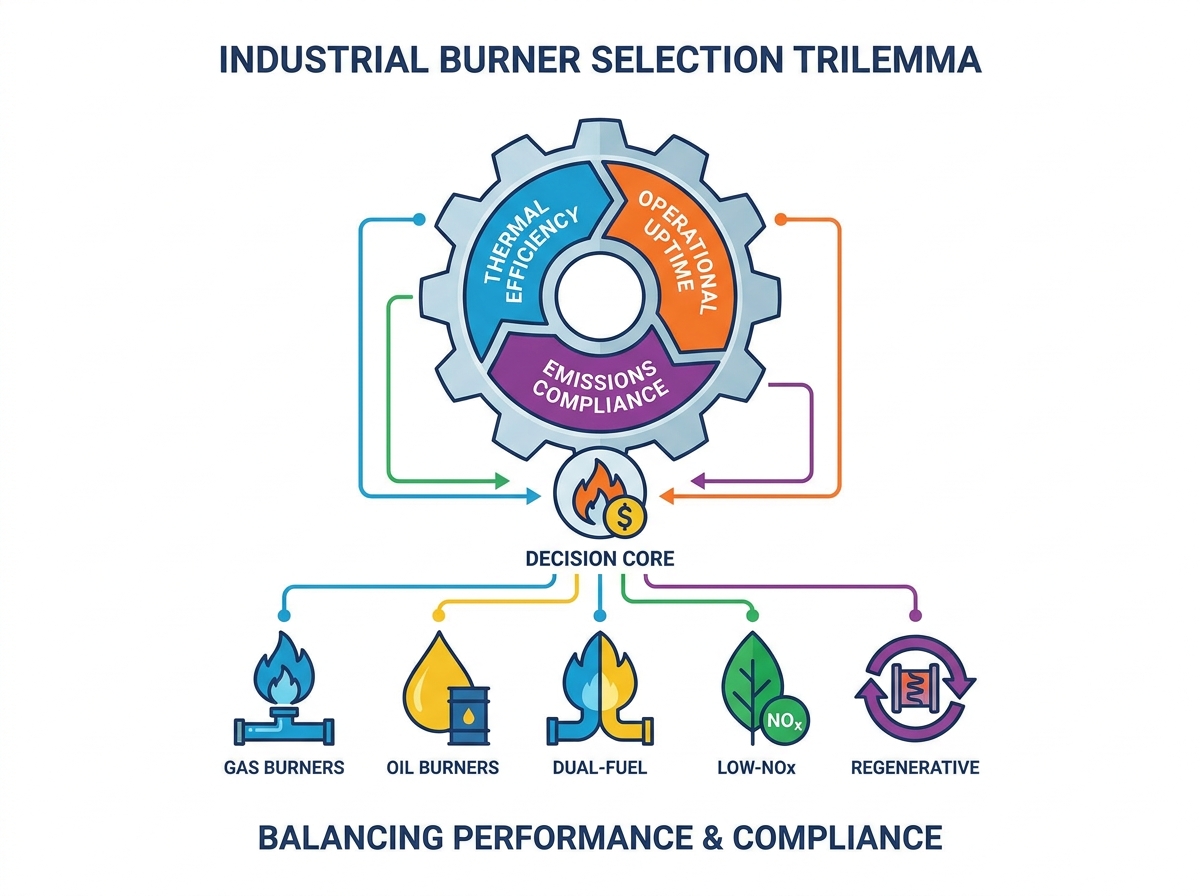
Selecting the correct combustion technology directly influences your facility output. We objectively evaluate the top five choices below to guide your procurement strategy.
Mechanism: This design carefully mixes gaseous fuel and air. The mechanical mixing occurs just prior to or exactly at the point of ignition.
Strengths: Gas represents the cleanest burning standard fossil fuel available. These units require minimal ongoing mechanical maintenance. They also deliver highly consistent combustion profiles over many years of operation.
Ideal Use Case: Many facilities enjoy reliable, grid-supplied natural gas. If you face standard regulatory environments, this option works perfectly. It provides steady performance without introducing excessive technical complexity to your operators.
Mechanism: The system forcefully atomizes liquid fuel for combustion. It achieves this fine mist mechanically or uses high-pressure steam and air.
Strengths: Liquid fuel offers extremely high energy density per gallon. The system functions completely independently of vulnerable municipal gas pipelines. You control your own energy reserves directly on-site.
Limitations: Operators face a substantially higher maintenance burden. Nozzle clogging and restrictive soot buildup happen frequently. Heavy oils also require extensive on-site storage tanks and dedicated pre-heating equipment.
Ideal Use Case: We see these deployed heavily in remote facilities. They also dominate large marine applications. Regions experiencing severe gas supply instability rely on them to guarantee uptime.
Mechanism: These advanced systems switch seamlessly between gaseous and liquid fuels. Modern designs perform this changeover automatically. They require minimal downtime during the fuel transition phase.
Strengths: They provide the ultimate operational and financial resilience. Facilities can leverage fluctuating global fuel market prices effectively. You simply choose to burn whichever fuel costs less on any given day.
Complexity: The setup requires entirely dual fuel delivery trains. You also need much more sophisticated Burner Management Systems. Maintenance demands naturally increase due to the duplicated plumbing and valving.
Mechanism: These utilize complex staged combustion or Flue Gas Recirculation (FGR). FGR lowers peak flame temperatures highly effectively. This cooler, elongated flame directly suppresses harmful NOx formation at the chemical level.
Strengths: They are absolutely essential for strict regulatory compliance. Tightly regulated industrial zones demand them by law. Facilities in California or urban European centers cannot operate legally otherwise.
Trade-offs: Aggressive FGR can slightly reduce overall thermal efficiency. The system requires significantly larger blower motors to push the gas. These larger motors noticeably increase your parasitic electrical load and utility bills.
Mechanism: These specialized systems always operate in alternating pairs. They use internal ceramic media heat exchangers. The media captures outgoing exhaust heat and aggressively preheats incoming combustion air.
Strengths: They deliver extreme fuel efficiency for heavy industries. You can see up to 30-50% fuel savings compared to cold-air units. They perform exceptionally best in ultra-high-temperature industrial applications like metal forging.
Limitations: You will face very high upfront capital expenditures. They also require a massive physical footprint. Installation space often becomes a severe limiting factor in older, cramped plants.
Use the chart below to compare basic capabilities quickly during initial planning.
Industrial Burner Technology Comparison
| Technology Type | Primary Fuel | Maintenance Level | Best Feature |
|---|---|---|---|
| Gas | Natural Gas / Propane | Low | Clean, consistent burn |
| Oil | Light / Heavy Oil | High | High energy density |
| Dual-Fuel | Gas and Oil | Medium to High | Operational resilience |
| Low-NOx | Various | Medium | Emissions compliance |
| Regenerative | Various | High | Extreme efficiency |
You must evaluate exactly how a new system fits your current operation. Several key dimensions require your immediate attention before requesting quotes.
You must match burner output to peak load demands exactly. Measure your maximum output requirement in BTU/hr carefully. You also need to ensure a capable turndown ratio. An advanced 10:1 ratio accommodates low-load periods easily. It prevents the system from short-cycling during off-peak hours. Short-cycling wastes unburned fuel and destroys mechanical components rapidly.
Assess your existing furnace or boiler geometry very carefully. Can the vessel handle the specific flame shape of the new burner? If the flame physically touches the walls, severe problems occur. Direct flame impingement causes localized boiler tube failure quickly. Evaluating dimensional compatibility prevents catastrophic structural damage down the line.
Do not just look at current local emissions standards. You must evaluate anticipated environmental regulatory roadmaps. Look ahead five to ten years into the future. Will local air quality boards tighten restrictions soon? Planning ahead helps you avoid premature equipment obsolescence. Buying a barely compliant unit today wastes capital tomorrow.
Determine your current level of operational automation. Does the facility still rely on mechanical linkage controls? These outdated mechanical systems waste significant fuel due to hysteresis. Modern systems use advanced parallel positioning. They often incorporate real-time oxygen trim technology. Parallel positioning is absolutely ideal for modern, highly efficient Industrial Burners.
Replacing large industrial equipment brings inevitable operational disruptions. You must plan for these physical realities carefully to minimize financial impact.
Acknowledge early on how replacement requires total facility downtime. You cannot run production during a major equipment swap. Outline standard project timelines for the entire process. Allow adequate time for safe removal and proper installation. Refractory curing alone takes several continuous days. Commissioning and safety tuning require precise engineering attention. Rushing any single step causes long-term operational headaches.
Replacing combustion equipment often triggers additional strict requirements. You might need upgraded gas trains immediately to meet current codes. Enhanced draft fans are sometimes necessary to support Low-NOx FGR models. You may also need modernized programmable logic controllers (PLCs). Identify these ancillary components during the initial engineering phase. Nasty surprises during installation ruin departmental budgets quickly.
Advanced units require highly specialized tuning and daily oversight. Low-NOx and Dual-Fuel models are particularly sensitive to ambient changes. Emphasize the absolute necessity of post-installation operator training. Your team must understand the new digital control interfaces perfectly. Establish strict routine maintenance scheduling immediately after handover. Poorly maintained advanced units will underperform older, simpler models drastically.
Follow a rigorous, structured path before signing a final purchase order.
Do not guess your current operational efficiency levels. Require a professional third-party flue gas analysis first. This establishes an accurate, undeniable baseline. You need real numbers to justify the massive capital upgrade. The audit highlights exact technical areas needing immediate improvement.
Clearly map out what is included in the manufacturer quote. Ambiguity leads to incredibly expensive change orders later. Is the main fuel train included in the base price? Is the Burner Management System fully pre-wired and factory tested? Getting these specific answers in writing protects your capital allocation.
Ask vendors for multiple reference installations. They should show similar heavy industrial applications. Specifically request data on actual long-term turndown performance. Ask about real-world preventative maintenance intervals. Do not accept mere pristine laboratory test conditions. Field data proves the true rugged reliability of the equipment.
Selecting the right industrial combustion technology requires careful, objective balancing. You must weigh initial capital expenditure strictly against long-term fuel usage. You must also face strict environmental regulatory realities head-on.
Following these precise steps ensures a successful, highly efficient operational deployment.
A: They typically last 15 to 25 years in standard environments. This lifespan depends heavily on rigorous preventative maintenance schedules. The specific type of fuel burned also plays a major role. Clean gas units generally last longer than heavy oil units. Regular inspections and timely wear-parts replacement maximize this operational window.
A: Some basic retrofits are certainly possible for minor reductions. However, achieving true stringent Low-NOx performance is mechanically complex. It often requires installing a completely new burner head. You usually need a redesigned, larger fan assembly as well. Flue Gas Recirculation systems demand specific physical modifications to the boiler shell.
A: Older standard units typically feature a basic 4:1 ratio. Advanced modern units often achieve impressive 10:1 ratios or better. Higher ratios impact daily fuel savings dramatically. They allow the unit to idle efficiently during low demand. This prevents complete system shutdowns and avoids costly, wasteful restart purge cycles.
A: No, it typically does not. Modern Burner Management Systems offer fully unified control. They integrate both the gas and oil fuel trains into a single digital interface. Operators can monitor performance and switch fuels from one central touchscreen panel. This tight integration drastically simplifies facility operations and improves overall safety protocols.