lucy@zlwyindustry.com
+86-158-1688-2025
Please Choose Your Language
- All
- Product Name
- Product Keyword
- Product Model
- Product Summary
- Product Description
- Multi Field Search

Views: 0 Author: Site Editor Publish Time: 2026-11-05 Origin: Site


Sourcing the correct Burner Oil Pumps goes far beyond a simple procurement task. It remains a critical engineering decision dictating boiler efficiency, system safety, and ongoing maintenance overhead. Specifying hardware lacking adequate pressure tolerance leads directly to incomplete combustion. Incompatible fuel handling triggers frequent burner lockouts and accelerates wear on vital components. Conversely, over-specifying hardware simply wastes initial capital and drives up unnecessary daily operating costs.
We provide a transparent, specification-driven framework for evaluating your available hardware options. You will discover how to match equipment directly to operational realities and precise heating load requirements. We guide you through assessing system compatibility for residential, commercial, and industrial environments. This framework ensures you secure reliable performance while avoiding dangerous system mismatches.
Operational continuity relies heavily on precise and consistent fuel delivery. Misaligned hardware often causes severe misfires and heavy internal soot buildup. These issues quickly escalate into costly emergency downtime. In demanding commercial and industrial heating environments, you simply cannot afford unexpected equipment failures. Facility managers require seamless operation throughout peak demand cycles. Proper equipment specification eliminates erratic burner behavior. It ensures your facility maintains required temperature baselines without costly interruptions.
Stable atomization pressure guarantees optimal fuel-to-air ratios inside the combustion chamber. This stability directly improves your long-term fuel consumption metrics. Precise fuel delivery maximizes thermal output per gallon burned. You secure a stronger return on investment through maximized efficiency. Efficient combustion also reduces secondary maintenance tasks. Technicians spend less time scrubbing fouled heat exchangers. They avoid replacing clogged nozzles prematurely. Better efficiency translates directly into smoother daily operations.
Improper sizing carries significant safety and compliance liability risks. You face potential fire hazards from unstable ignition sequences. Severe fuel leaks occur when seals fail under incorrect operating pressures. Equipment failure also risks violating stringent local environmental emissions standards. Unburned hydrocarbons trigger immediate regulatory scrutiny. Selecting the correct specifications mitigates these severe liability risks. It protects your personnel, your facility infrastructure, and your operational reputation.
Internal gearsets serve as the primary fluid pumping mechanism. They dictate flow consistency under continuous heavy loads. Precision machining ensures these gears interlock flawlessly. High-quality gears resist wear over exceptionally long operating cycles. They pull fluid from the supply line and push it toward the nozzle assembly. The physical tolerances between these gears determine overall vacuum strength. Tight clearances generate the necessary lift for reliable daily operation.
Pressure regulating valves play an equally vital mechanical role. Integrated valves maintain stable delivery pressure reaching the burner nozzle. They achieve this stability despite inevitable fluctuations in fluid viscosity. The valve automatically bypasses excess fluid back to the return line. This action keeps atomization pressure perfectly uniform. A failing valve causes dangerous pressure spikes. These spikes ruin the spray pattern and destabilize the main burner flame.
Built-in strainers and filtration mechanisms protect these sensitive internal parts. Effective filters block destructive particulate damage before it reaches the gearsets. Fuel tanks routinely accumulate sludge, rust, and organic debris. Strainers capture these contaminants efficiently. You must inspect and clean these screens during routine maintenance. Neglected strainers starve the gearset of fuel. This starvation causes severe friction and catastrophic mechanical failure.
Shaft seals demand careful material evaluation before installation. Elastomer materials require specific chemical compatibility checks. You must compare Viton compounds against standard Nitrile seals. Viton generally offers superior long-term leak prevention. It also ensures strict compatibility alongside modern biodiesel fuel blends. Standard seals degrade rapidly when exposed to certain modern additives. A compromised shaft seal creates massive fluid leaks. It also introduces unwanted air into the combustion supply line.
Flow rate capacity requires accurate and methodical calculation. You measure this specific capacity in gallons-per-hour (GPH). Your hardware choice must match total boiler output requirements exactly. The flow rating determines how much fluid reaches the nozzle under load. Excessive capacity creates damaging bypass wear inside the unit. Insufficient capacity causes the flame to sputter and fail. You must consult the specific boiler nameplate for exact GPH targets.
Pressure ranges and factory settings determine safe operating thresholds. You should utilize standard pressure charts to verify your necessary operating metrics. Standard residential units typically run between 100 to 150 PSI. The factory usually presets them at 100 PSI for baseline testing. Specialized industrial units scale much higher to handle heavy fluids. Technicians adjust this setting using an integrated adjustment screw. They verify the final output using a calibrated liquid-filled gauge.
| Application Level | Default Factory Setting (PSI) | Typical Operating Range (PSI) | Compatible Fuel Grade |
|---|---|---|---|
| Residential Heating | 100 | 100 - 150 | No. 1, No. 2 |
| Light Commercial | 100 | 100 - 200 | No. 2, ULSD |
| Heavy Industrial | 150 | 150 - 300+ | No. 4, No. 6 |
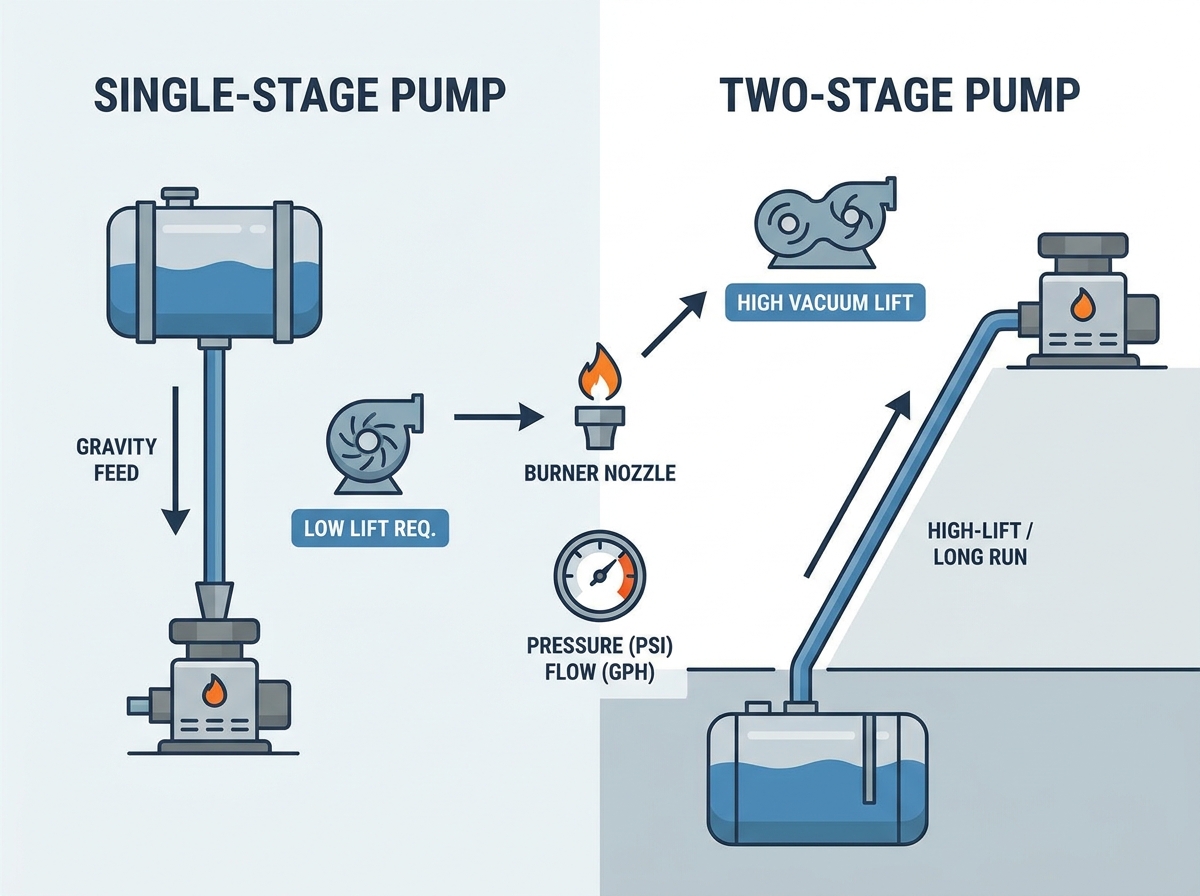
Single-stage and two-stage configurations serve entirely different system layouts. Single-stage models work perfectly for standard gravity-fed systems. Use them when your storage tank sits above the burner assembly. Two-stage models handle installations requiring significant vacuum lift. Underground tanks or exceptionally long supply runs require this heavier configuration. The secondary gearset prevents damaging oil foaming. It completely eliminates cavitation risks inherent in high-lift scenarios.
Rotational speed (RPM) ensures proper mechanical compatibility. You must align hardware RPM directly to existing burner motor specifications. The industry standard speeds usually sit at 1725 or 3450 RPM. A mismatch here prevents proper mounting and coupling. It destroys the internal drive shaft almost immediately upon startup. Always verify the motor nameplate before ordering replacement components. Correct RPM matching guarantees smooth, vibration-free fluid transfer.
| Stage Type | Supply Layout | Maximum Lift Capacity | Best Application |
|---|---|---|---|
| Single-Stage | Gravity Fed / Overhead Tank | Minimal (Up to 8 ft) | Standard residential basements |
| Two-Stage | High Vacuum / Underground Tank | High (Up to 15-20 ft) | Commercial long-run supply lines |
Residential and light commercial heating boilers have unique operational needs. You should prioritize compact footprints for tight basement installation spaces. Low decibel operation keeps indoor environmental noise levels manageable for occupants. Standard fuel oil (No. 2) compatibility handles most typical neighborhood setups. These units require straightforward maintenance access for annual service calls. Technicians appreciate clearly marked bleeder ports and accessible strainer covers. Simplicity drives reliability in light commercial and residential settings.
Heavy industrial processing environments demand much tougher hardware entirely. You must evaluate equipment specifically rated for heavier industrial fuels. Number 4 or Number 6 fuel oils possess exceptionally high viscosity. These specific applications require dedicated fluid pre-heating capabilities. High-torque operation handles the increased fluid resistance easily. The internal seals must withstand elevated temperatures from the pre-heaters. Heavy industrial units feature robust cast-iron housings to survive harsh operating conditions.
Manual transfer alternatives fulfill specific and necessary niche scenarios. Automated systems sometimes require manual hand-crank hardware as reliable backups. Manual units also facilitate initial system priming procedures safely. You complete this manual priming prior to engaging automated burner ignition. It prevents the primary gearsets from running dry during initial commissioning. Facilities located in regions prone to severe power outages benefit greatly here. Manual transfer ensures operators can move fluid safely during electrical blackouts.
Viscosity and fuel blend risks remain a constant operational threat. Ultra-low sulfur diesel (ULSD) presents specific and severe lubrication challenges. Modern biofuel blends also offer far less natural lubrication than traditional fluids. You must specify specialized hardened gearsets for these modern fuels. Standard gears suffer premature failure without this extra physical protection. The lack of sulfur increases internal metal-on-metal friction significantly. Equipment designed explicitly for biodiesel utilizes specialized internal coatings to combat this friction.
Cavitation hazards destroy heating equipment rapidly and violently. Improper sizing of supply lines directly causes dangerous vacuum leaks. Specifying a single-stage model for a high-lift application guarantees operational failure. You will experience immediate gear destruction and highly erratic burner operation. Cavitation creates microscopic vacuum bubbles inside the fluid stream. These bubbles collapse violently against the internal metal surfaces. They erode the gear teeth and destroy the pressure regulating valve integrity.
Fail-safes and bleeding protocols protect your technicians during maintenance. Built-in bypass plugs allow safe internal pressure diversion during two-pipe operation. Easy-access bleeder valves simplify routine system purging procedures. Pressure-relief mechanisms remain absolutely essential for safe daily operation. They ensure safe commissioning and streamline your routine maintenance cycles. You should adhere strictly to the following best practices during implementation:
Selecting the right hardware requires a methodical and disciplined approach. Guesswork leads to immediate system failures and compromised safety. You should follow a strict technical audit process. This ensures every variable aligns with your facility infrastructure.
By strictly following this framework, you eliminate incompatible options quickly. You protect your facility infrastructure from erratic performance. Your final selection will deliver stable pressure, consistent atomization, and reliable daily heating.
Selecting reliable Burner Oil Pumps requires moving beyond basic brand familiarity. You must strictly match core engineering specifications to your facility's exact heating load. Precise alignment of GPH, PSI, lift requirements, and RPM guarantees optimal combustion. It prevents dangerous misfires, soot accumulation, and premature mechanical wear.
Prioritize models offering verifiable OEM pressure charts and transparent material specifications. Verify that internal seals withstand modern low-sulfur fuels and biodiesel blends safely. Choose structural designs explicitly mitigating the risks of your specific supply line configuration. By insisting on exact technical compatibility, you secure reliable, safe, and highly efficient heating performance.
A: Standard operating pressure is typically set at 100 PSI from the factory for many residential and light commercial units. However, technicians commonly adjust these settings up to 140-150 PSI. These adjustments depend entirely on specific nozzle designs and strict burner manufacturer requirements for optimal atomization.
A: If your oil supply is gravity-fed or requires minimal vertical lift, a single-stage model is sufficient. If the system requires lifting fluid from a buried tank or over long distances, high vacuum requirements emerge. In these high-lift scenarios, a two-stage model becomes absolutely mandatory to prevent cavitation.
A: Ultra-low sulfur fuels lack the inherent lubricity found in traditional heating oils. Without specialized elastomer seals or hardened internal gears rated for modern blends, internal friction increases drastically. This excessive friction leads directly to accelerated gear wear and rapid seal degradation.
A: Manual pumps are generally not used for continuous automated burner operation. Technicians frequently utilize them for safe fluid transfer and initial system priming. They also serve as emergency fuel supply routing mechanisms during critical power outages or heavy maintenance cycles.