lucy@zlwyindustry.com
+86-158-1688-2025
Please Choose Your Language
- All
- Product Name
- Product Keyword
- Product Model
- Product Summary
- Product Description
- Multi Field Search

Views: 0 Author: Site Editor Publish Time: 2026-11-02 Origin: Site


In gas detection, over-specifying hardware wastes valuable resources unnecessarily. Under-specifying creates critical safety liabilities and severe compliance failures almost immediately. Getting the equipment right remains a literal matter of life and death for any facility. Standard marketing materials for gas leak detectors often obscure practical limitations behind flashy metrics. Vital constraints like sensor poisoning or cross-sensitivity frequently go unmentioned in basic brochures. This leaves buyers vulnerable to dangerous operational gaps.
This guide provides an objective, spec-by-spec teardown of current detection technologies. It helps safety managers, procurement teams, and serious professionals evaluate technical requirements accurately. You will learn how to match instrument specifications against actual field conditions safely. We strip away the marketing jargon to focus purely on performance realities. You can then deploy the correct technology for your specific hazard profile confidently and securely.
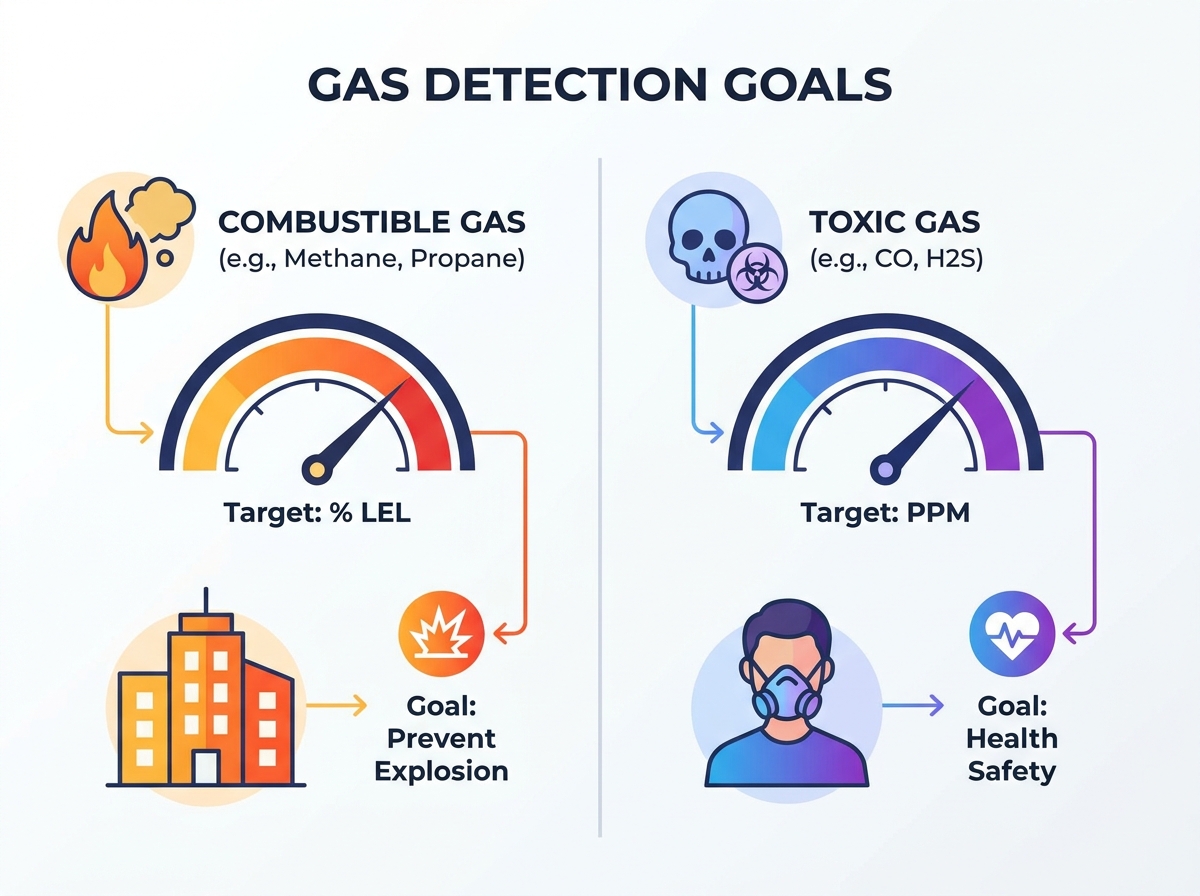
You must separate gas detection into two primary categories based on the specific hazard type. A fundamental error occurs when users deploy a single monitor hoping it covers every atmospheric danger. Combustible threats behave entirely differently from toxic threats. They require different operational responses and entirely different sensor capabilities.
Combustible gas monitoring prevents catastrophic explosions. It focuses on gases like methane, propane, and natural gas. You measure these gases against their Lower Explosive Limit (LEL). The LEL represents the minimum concentration of a gas in the air that can ignite. A monitor reading 50% LEL means the gas concentration has reached half the amount needed for an explosion. Early detection allows personnel to shut down equipment, increase ventilation, and evacuate before ignition occurs. Combustible monitors serve as broad area alarms rather than precision measuring tools.
Toxic gas detection requires microscopic precision. Gases like Carbon Monoxide (CO) or Hydrogen Sulfide (H2S) present an immediate danger to life and health at extremely low levels. You measure toxic gases in Parts Per Million (PPM). Exposure to just 100 PPM of H2S can cause immediate olfactory paralysis and unconsciousness. Therefore, toxic monitors must pinpoint exact concentrations rapidly. They focus on protecting the individual worker's breathing zone from invisible, odorless, or highly lethal poisons.
Beware of devices claiming to detect everything with equal accuracy. The universal detector remains a dangerous myth in industrial safety. Cross-sensitivity presents a massive challenge. This occurs when non-target gases trigger false alarms or completely mask true hazards. For example, a combustible sensor might react slightly to a heavy solvent vapor, causing unwarranted panic. Conversely, a toxic sensor might fail to register a massive natural gas leak. Relying on a single sensor technology for multiple distinct hazard classes compromises site safety fundamentally.
Understanding the internal sensor mechanism determines how well your equipment performs in real-world environments. Each technology possesses distinct strengths and fatal weaknesses.
Catalytic bead sensors remain the industry standard for detecting general combustible gases. They operate by oxidizing the target gas on a heated coil, measuring the resulting temperature change.
Best for: Standard combustible gases in typical industrial environments.
Critical Limitation: They suffer from sensor poisoning easily. Common chemicals like silicones, lead, or high concentrations of sulfur compounds permanently coat the heated bead. Once poisoned, the sensor reads zero even in an explosive atmosphere. Additionally, they require sufficient ambient oxygen to function. They fail completely in inert, oxygen-depleted environments.
NDIR sensors use infrared light absorption to identify specific gas molecules. They do not rely on oxidation.
Best for: Hydrocarbons in low-oxygen or inert environments.
Critical Limitation: They cannot detect hydrogen gas because hydrogen does not absorb infrared light. They also require more complex engineering and integration into safety systems compared to traditional pellistors.
MOS sensors use a heated metal oxide film that changes electrical resistance when exposed to various gases.
Best for: Accessible, broad-spectrum leak pinpointing. You often find MOS technology in handheld professional or prosumer units used by home inspectors.
Critical Limitation: They react intensely to ambient humidity and temperature shifts. They frequently trigger false positives from everyday household chemicals, cleaning supplies, or even heavy perfumes.
PID sensors utilize ultraviolet light to ionize gas molecules, creating a measurable electrical current.
Best for: Volatile Organic Compounds (VOCs) like benzene, toluene, and xylene at very low PPM levels.
Critical Limitation: The UV lamp requires frequent physical cleaning and eventual replacement. Furthermore, a PID cannot identify the specific VOC present. It only alerts you that some type of VOC exists in the atmosphere.
| Sensor Type | Primary Application | Key Vulnerability | Measurement Unit |
|---|---|---|---|
| Catalytic Bead | Combustibles | Sensor Poisoning, Needs O2 | % LEL |
| NDIR | Hydrocarbons in Inert Spaces | Cannot Detect Hydrogen | % LEL / Vol |
| MOS | General Leak Pinpointing | Humidity, False Positives | PPM / Visual Scales |
| PID | VOCs | High Maintenance, Non-Specific | PPM / PPB |
Reviewing a specification sheet requires separating marketing fluff from critical performance indicators. The numbers listed directly dictate whether a device protects your team or leaves them exposed.
You must match the instrument's resolution strictly to your operational use case. An HVAC technician pinpointing a hairline fracture in a refrigerant fitting requires extreme PPM sensitivity. They need to find a microscopic source. Conversely, a facility manager monitoring a large boiler room needs broader % LEL alarms. If a monitor only displays LEL, it remains practically useless for finding tiny pinhole leaks behind drywall. Match the measurement scale to the physical task at hand.
T90 represents the exact time it takes for a sensor to reach 90% of its final accurate reading when exposed to a gas. You will often see T90 times ranging from 10 to 40 seconds. In confined space entries, a difference of 5 seconds changes the entire emergency response outcome. If a worker walks into a highly concentrated H2S pocket, a slow T90 means they inhale multiple toxic breaths before the alarm ever sounds. Always prioritize the lowest T90 rating available for hazardous environments.
Pay close attention to Ingress Protection (IP) ratings, temperature ranges, and humidity tolerances. These are non-negotiable specifications for industrial or outdoor use.
Form factor represents a functional requirement, not just an aesthetic choice. A standard diffusion monitor clips to a worker's lapel to sample ambient breathing air. It works perfectly for personal exposure monitoring. However, you cannot easily shove a bulky lapel monitor behind an active furnace. Evaluating pipe joints, reaching behind appliances, or checking tight industrial ductwork requires a flexible gooseneck probe. An 11-inch flexible probe extends the sensor directly into the hazard zone while keeping the user at a safe distance.
Hardware deployment marks only the beginning of a safety program. The ongoing operational viability of any device relies entirely on strict, documented maintenance routines.
Demystifying the calibration process prevents catastrophic sensor failures. Any credible detection instrument requires regular testing to remain compliant.
First, users must perform daily bump tests. A bump test involves exposing the sensor to a known concentration of target gas briefly. It simply verifies that the sensors respond and the alarms activate. It does not adjust accuracy.
Second, periodic span calibration adjusts the sensor's internal baseline. Sensors drift over time due to environmental stress. Span calibration uses regulated gas mixtures to force the device back to absolute accuracy. Skipping calibrations voids safety certifications immediately.
Sensors act like batteries; they deplete continuously from the moment they are manufactured. You must plan for their inevitable degradation. Electrochemical sensors used for toxic gases typically deplete over 24 to 36 months, even if they sit on a shelf. Catalytic bead sensors can last 3 to 5 years, assuming they avoid silicone poisoning. NDIR sensors often last beyond 7 years because they lack consumable chemical parts. Tracking these expiration dates prevents field teams from carrying dead instruments.
The consumer market differs wildly from the commercial sector regarding maintenance. Many consumer-grade models act as disposable units. Once the internal sensor dies, you discard the entire device. Professional commercial units allow for modular sensor replacement. Facilities often utilize automated fleet management docks. These docking stations run automatic daily bump tests, update firmware, and log compliance data effortlessly. Facility managers must also manage the logistics of sourcing certified calibration gas cylinders and specialized flow regulators to maintain these fleets properly.
Selecting the right equipment requires aligning the technology with the specific end-user environment. Use the following categories to narrow your selection.
Homeowners checking gas stoves, furnaces, or backyard grills operate in controlled, low-complexity environments.
Technicians move constantly between residential basements and commercial rooftops. They need versatile, robust tools.
Refineries and chemical plants present extreme environmental stress and constant exposure risks.
Move your selection process forward using this systematic approach:
A gas leak detector serves as critical life-safety equipment first and foremost. You cannot compromise on its fundamental capabilities. The specification sheet you evaluate must align flawlessly with the physical realities of the deployment environment. Misunderstanding the difference between LEL and PPM, or ignoring sensor poisoning risks, leads directly to operational disaster.
Encourage your teams to prioritize sensor reliability and verifiable compliance certifications above all else. Superficial features mean nothing if the internal sensor fails to register a hazard. Build strict bump testing and calibration routines into your standard operating procedures immediately.
Take proactive steps today to secure your facility. Browse specific detector categories relevant to your hazard profile. Download a detailed technical comparison chart, or contact a certified technical sales representative to configure a custom monitoring solution for your specific site requirements.
A: Safety standards like OSHA recommend a functional "bump test" before every daily use to ensure alarms activate. Full span calibrations, which reset the sensor's accuracy, typically occur every 30, 60, or 90 days. Always follow the specific manufacturer's manual and your local regulatory safety guidelines to maintain compliance.
A: False alarms frequently stem from cross-sensitivity. Sensors might react to ambient chemicals like heavy cleaning supplies, paint fumes, or strong perfumes. Sudden shifts in extreme humidity or temperature can also trigger MOS sensors. Finally, partial sensor poisoning can cause erratic baseline readings.
A: While multi-gas detectors exist, a single internal sensor cannot safely detect both optimally. Natural gas requires combustible monitoring (% LEL), while carbon monoxide requires precise toxic monitoring (PPM). Multi-gas units house completely separate internal sensors to monitor these distinct hazards simultaneously without compromising accuracy.
A: Sensor lifespan depends entirely on the technology and environmental exposure. Electrochemical sensors (for toxics) degrade continuously, lasting roughly 2 to 3 years. Catalytic bead sensors (for combustibles) typically last 3 to 5 years if they avoid chemical poisoning. NDIR sensors can operate effectively for over 10 years.
A: An intrinsically safe device is engineered so its internal electrical energy remains too low to ignite a surrounding explosive atmosphere. It prevents sparks or thermal heat generation. Regulatory bodies legally require these specific certifications (like ATEX or UL) for equipment used in hazardous locations like refineries or chemical plants.