lucy@zlwyindustry.com
+86-158-1688-2025
Please Choose Your Language
- All
- Product Name
- Product Keyword
- Product Model
- Product Summary
- Product Description
- Multi Field Search

Views: 0 Author: Site Editor Publish Time: 2026-11-23 Origin: Site


Heavy fuel oil (HFO) remains a powerhouse in industrial thermal energy. It offers unmatched cost-effectiveness for marine vessels and large-scale manufacturing facilities. However, harnessing this thick, viscous fuel presents serious engineering hurdles.
Burning high-residue fuels natively creates enormous challenges. Facilities often struggle against poor atomization, skyrocketing emissions, and rapid equipment fouling. When systems fail to prepare and ignite these fuels correctly, operators face costly downtime and severe regulatory fines.
We will explore a structured evaluation framework for selecting industrial combustion equipment. You will learn how different atomization technologies function under varying loads. We also break down the exact technical specifications required to deploy Heavy Oil Burners reliably and efficiently.
Many industries rely on residual fuels to drive down energy costs. They accept the complex handling requirements in exchange for cheaper baseline thermal energy. You must define operational success criteria early. A successful deployment guarantees a stable flame under varying loads. It produces minimal unburned carbon. It also ensures continuous operation between planned maintenance cycles.
Weighing fuel economics against infrastructure costs reveals a critical balance. HFO is undeniably cheaper than diesel or natural gas. However, you must invest heavily in mandatory facility upgrades. Thick residual oils cannot flow at room temperature. They require extensive pumping stations, trace-heated pipelines, and robust filtration systems. You must factor these capital investments into your initial project scope to avoid budget overruns.
Modern facilities increasingly specify dual-fuel capabilities. Supply chains face constant volatility today. Regulatory shifts often restrict heavy fuel usage during specific seasons to control local smog. Installing a burner capable of firing both heavy oil and natural gas provides immense operational resilience. Operators can seamlessly switch fuels based on real-time pricing or emergency emissions mandates. This flexibility protects production schedules from unexpected disruptions.
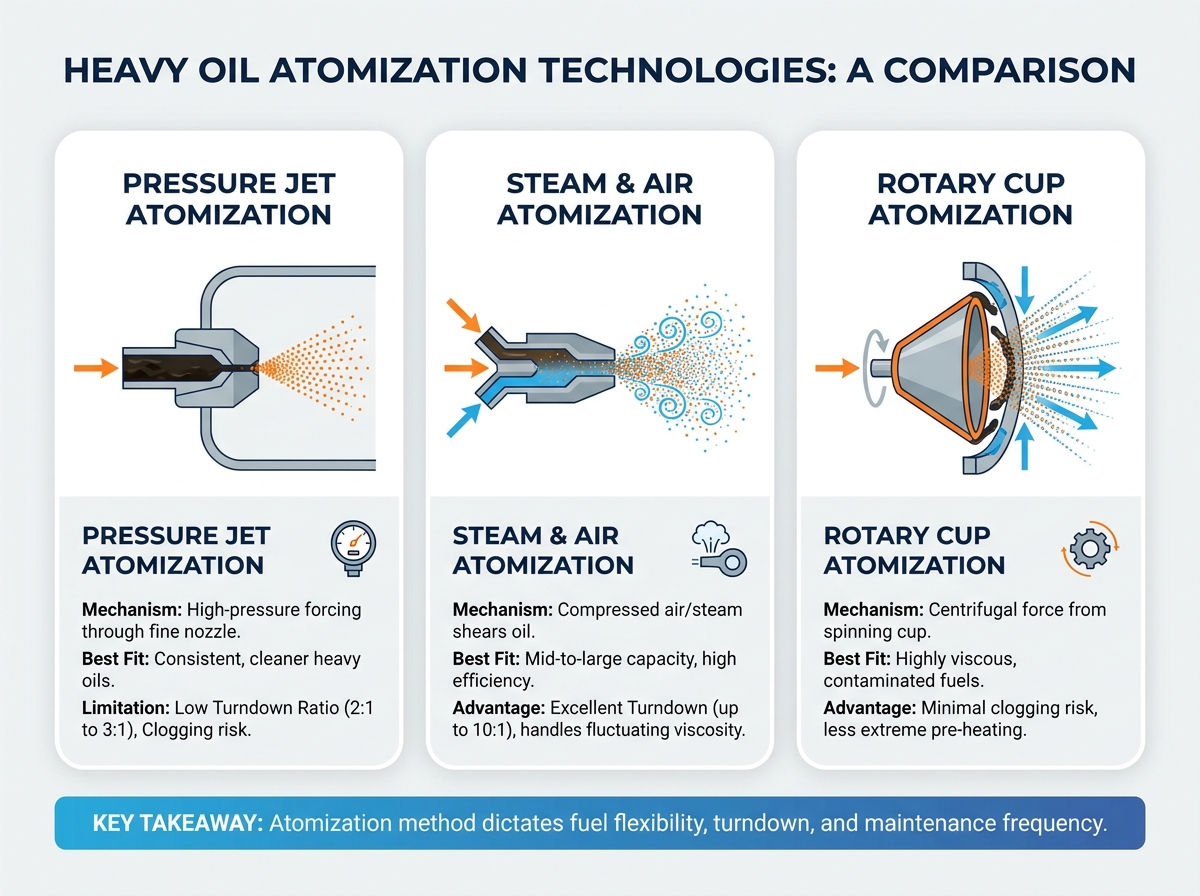
Atomization breaks thick liquid fuel into microscopic droplets. This process exponentially increases the surface area exposed to oxygen. Proper atomization guarantees rapid, complete combustion. Manufacturers categorize these systems by their primary atomization mechanism.
This mechanism relies on pure mechanical force. A high-pressure fuel pump forces hot oil through a precisely machined nozzle. The sheer velocity of the liquid exiting the fine orifice shatters it into a combustible mist.
These units best fit smaller industrial applications. They perform exceptionally well when supplied consistently with cleaner grades of heavy oil. They require less complex auxiliary equipment than steam-assisted models, making them easier to install in confined boiler rooms.
However, they possess notable limitations. You will typically see a lower turndown ratio, often restricted to 2:1 or 3:1. Furthermore, they exhibit high susceptibility to nozzle wear. Abrasive particulates in residual fuels quickly erode the tiny orifices. Operators face frequent clogging risks. You must schedule regular nozzle replacements to maintain baseline efficiency.
This technology introduces a secondary fluid to break apart the fuel. Compressed air or pressurized steam collides violently against the heavy oil stream inside the nozzle. This aggressive shearing action atomizes the viscous liquid into exceptionally fine droplets.
They fit perfectly into mid-to-large capacity boiler systems. Large-scale processing plants demand high thermal efficiency and strict emissions control. Steam atomization excels in these rigorous environments.
The primary advantage lies in exceptional operational flexibility. They boast excellent turndown ratios, frequently reaching up to 10:1. They handle fluctuating fuel viscosities easily. When fuel quality drops, steam atomizers power through without immediate clogging or flame instability.
This mechanism takes a completely different approach. It utilizes a rapidly spinning cup driven by a dedicated motor. Fuel enters the back of the cup and travels forward along the interior wall. Centrifugal force flings the oil outward off the cup's rim. High-velocity primary air immediately shears this flying liquid into a fine mist.
They represent the best fit for the worst fuels. Facilities burning highly viscous, heavily contaminated, or variable-quality residual fuels rely on this technology. Marine environments and remote processing plants frequently deploy them for reliability.
Their distinct advantages include:
You must evaluate exact engineering specifications before procurement. Guessing leads to catastrophic equipment failure. Careful specification alignment ensures reliable, long-term operation.
Kinematic Viscosity & Pre-Heating Limits: Viscosity handling remains the most critical metric. Determine the burner’s exact kinematic viscosity limits, typically measured in centistokes (cSt). HFO behaves like molasses at room temperature. You must establish the required pre-heating temperatures necessary to reach optimal combustion viscosity at the burner head. Most systems require heating the oil until it drops to 15-25 cSt. If the heater fails to reach this target, poor atomization and heavy soot immediately follow.
Turndown Ratio Requirements: Turndown dictates your system's agility. You must match the modulation capabilities to the facility's actual load profile. A 10:1 turndown means the burner operates stably at 10% of its maximum capacity. Oversized burners with poor turndown lead to inefficient short-cycling. The burner constantly fires, shuts down, and purges. This wastes massive amounts of heat and causes thermal shock to boiler components.
Draft Compatibility & Backpressure: Draft compatibility determines how air moves through the combustion chamber. Assess specification alignment carefully against your existing furnace. Systems utilize forced draft, induced draft, or balanced draft configurations. The burner fan must overcome furnace backpressure. If the fan cannot push against this resistance, the flame suffocates.
Combustion Head Geometry: This geometry dictates the physical flame shape. The design of the diffuser and blast tube influences how the fire develops. A long, narrow furnace requires a long, narrow flame. You must ensure the flame does not impinge on boiler walls. Flame impingement on cold water tubes halts combustion, creating massive soot deposits and localized tube failures.
Table: Technical Comparison of Atomization Methods
| Atomization Type | Typical Turndown Ratio | Fuel Flexibility | Maintenance Frequency |
|---|---|---|---|
| Pressure Jet | 2:1 to 3:1 | Low (requires clean, consistent fuel) | High (frequent nozzle replacements) |
| Steam/Air Atomizing | Up to 10:1 | High (handles viscosity swings well) | Medium (requires clean steam/air supply) |
| Rotary Cup | Up to 5:1 | Excellent (burns dirty, variable fuels) | Low (no tiny orifices to clog) |
Combustion optimization requires constant balancing. You want maximum heat extraction alongside minimal pollutant generation. This requires precise control over air, fuel, and exhaust pathways.
Excess air control acts as your primary efficiency lever. You must introduce enough excess air to eliminate soot and carbon monoxide. Oxygen must find every fuel droplet. However, you must keep this excess air low enough to maximize thermal efficiency. Pumping too much cold air into the furnace steals heat and sends it up the stack. Furthermore, excess oxygen at high temperatures accelerates NOx formation.
Emissions mitigation drives modern burner design. Local regulations demand strict adherence to clean air standards. Specific configurations support low-NOx requirements. Flue Gas Recirculation (FGR) pipes inert exhaust gases back into the combustion zone. This lowers the peak flame temperature, significantly reducing thermal NOx. Managing sulfur oxides (SOx) requires a different approach. Because burners cannot destroy the sulfur inherent in heavy fuels, you must rely on backend exhaust scrubbers or switch to low-sulfur fuels to maintain compliance.
Integration with advanced control systems elevates overall performance. Evaluate compatibility with modern Burner Management Systems (BMS). Automated air-fuel ratio modulation, often called O2 trim, continuously monitors stack gases. It dynamically adjusts air dampers to maintain peak efficiency despite changes in atmospheric pressure or fuel viscosity. This automation eliminates human error and guarantees steady operation.
Operating residual fuel systems requires relentless maintenance. It represents a harsh, dirty process. Acknowledging these realities early prevents operational disasters and protects your facility's output.
Fuel ring main requirements dominate the facility layout. You cannot run a single, dead-end pipe to a heavy oil burner. You must engineer a continuous circulation loop. This ring main keeps the heavy oil heated, agitated, and constantly moving right up to the burner inlet. If the flow stops and the oil cools, it solidifies into a pipe-destroying plug.
Wear and tear accelerate rapidly when burning residual fuels. You must anticipate aggressive replacement cycles. Atomizing nozzles, ignition electrodes, and refractory components suffer constantly. The abrasive nature of ash-laden heavy oil erodes metal surfaces quickly. Keep critical spares in local inventory to prevent prolonged outages.
Fouling and soot blowing represent daily operational realities. Managing ash and soot buildup in boiler tubes requires diligent oversight. Soot acts as a powerful insulator. Just a few millimeters of soot severely reduces heat transfer into the boiler water. Burner tuning remains a continuous maintenance requirement, not a set-and-forget task. Mechanics must regularly inspect the flame patterns and clean fireside surfaces to maintain baseline efficiency.
Selecting the right equipment secures your facility's operational future. The optimal choice aligns the specific atomization type with your anticipated fuel grades. You must map your facility's load profiles against the equipment's modulation capabilities. Never underestimate your team's maintenance capacity when choosing a complex steam-atomized or rotary cup system.
Conduct rigorous vendor vetting before making a final decision. Advise your procurement team to request guaranteed emissions data. Ask for verified turndown performance curves from third-party testing. Always demand reference installations operating on identical fuel grades. Seeing equipment run in similar conditions proves its real-world viability.
Take one actionable next step today. Recommend initiating a comprehensive fuel analysis. Test your current supply for exact viscosity curves, sulfur content, and ash volume. Completing this analysis prior to requesting formal manufacturer quotes ensures you receive accurate, reliable system proposals.
A: It depends heavily on the specific grade of Heavy Fuel Oil (HFO) and the atomization method you deploy. However, operators typically heat the fuel to a range of 90°C to 140°C. This temperature band lowers the oil's viscosity to 15 to 25 cSt at the nozzle, which ensures optimal atomization and prevents thick fuel from extinguishing the flame.
A: While some retrofits are technically possible, engineers often find it more reliable to install a purpose-built dual-fuel burner. Conversions face significant hurdles regarding gas ring integration and distinct combustion volume requirements. Natural gas burns differently than oil, often requiring different draft parameters to prevent overheating the boiler's back wall.
A: Industry standards vary by technology. Pressure jet systems typically achieve 2:1 to 3:1. Rotary cup models reach up to 5:1. Steam or air atomizing burners boast the highest agility, achieving up to 8:1 or 10:1. You should tie your ideal turndown ratio directly to your facility's daily load variance to prevent short-cycling.
A: Burning heavy oil drastically increases your maintenance workload. You must perform fireside cleaning and soot blowing much more frequently. Higher ash, sulfur, and particulate content in heavy oils accelerate nozzle wear and fuel filter clogging. Operators must dedicate specific maintenance hours weekly to manage the abrasive and fouling nature of residual fuels.