lucy@zlwyindustry.com
+86-158-1688-2025
Please Choose Your Language
- All
- Product Name
- Product Keyword
- Product Model
- Product Summary
- Product Description
- Multi Field Search

Views: 0 Author: Site Editor Publish Time: 2026-11-08 Origin: Site


Industrial Burners operate as the critical core of plant heating systems. They drive boiling and processing operations across heavy manufacturing. These units act as the primary engine for thermal generation. Without them, facility operations would quickly grind to a halt.
Operations managers face an immediate tension today. You must balance tightening emissions standards against rising fuel costs. Strict environmental regulations push facilities to upgrade their equipment. Meanwhile, you need to maintain continuous production uptime. You cannot afford to burn through limited capital budgets. This creates a difficult balancing act for any facility team.
This guide offers a pragmatic framework for facility engineers. We will help you evaluate modern burner technologies effectively. You will learn how to balance compliance realities with operational efficiency. We explore fuel types, turndown ratios, and control system integration. You can use these insights to make confident procurement decisions. You will secure long-term value while meeting strict local emission mandates.
Facilities rarely replace combustion equipment just for the sake of an upgrade. The decision usually stems from urgent operational pressures. Plant managers must address financial losses tied to outdated systems. They also face aggressive regulatory deadlines. Understanding these drivers helps you justify the investment in new equipment.
Legacy systems waste massive amounts of fuel daily. They suffer from poor air-to-fuel ratio control. Older mechanical linkages slip and degrade over time. This slippage introduces excess air into the combustion chamber. Excess air forces the system to consume more fuel to maintain temperatures. Furthermore, older units have limited turndown capabilities. You cannot easily adjust their output to match low demand. This forces them to cycle on and off constantly. Short-cycling wastes energy and dramatically damages internal components.
Local and federal emissions mandates are tightening globally. These laws force facilities to adopt Ultra-Low NOx (ULN) configurations. Authorities regularly designate specific regions as non-attainment zones. Operating non-compliant equipment in these zones results in severe fines. You can no longer rely on standard combustion technology. You must install advanced equipment designed specifically for emissions reduction. This reality makes regulatory compliance the primary catalyst for system retrofits.
Unplanned downtime destroys profit margins. Aging combustion equipment presents a massive financial risk. Parts obsolescence makes simple repairs incredibly difficult. You might wait weeks for a customized replacement part. Frequent maintenance cycles also drag down productivity. Modern facilities require reliable continuous operation. Upgrading your combustion systems eliminates these recurring reliability issues. You gain peace of mind and protect your production schedule.
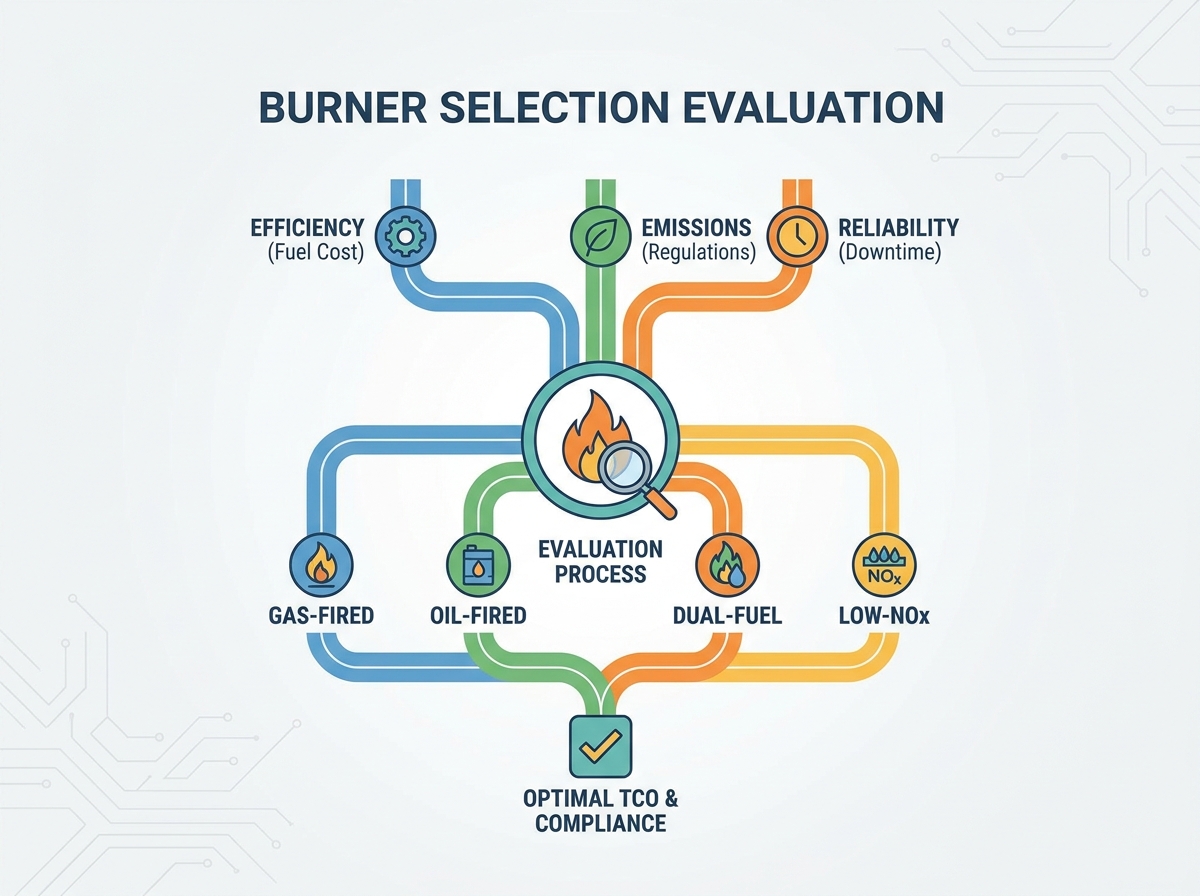
Choosing the right hardware depends heavily on your available fuel sources. You must also consider local emission laws and your facility's layout. Manufacturers engineer several distinct categories of equipment to meet these diverse needs. Each category offers specific advantages for different operational environments.
Gas-fired variants typically utilize natural gas or propane. They represent the industry standard for modern facilities. Gas provides a very clean burn profile. This makes achieving low emissions much easier. You should select these models if your plant prioritizes straightforward emissions compliance. They require significantly less routine maintenance than oil-fired alternatives.
These units utilize light or heavy fuel oils. You will typically find them in remote facilities. They are essential for industries where natural gas infrastructure remains unavailable. However, oil combustion creates soot and heavy particulate matter. This requires a rigorous, scheduled maintenance program. Your maintenance team must frequently clean the firing head and internal chamber. You must account for these higher maintenance demands.
Dual-fuel models provide the ability to switch between gas and oil seamlessly. High-reliability sectors rely heavily on these units. Hospitals and mission-critical manufacturing plants cannot tolerate fuel supply interruptions. Dual-fuel capabilities offer incredible risk mitigation. If gas prices spike or supply lines fail, you simply switch to oil. This redundancy acts as an essential hedge against supply chain volatility.
These advanced models include premix, staged combustion, and flue gas recirculation (FGR) designs. They engineer the flame profile to reduce peak combustion temperatures. Lower temperatures prevent the formation of nitrogen oxides. Facilities operating in strict non-attainment zones require these units. They provide guaranteed emissions reductions. However, you must carefully tune them to maintain optimal thermal efficiency.
Different industrial processes demand entirely different thermal characteristics. A system designed for a commercial boiler will fail in a cement kiln. You must match the equipment design precisely to your core application. Let us explore how these systems adapt to various heavy industry sectors.
| Industrial Application | Primary Process Function | Key Burner Requirement |
|---|---|---|
| Industrial Boilers | Steam and hot water generation | Precise load-tracking and high turndown |
| Furnaces and Ovens | Metal smelting and heat-treatment | Uniform temperature distribution |
| Rotary Kilns | Cement, asphalt, mineral processing | Adjustable flame shape and material penetration |
| Thermal Oxidizers | Waste management, VOC destruction | Stable combustion at extreme temperatures |
Boilers drive steam and hot water generation for countless sectors. Power plants, textile mills, and food processing facilities rely on them daily. In these applications, load-tracking capabilities reign supreme. Steam demand fluctuates rapidly throughout a production shift. The burner must ramp up or down instantly. This prevents pressure drops and ensures consistent process heat.
Metal smelting, forging, and heat-treatment operations utilize large industrial furnaces. These environments require uniform temperature distribution. Cold spots in a furnace can ruin a batch of forged steel. The burner must provide high radiant heat. It must push thermal energy evenly across the entire chamber. Specialized flat-flame models often serve this specific purpose well.
Cement, asphalt, and mineral processing facilities utilize massive rotary kilns. These applications require intense flame shape control. The flame must reach deep into the rotating drum. It must penetrate the raw materials effectively. Operators adjust the flame length to control the calcination process. Only highly specialized, heavy-duty systems can survive this harsh environment.
Waste management facilities use incinerators to destroy hazardous materials. Chemical plants use thermal oxidizers to eliminate volatile organic compounds (VOCs). These applications require incredibly stable combustion. The system must maintain exceptionally high temperatures constantly. If the flame flickers or drops in temperature, dangerous chemicals could escape into the atmosphere. Reliability here is a matter of public safety.
Procuring new combustion equipment requires deep technical analysis. You cannot simply look at the maximum heat output. You must evaluate how the system performs under real-world stress. Consider the following crucial dimensions when reviewing vendor proposals.
Turndown ratio defines a unit's operational flexibility. It measures the ratio between maximum and minimum firing rates. An older unit might offer a 4:1 turndown. A modern, advanced unit can achieve a 10:1 turndown. High turndown ratios allow the system to maintain efficiency at partial loads. This prevents the unit from shutting off entirely during low-demand periods. Preventing short-cycling extends the lifespan of blower motors and ignition transformers.
You must assess whether the equipment meets current environmental mandates. However, you also need to project future regulatory changes. Many systems use Flue Gas Recirculation (FGR) to achieve Ultra-Low NOx. FGR introduces inert exhaust gases back into the flame. This lowers the temperature but can degrade overall efficiency. You must balance the necessary emissions reductions against potential efficiency losses. Ask vendors for guaranteed emissions data across the entire firing range.
The best hardware fails without intelligent controls. You must verify integration with your existing Burner Management Systems (BMS). You also need compatibility with your Combustion Control Systems (CCS). Modern facilities upgrade to linkageless controls. These systems use independent servo motors for air and fuel valves. They offer precise, repeatable positioning. This eliminates the physical slippage found in older parallel positioning linkages. Better control directly equals lower fuel consumption.
Do not ignore the daily experience of your maintenance crew. Poorly designed equipment makes routine service a nightmare. Look for design features that allow quick internal access. Maintenance teams need to reach the firing head easily. They must clean ignition systems and replace UV flame scanners quickly. Systems requiring total disassembly for minor checks will increase your labor costs significantly.
Buying the equipment is only the first step. Installing it presents a new set of engineering challenges. Facility managers often underestimate the complexity of an upgrade project. You must anticipate physical constraints and hidden installation costs.
You must decide between retrofitting a new firing head or replacing the entire boiler. Retrofitting saves substantial capital initially. However, you face the engineering reality of furnace geometry. The new flame profile must fit into the existing chamber perfectly. If the flame touches the chamber walls, it causes flame impingement. Impingement creates severe soot buildup and damages the vessel. A complete replacement avoids this mismatch but requires a larger budget.
Many facilities forget about the fuel delivery network. You will likely face hidden costs regarding gas train upgrades. Modern equipment often requires different fuel pressures than legacy systems. Furthermore, National Fire Protection Association (NFPA) codes change frequently. Your existing piping might not meet current safety standards. You must factor new gas trains, pressure regulators, and safety shutoff valves into your project budget.
Installation requires shutting down your thermal processes completely. You must plan for realistic timelines. Removing old equipment takes time. Wiring new control panels demands precision. Finally, the commissioning phase involves extensive tuning. Technicians must calibrate the air-to-fuel ratio across every firing point. They also perform mandatory emissions testing. Do not rush this process. Improper tuning ruins the efficiency gains you just purchased.
Approaching vendors without internal data puts you at a disadvantage. You must build a solid business case before requesting proposals. Follow a logical sequence to ensure you purchase exactly what your facility needs.
You cannot measure improvement without knowing your starting point. Document your existing fuel consumption meticulously. Gather historical emissions output data from past environmental audits. Review your maintenance logs to identify recurring failure points. This baseline data provides the exact metrics you need to challenge vendor performance claims.
Calculate your return on investment based on concrete operational savings. Look closely at projected fuel savings over a ten-year period. Factor in the financial value of avoided non-compliance fines. Consider the labor savings from reduced maintenance schedules. Focusing on these long-term returns helps justify a higher initial capital expenditure for premium equipment.
Never buy combustion equipment out of a catalog. You must demand a comprehensive site survey. Bring in a vendor-agnostic combustion engineer to audit your facility. They will evaluate your fuel delivery pressure, draft conditions, and physical space constraints. This survey acts as a mandatory precursor to issuing a Request for Proposal (RFP). It ensures all vendors bid on accurate, real-world facility parameters.
Selecting the right thermal equipment represents a critical exercise in risk management. You must carefully balance strict emissions compliance against long-term fuel efficiency. A successful upgrade project relies on thorough preparation and realistic implementation planning. Keep these action-oriented steps in mind as you move forward:
A: These units typically last 15 to 20 years with rigorous, proper maintenance. The heavy metal components withstand extreme heat well. However, control components, servo motors, and flame scanners usually require earlier upgrades to maintain peak efficiency.
A: It depends entirely on the pressure vessel's integrity. Retrofitting proves highly cost-effective if the vessel has 10 or more years of life remaining. If the vessel shows signs of metal fatigue or severe scaling, replacing the entire unit is safer.
A: It represents the ratio between the maximum and minimum firing rates. A higher ratio allows the equipment to operate efficiently during low-demand periods. This flexibility prevents the system from shutting off completely, reducing wear and tear.
A: Facilities often see immediate fuel savings between 3% and 7%. Linkageless controls use independent servo motors for precise air and fuel positioning. This eliminates the physical slop and wear of mechanical linkages that degrade over time.