lucy@zlwyindustry.com
+86-158-1688-2025
Please Choose Your Language
- All
- Product Name
- Product Keyword
- Product Model
- Product Summary
- Product Description
- Multi Field Search

Views: 0 Author: Site Editor Publish Time: 2026-10-31 Origin: Site


Combustible and toxic gases can accumulate silently, creating invisible threats in both homes and workplaces. The stakes are incredibly high. These unseen risks escalate rapidly from minor issues to major emergencies. Early detection forms the only reliable barrier preventing a small leak from causing catastrophic property loss or severe health hazards. You simply cannot rely on human senses alone to identify dangerous gas concentrations in time.
Modern Gas leak detectors serve as critical compliance and risk-mitigation tools. They go far beyond basic alarms. These devices actively monitor Lower Explosive Limits (LEL) and Parts Per Million (PPM) thresholds to keep environments safe. By identifying harmful gases before they reach critical levels, they protect lives and infrastructure.
This article provides a transparent, technical framework. It will help you evaluate, select, and implement the ideal gas detection system. You will learn how to match specific sensor technologies to your unique environmental and regulatory requirements.
Choosing the right detection system starts by understanding the sensors inside them. Different gases require entirely different detection methods. You must match the sensor technology to your specific environmental hazards.
Catalytic bead sensors are the industry standard for detecting combustible gases. They operate by oxidizing combustible gases on a heated element. This oxidation process changes the sensor's internal temperature. The device measures this temperature shift to calculate gas concentration.
These sensors are highly cost-effective. They work reliably for a wide range of combustible gases. However, they remain highly susceptible to "sensor poisoning." Chemicals like airborne silicones or lead can permanently coat the heated bead. This coating ruins the sensor's ability to oxidize gas. You should avoid installing these in areas heavily exposed to silicone-based lubricants or specific industrial solvents.
Non-Dispersive Infrared (NDIR) sensors represent a more advanced approach. They use infrared light absorption to detect gas signatures. Specific gas molecules absorb distinct wavelengths of infrared light. The sensor measures how much light passes through the air sample to determine gas levels.
NDIR sensors are highly durable and fail-safe. They remain entirely immune to the sensor poisoning that plagues catalytic beads. They require a higher upfront cost. Yet, they offer significantly lower long-term maintenance needs. These devices thrive in harsh industrial environments or spaces where oxygen levels fluctuate drastically.
Electrochemical and semiconductor sensors target toxic threats rather than explosive ones. They measure electrical resistance changes when exposed to specific target gases. A chemical reaction occurs inside the sensor casing, generating a tiny electrical current.
These units are incredibly sensitive. They easily detect Carbon Monoxide (CO) and Hydrogen Sulfide (H2S) at very low Parts Per Million (PPM). However, you must monitor them closely. The internal chemicals deplete over time. This depletion gives electrochemical sensors a strict lifespan limit, typically lasting just three to five years before requiring total replacement.
You cannot treat all gases equally. Different compounds behave uniquely when released into the air. Understanding these physical properties dictates how you monitor them.
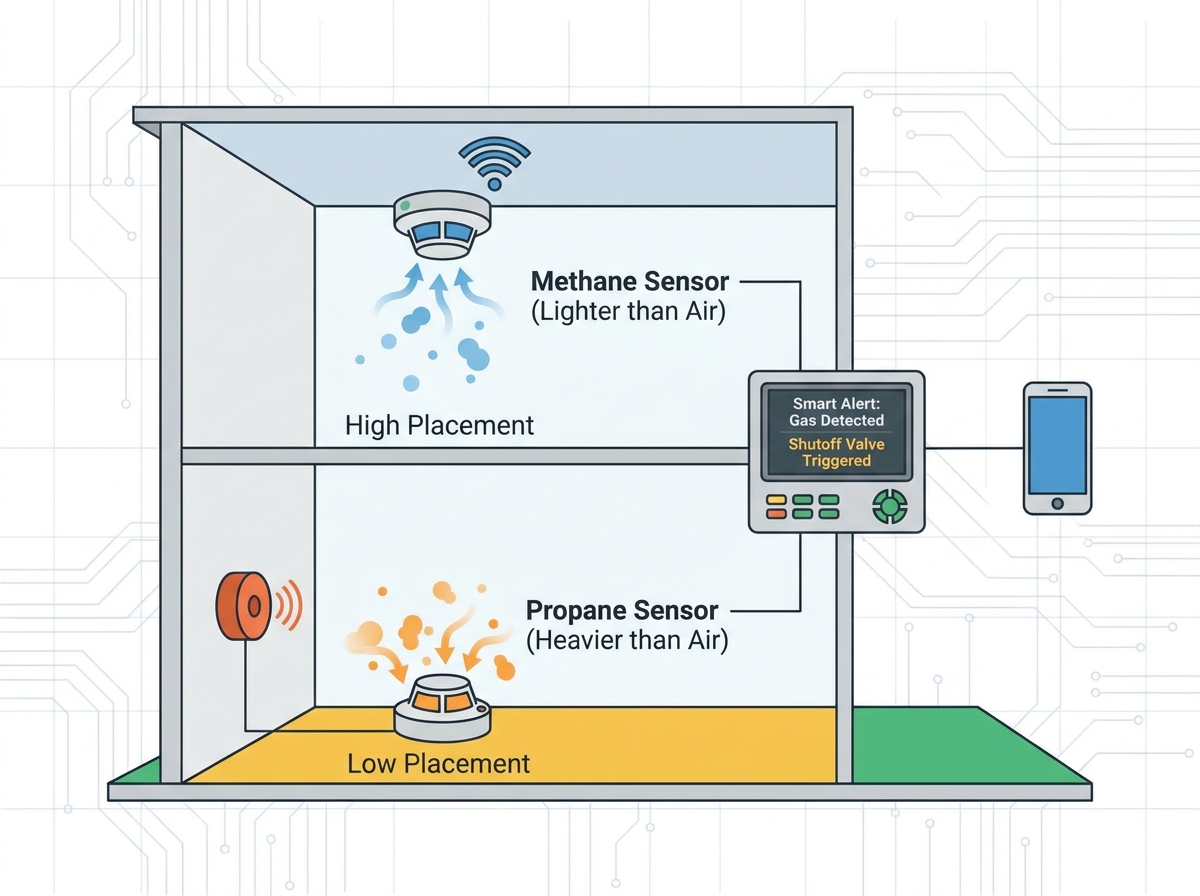
Methane serves as the primary component of natural gas. It is significantly lighter than air. When a leak occurs, methane rapidly rises toward the ceiling. Detectors must trigger well before the room concentration reaches 5% by volume. This 5% mark represents methane's Lower Explosive Limit (LEL), where the gas becomes highly combustible.
Liquid Petroleum Gas acts completely differently. Propane and butane are heavier than air. During a leak, these gases sink rapidly. They pool heavily in basements, trenches, and low-lying areas. Monitoring equipment must sit low to the ground to catch these pooling threats early.
Toxic gases like Carbon Monoxide pose a physiological threat rather than an explosive one. Industry standards evaluate them strictly on PPM thresholds instead of LEL. Carbon Monoxide binds to hemoglobin in the blood. Even small concentrations over prolonged periods can prove fatal. Detectors track these precise PPM accumulations to sound alarms before physical symptoms begin.
Always exercise caution around "all-in-one" detector claims. You should avoid these units unless the manufacturer explicitly specifies distinct, separate sensors for combustible versus toxic gases. Combustible and toxic gases have fundamentally conflicting detection methodologies. Furthermore, their placement requirements contradict each other. An optimal position for methane detection is terrible for carbon monoxide monitoring.
| Target Gas | Density vs. Air | Detection Metric | Optimal Sensor Placement |
|---|---|---|---|
| Methane (Natural Gas) | Lighter | % LEL | High on walls / Near ceiling |
| Propane / Butane | Heavier | % LEL | Low on walls / Near floor |
| Carbon Monoxide (CO) | Slightly Lighter / Neutral | PPM | Breathing zone / Mid-wall |
| Hydrogen Sulfide (H2S) | Heavier | PPM | Low on walls / Ground level |
Selecting reliable equipment requires a structured evaluation. You must look past marketing jargon. Focus strictly on measurable performance metrics and verified certifications.
Response time often dictates survival during a severe leak. Engineers measure this using the T90 metric. T90 represents the time it takes for a detector to read 90% of the actual gas concentration in the air. Faster response times are absolutely critical for explosive gases. A slow T90 value allows dangerous volumes to accumulate before the alarm triggers.
Continuous monitoring demands uninterrupted power. Hardwired systems offer excellent baseline reliability. However, they fail instantly during electrical grid outages. Major storms often cause both gas line damage and power losses simultaneously. Battery backups serve as a mandatory evaluation criterion. Never purchase a hardwired unit lacking a robust battery failover mechanism.
A detection system holds zero value if occupants cannot hear or see it. Alarm mechanisms require rigorous scrutiny.
Never trust unverified claims. Ensure your shortlisting phase only includes devices bearing verifiable third-party testing marks. Look for UL, CSA, or CE logos. These marks prove the equipment meets strict performance and durability standards under laboratory conditions.
The operational divide between consumer and commercial monitoring systems is massive. You must align your system architecture with your specific liability exposure.
Direct-to-consumer residential systems prioritize ease of installation. Homeowners typically prefer combination CO and explosive gas units. If you use combo units, remember the dual-sensor placement caveats discussed earlier. Residential applications focus heavily on smart-home integration. The primary goal remains protecting personal property and waking family members during nighttime emergencies.
Commercial safety demands a completely different approach. Facilities require fixed, continuous monitoring systems wired across large zones. Workers in confined spaces need portable personal detectors attached to their safety vests. B2B systems emphasize data logging. Maintaining detailed records proves vital for strict OSHA compliance. Environments handling volatile chemicals require ATEX or IECEx certifications to ensure the monitors themselves do not ignite explosive atmospheres.
Base your category selection on your precise operational needs. Follow this progressive logic:
Purchasing top-tier equipment solves only half the problem. Poor installation and neglected maintenance render even the best technology useless.
Improper installation presents a massive hidden risk. You must respect gas density physics. Methane detectors belong exactly 6 to 12 inches from the ceiling. Propane detectors belong near the floor. Never install any gas monitor near fresh air drafts, HVAC vents, or open windows. Drafts dilute gas concentrations, delaying the alarm. Furthermore, avoid placing units near direct cooking heat. Stove fumes frequently cause frustrating false positives.
Sensors drift over time. They lose their baseline accuracy due to temperature shifts and humidity. You must maintain them proactively.
Gas leak detectors do not last forever. Many buyers falsely assume these are lifetime investments. Address the industry standard EOL immediately upon purchase. Most consumer units and industrial sensors expire between 5 to 10 years after activation. The internal chemicals degrade irreversibly. Users must budget for full unit replacements or recurring sensor-cartridge swaps.
Gas leak detectors operate as highly specialized, scientific safety tools. They are not simple plug-and-play gadgets. Treating them as generic appliances leads to dangerous vulnerabilities in your safety strategy. You must respect the distinct chemical properties of the gases you aim to monitor.
To move forward safely, take immediate action. First, audit your specific gas risks carefully, mapping out methane, propane, or carbon monoxide sources. Next, measure your installation spaces to ensure you can meet the strict placement physics required for each gas type. Finally, select a detector featuring the appropriate sensor technology, verifiable compliance certifications, and robust power redundancy to safeguard your environment effectively.
A: No. CO detectors monitor toxic PPM levels from incomplete combustion. They cannot detect raw, unburned combustible gases like methane or propane.
A: Most sensors expire after 5 to 7 years. Check the manufacturer's specified End-of-Life (EOL) date printed on the device.
A: High humidity, aerosol sprays, harsh cleaning chemicals, and placement too close to gas-burning appliances (like stoves) can trigger false positives.
A: Directly above a stove, near an open window, or in a damp bathroom. Drafts dilute gas concentrations, while cooking fumes cause nuisance alarms.