Upgrading industrial fire safety infrastructure historically required extensive cabling. These legacy projects caused prolonged downtime and heavy logistical burdens. Modern wireless
Flame Detectors provide a highly capable alternative for hazardous and remote environments. However, transitioning from wired systems requires rigorous evaluation. You must assess network reliability, battery lifecycles, and strict compliance standards before proceeding. This guide provides a clear framework for evaluating wireless flame detection systems. We analyze technical advantages, implementation realities, and critical compliance requirements. You will learn how to deploy these devices effectively across complex industrial settings. Our practical insights ensure you maintain maximum safety while modernizing your facility infrastructure.
Key Takeaways
- Wireless architectures eliminate up to 70% of installation costs associated with trenching, conduit routing, and cabling in hazardous zones.
- Selecting the right device requires balancing sensor technology (e.g., UV/IR, Multi-Spectrum IR) with wireless protocol reliability (e.g., WirelessHART, ISA100.11a).
- Deployment success depends on comprehensive site signal mapping to mitigate interference and optimize mesh network redundancy.
- Compliance with industry standards (ATEX, IECEx, SIL-2/SIL-3) remains non-negotiable for critical safety applications.
The Business Case: Wireless vs. Traditional Wired Systems
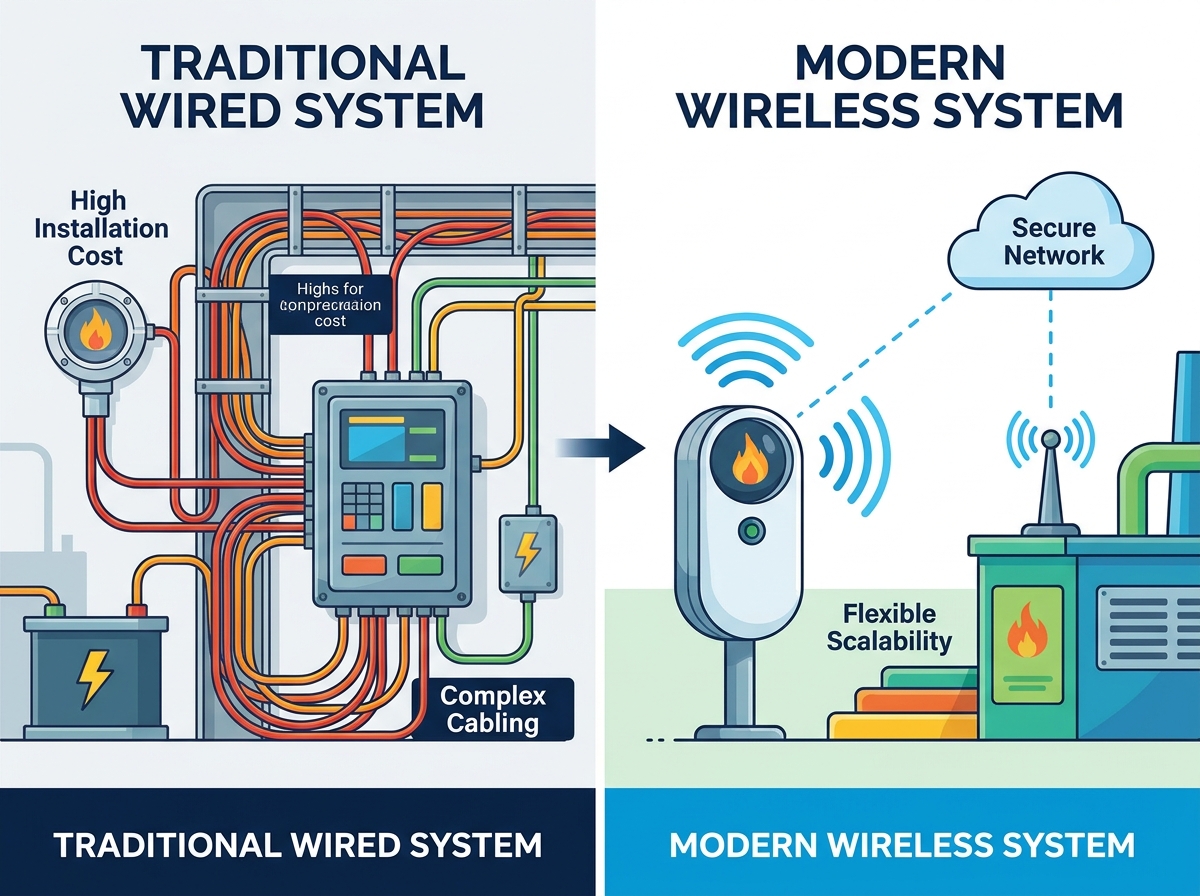
Logistical Efficiency Comparison Traditional wired setups demand immense physical infrastructure. You must install heavy cable trays across expansive plant layouts. Labor-intensive trenching disrupts daily operations severely. Eliminating copper wiring removes these massive physical burdens entirely. Facility managers avoid complex permit-to-work applications previously needed for structural drilling. The sheer reduction in physical materials streamlines project timelines dramatically. Deployment Speed and Scalability Wireless networks allow for rapid commissioning. Scaling becomes effortless as your facility footprints expand or change. Adding a new sensor takes hours instead of weeks. You simply mount the device and provision it securely onto the existing network. This agility proves invaluable during sudden operational expansions. It prevents safety infrastructure from becoming a bottleneck during plant upgrades. Overcoming Geographical & Structural Limitations Remote wellpads often lack existing infrastructure completely. Running cables to these isolated locations is impractical. Offshore platforms restrict structural drilling to maintain hull integrity. Legacy manufacturing facilities present similar physical barriers. Thick concrete walls and dense steel structures block traditional wiring routes. Wireless systems bypass these hard limitations easily. They provide immediate coverage in areas previously considered impossible to monitor. Success Criteria A successful transition demands specific performance outcomes. You need zero drop in response time compared to legacy wired units. Integrated diagnostics must function flawlessly. Stable network availability remains absolutely non-negotiable. Real-time device health data should integrate directly into your central control room seamlessly.
Core Evaluation Dimensions for Wireless Flame Detectors
Sensor Technology & False Alarm Immunity Different hazard zones require specific sensor types. Single UV sensors react quickly to open fires. However, they sometimes trigger false alarms from arc welding or lightning. UV/IR detectors combine two distinct spectrums. They offer much better immunity to false stimuli. Multi-Spectrum (Triple IR or IR3) detectors provide the highest reliability available. They analyze three specific infrared bands simultaneously. They look for the unique 4.3 to 4.5-micron wavelength produced by burning hydrocarbons. This allows them to distinguish actual fires from sunlight, hot machinery, or reflections effortlessly. Table 1: Flame Detector Sensor Technology Comparison
| Sensor Technology | Primary Detection Method | False Alarm Immunity | Ideal Application |
| Single UV | Ultraviolet radiation (below 300nm) | Low (susceptible to welding/lightning) | Enclosed indoor spaces without competing light sources |
| UV/IR | Combined UV and Infrared signatures | Moderate to High | General industrial areas, indoor/outdoor mix |
| Triple IR (IR3) | Three distinct Infrared wavelengths | Very High (ignores sunlight/machinery) | Harsh outdoor environments, heavy machinery zones |
Network Protocol & Signal Redundancy Industrial environments demand robust wireless communication. Standard commercial Wi-Fi fails under heavy industrial interference. ISA100.11a and WirelessHART lead the industry for safety applications. Both protocols offer self-healing mesh capabilities. They route data around physical obstacles automatically. If one node drops, the network finds an alternate path instantly. Determinism ensures highly predictable data delivery. You must evaluate latency expectations thoroughly during procurement. Systems must guarantee sub-second transmission from sensor activation to control room notification. Power Management Profiles Battery life claims often suggest three to five years of continuous operation. Real-world environmental factors impact this duration heavily. Extreme cold drains lithium power cells faster. Intense ambient heat degrades internal components over time. Frequent network polling also reduces longevity. Low-power diagnostics are crucial for operational stability. Automated battery health reporting prevents unexpected sensor failures. You must ensure your maintenance teams receive proactive alerts well before devices lose power entirely.
Critical Industrial Applications and Deployment Scenarios
Wireless
Flame Detectors excel in environments where traditional methods fail. Consider these critical deployment scenarios:
- Oil, Gas, and Petrochemical Facilities: Remote storage tank farms need continuous monitoring across vast distances. Pipeline pump stations operate far from central hubs. Temporary drilling sites require immediate protection. Hardwiring these locations proves logistically impossible and highly disruptive.
- Automated Warehousing and Logistics: Modern logistics centers feature remarkably high roofs. Robotic sorting areas require flexible sensor placement. Traditional conduits interfere with fast-moving automated storage and retrieval systems (ASRS). Wireless devices mount securely out of the way.
- Heavy Manufacturing & Chemical Processing: Chemical processing areas contain highly corrosive atmospheres. Traditional rigid galvanized steel conduits degrade rapidly here. Wireless sensors eliminate exposed wiring vulnerabilities entirely.
- Temporary or Mobile Hazards: Facility maintenance often introduces temporary chemical storage. Turnarounds require portable safety coverage in unconventional locations. Wireless setups provide immediate, flexible protection during these volatile periods.
Compliance, Safety Standards, and Security Requirements
Hazardous Area Certifications Intrinsic safety ratings remain strictly mandatory for explosive atmospheres. ATEX and IECEx certify devices for global deployments. FM and CSA provide essential North American approvals. You need these certifications for any Zone 0, 1, or 2 deployment. Class I, Division 1 and 2 environments require identical rigor. The wireless device casing must prevent internal sparks from igniting external volatile gases. Performance and Reliability Approvals Safety devices must adhere to established performance baselines. NFPA 72 compliance dictates strict reliability and installation guidelines. FM 3260 outlines specific testing criteria for optical fire sensors. EN 54-10 standards govern European installations. You must verify these specific approvals before finalizing any purchase. Uncertified devices introduce unacceptable operational liabilities. Safety Integrity Level (SIL) Wireless safety-instrumented systems (SIS) require rigorous evaluation. Achieving SIL-2 or SIL-3 ratings demands high redundancy. SIL metrics measure the Probability of Failure on Demand (PFD). You must prove the system fails predictably under fault conditions. Many wireless systems achieve SIL-2 by using redundant gateways and overlapping mesh topologies. Cybersecurity in Wireless Sensor Networks Wireless networks face unique security threats compared to closed-loop wired systems. You must protect data packets from interception or manipulation. Encryption standards like AES-128 secure all transmissions effectively. Strict device authentication prevents unauthorized network access. You must implement strong defenses against signal jamming and spoofing. Proper cryptographic key management ensures only authorized sensors communicate with your central gateway.
Implementation Realities and Adoption Risks
Pre-Deployment Site Surveys (Signal Mapping) Physical RF site assessments are strictly mandatory. Steel tanks block wireless signals completely. Thick concrete walls degrade transmission strength significantly. Signal mapping identifies these structural interferences early in the project. It helps establish clear lines of sight between mesh nodes. Surveyors use spectrum analyzers to measure background noise. They place temporary nodes to validate actual signal strength before permanent installation. Maintenance & Operations Adjustments Operations teams face a significant procedural shift. Wired systems allowed a passive "set-and-forget" mentality. Wireless networks require proactive battery replacement schedules. You must integrate battery alerts into daily maintenance routines. Technicians need easy access to hazardous areas when replacements are due. Holding spare battery packs in inventory becomes a new operational requirement. Integration with Legacy Systems Tying wireless gateways into legacy infrastructure requires careful planning. Distributed Control Systems (DCS) need seamless, uninterrupted data feeds. Fire alarm control panels often use Modbus TCP/IP or OPC protocols. Proper gateway configuration ensures smooth bidirectional communication. You must map specific device registers accurately. This ensures the control room sees precise alarm types rather than generic fault codes. Shortlisting Logic Procurement teams need a structured evaluation approach. You must validate vendor claims through actual pilot testing. Do not rush into a full-scale rollout blindly. Use this step-by-step checklist to guide your evaluation:
- Define the specific fire hazard and environmental challenges for your facility.
- Conduct a preliminary RF site assessment using spectrum analyzers.
- Request pilot testing units from multiple shortlisted vendors.
- Monitor battery performance and signal stability continuously for thirty days.
- Evaluate gateway integration capabilities with your existing DCS or alarm panel.
- Review all hazardous area certificates and SIL documentation thoroughly.
Conclusion
Wireless
Flame Detectors offer unmatched flexibility and operational efficiency for challenging industrial environments. They bypass severe structural limitations easily. They allow you to scale safety infrastructure without disrupting active production lines. However, success requires matching the network architecture and sensor technology to your specific hazards. We strongly advise decision-makers to prioritize vendors offering robust site-survey support. Choose systems utilizing proven industrial protocols like WirelessHART or ISA100.11a. Demand transparent battery performance data under heavy operational load. Your next step should be initiating a localized pilot program. Conduct an exhaustive RF site assessment first. Validate network coverage thoroughly before committing to a facility-wide transition. Careful planning ensures you achieve maximum safety and seamless integration.
FAQ
Q: Are wireless flame detectors as fast as wired ones?
A: Yes. Industrial mesh networks like ISA100.11a and WirelessHART use deterministic routing. They guarantee sub-second data packet delivery. When configured correctly, latency from sensor activation to control room notification matches traditional hardwired systems. Overlapping mesh nodes ensure alternate pathways exist if a primary signal path experiences temporary interference.
Q: How does extreme weather affect wireless detector performance?
A: Extreme cold drains lithium batteries significantly faster than moderate climates. Frequent temperature fluctuations can also impact battery lifespan. Additionally, heavy snow, ice, or blowing sand can obscure the sensor lens. Most high-end units feature heated optics to prevent condensation or freezing, though this feature consumes more battery power.
Q: What happens if the wireless gateway loses power?
A: High-reliability deployments utilize redundant gateway architectures. If the primary gateway loses power, the secondary gateway takes over network management instantly. Individual sensors also have local fail-safes. They store data locally and continue monitoring the environment. They will retransmit queued alarm data immediately once network connectivity is restored.
Q: Can wireless detectors trigger automatic suppression systems?
A: Generally, local fire codes restrict wireless initiation of suppression systems. Wireless devices primarily serve notification and monitoring functions. Triggering automated deluge or chemical suppression systems usually requires hardwired, SIL-3 certified loops. Always consult your local Authority Having Jurisdiction (AHJ) and NFPA codes regarding wireless initiation capabilities.
Q: How do you prevent false alarms in areas with heavy arc welding?
A: We recommend using multi-spectrum IR3 detectors in these environments. Arc welding produces intense UV radiation, which easily fools single-UV sensors. IR3 detectors analyze specific infrared signatures unique to burning hydrocarbons. Combined with intelligent threshold algorithms, they ignore welding flashes, reflections, and hot machinery completely.